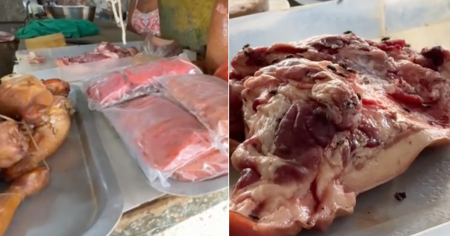
The meat production of the Cárnica Company in Sancti Spíritus dropped from more than 25,000 to 5,400 tons in seven years, a decline that is not only statistical but also social, economic, and human in a country where buying meat has become an occasional luxury, while in the province, prices range from 750 to 800 pesos per pound.
It was announced that 7,520 tons are the target for 2025, but this volume is still far from the actual demand, according to a report from the official newspaper Escambray.
Meanwhile, the most vulnerable groups -children, pregnant women, and patients on medical diets- will not see any increases this year. These are segments of the population for which “today they barely maintain any symbolic delivery because the cattle coming from the Agriculture system processed here is used based on a national balance, and it is a minimal number of heads,” revealed the media outlet.
According to official figures, an average of 26 kilograms of meat products were distributed per household in Sancti Spíritus in 2024, a minuscule amount considering basic food needs.
Although the company generates revenue and pays its workers an average of 17,000 pesos per month, this does not address the underlying issue: meat is either unavailable or arrives at prices that are unaffordable for most people.
However, "a significant portion" of the supplies -Escambray does not provide exact figures- are sold on the online sales platform Alimentos Cuba, in convertible currency stores of the Cimex Chain, or are sent to hotels of the Gaviota Corporation, which belongs to the military conglomerate GAESA.
The source claims that “these payments in hard currency are used for the purchase of equipment, feed, and various raw materials, aimed at producing its wide range of products, many of which are marketed in the national currency, either for prioritized entities, social consumption, or through liberated sales.”
The entity is trying to reinvent itself with strategies such as raising its own pigs, “which started last year and already totals nearly 3,000 animals across two farms.” Additionally, through the import of some feed, the purchase of honey, and the production of an animal protein feed using waste from its own industry, “they aim this year to ensure between 25 and 30 percent of their products come from these pigs,” the newspaper noted.
Another strategy of the company from Sancti Spíritus is to establish contracts with private management entities, as well as productive linkages with agricultural entities and producers.
The initiatives, while positive in intention, do not compensate for the accumulated setbacks. When it comes down to it, the table is empty for many, the food crisis remains without a visible solution, and it doesn't seem that meat products will return to the people's plates in the near future.
Cubans have reported on social media the poor quality of products made in Cuban meat companies, which are sold to the population through the rationing system. In this regard, they have denounced the bad odor, taste, and presentation of foods such as picadillo, the presence of worms or foreign objects in the ham, as well as in croquettes.
In 2018, Cuba achieved a record of 200,000 tons of pork, benefiting not only family consumption but also hospitals, tourism, and production centers. However, that scenario is now a thing of the past: national production fell to just over 9,000 tons in 2024, a figure that reflects the total debacle of one of the most important sectors of food in the country.
In November of last year, a report from the official press in Santiago de Cuba revealed the local efforts to revive pig farming, a goal that seemed unattainable amid shortages of supplies, deteriorating production infrastructure, and the loss of genetic capital in pig breeding. The authorities were attempting to revitalize a key sector without having the minimum conditions necessary to achieve it.
A few weeks later, another report highlighted that in several provinces, pork had become an absolute luxury item, with outrageous prices exceeding 1,000 pesos per pound, which put even chicharrones, a popular symbol of the Cuban diet, out of reach.
In 2021, farmers from Camagüey began selling their first cattle, after the government lifted the ban that restricted them from managing the meat and milk from their animals, a measure that aimed to urgently increase the limited food production in the country.
However, the production is so scarce that numerous citizens have stated they haven't eaten beef in months, while others, don't even remember the last time they enjoyed it.
In 1956, Cuba had 6.7 million people and a livestock sector with six million heads of cattle, which was approximately 0.90 cattle per inhabitant. Since 1959, the cattle population has continuously declined, resulting from a combination of external dependence, lack of adaptability in the production system, and poor resource and land management, which led to the collapse of the sector in the face of an economic crisis.
Authorities acknowledge the abandonment of the sector, while producers report unpaid dues, malnutrition among livestock, lack of institutional support, and constant theft of cattle from their farms by kidnappers and slaughterers operating illegally.
Filed under: