
Related videos:
The city of Matanzas is facing 91 identified leaks, some of them serious, while the Provincial Water and Sanitation Company (EPAA) claims it is powerless to repair them, partly due to the priority given to the Antonio Guiteras Thermoelectric Power Plant (CTE), which has tripled its consumption and cannot stop receiving supply.
Although the causes are multiple, the technical diagnosis presents a critical picture: the pumping stations fail due to electrical "spikes" caused by outages, malfunctions, or storms. With equipment designed to operate steadily, energy instability has accelerated breakages, worsening an already critical situation, acknowledged the official newspaper Girón.
In this regard, he emphasized that one minute of equipment downtime can result in between 40 minutes to an hour without pumping. The Company is facing issues with its generators, which decreases its ability to respond to these contingencies.
According to Guillermo Cué Lugo, director of the EPAA, the city operates with four main pumping systems, “whose electric service is being protected 24 hours a day,” which in turn connect to another four rebumping systems, but “only two do not shut down, the one in Naranjal and the one in Versalles.”
The dependence on a deteriorated and poorly maintained network intersects with a structural problem: the inability to intervene in the outlets connecting to the CTE Antonio Guiteras, the largest in the country, and "the connections to it cannot be worked on at the moment, as it would be impossible to stop the water service to the Industrial Zone."
And although the thermoelectric plant has tripled its water consumption, “which undoubtedly generates extra costs,” according to Cué Lugo, “this increase is not significant when compared to the water that is no longer pumped as a result of the 'shootings'.”
The official response has been to activate the distribution by tankers, but the coverage is limited. The number of families benefiting is insignificant, and, worse still, it has fueled speculation. Citizens report payments of up to 5,000 pesos for a tanker of water, more than two minimum wages, in a context where many people cannot afford even the basics.
Desperation leads to searching for water anywhere. Increasingly, the residents of Matanzas are exposing themselves to water sources not verified by health authorities, which could lead to a health crisis, the media outlet acknowledged.
Citizen frustration is further exacerbated by the lack of communication, as the EPAA does not maintain efficient channels of contact with users, neither on social media nor through institutional means.
Girón announced that it is preparing an extensive report to analyze the causes of the phenomenon, identify its effects and vulnerabilities, and propose possible solutions related to it.
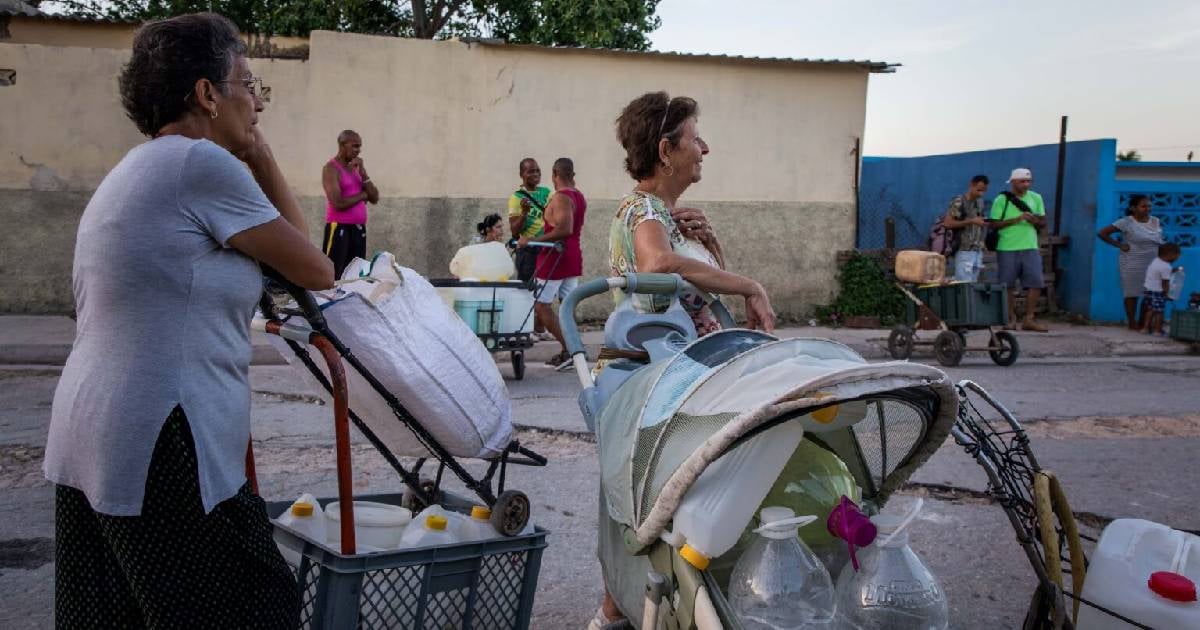
A recent photo report by the newspaper depicted the odyssey of obtaining water in the western province: long lines to fill containers, extensive blocks to walk carrying jugs, and a little bit of water accumulated wherever possible are the themes reflected in the images.
Some of the depicted scenes showed elderly people carrying gallons of water, bottles, and empty tanks, and even people bathing in the middle of the street, taking advantage of a leak. "In Matanzas, access to water has become a daily struggle, an act of silent resistance," the source acknowledged.
Weeks prior, he also acknowledged that institutions and companies that are major consumers of water are one of the reasons for the imbalance in the water supply in the city, including the CTE Antonio Guiteras.
The province of Matanzas is facing one of its worst water supply crises in years, with pumping equipment out of service, collapsed hydraulic networks, constant blackouts, and an infrastructure at its limit, despite being, ironically, an area with abundant underground water reserves.
Filed under: