
Related videos:
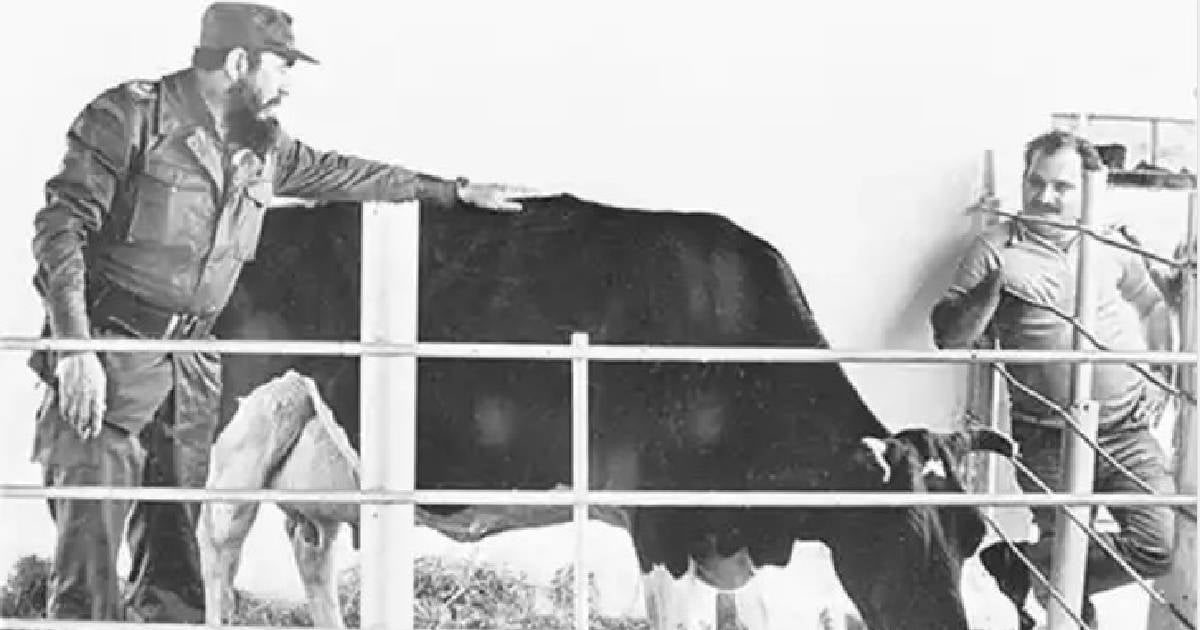
Doctor Ernesto Medina Álvarez, retired after decades of work in the cattle industry of Villa Clara, stated that the sector “is in debt” to Fidel Castro (1926-2016), whom he described as the main driver of livestock development in Cuba, despite the fact that the country has not achieved self-sufficiency in milk or meat for more than half a century.
The former provincial president of the Cuban Association of Animal Production listed the programs implemented under Castro's leadership, such as the network of insemination centers, genetic enterprises, and the use of industrial waste for cattle feeding.
In an interview with the radio network CMHW, Medina stated that "with supplies and technology," state-run livestock farming was "efficient." He cited figures from 1987, when companies in Villa Clara, such as La Vitrina and Remedios, produced more than 17 and 11 million liters of milk annually, respectively.
The specialist even recalled the visit of Uruguayan technicians sent by former president José Mujica (1935-2025), who praised the infrastructures created by Castro and criticized Cuban ranchers for not making the most of them.
Medina pointed out that today the majority of the sector is in private hands, with producers who have only a few cattle, which makes it difficult to apply science, techniques, and insemination programs.
He insisted that “it should not be the case that this is the only branch of agriculture with more penalties than benefits. If you do not register a birth, you are fined; if you do not report a theft and slaughter, you are fined; etc. What I mean is that livestock farming demands more support, more supplies.”
He also agreed that the island needs more cattle ranchers and not just "animal keepers," as is the case today.
He called for a change in the scenario that allows for exports and for the producer to receive foreign currency to acquire resources, using models from Latin American countries as a reference.
He also emphasized the need to resume the planting of protein-rich crops such as moringa, mulberry, and tithonia, whose effectiveness—he said—was demonstrated by Castro. He warned that the protein available in natural pastures is insufficient and that sugarcane, with only 3% protein, merely prevents the death of the animal, but does not support its development.
The expert's words contrast with a long history of failed livestock projects driven by Castro, from the famous case of Ubre Blanca to plans such as Rational Grazing Voisin or the mass cultivation of “Pangola,” which did not succeed in making Cuba a dairy powerhouse.
The goal announced for 1970 to surpass the Netherlands and France with eight million cows and 30 million liters of milk daily also did not come to fruition.
Cuban livestock is facing a severe crisis, with an accumulated loss of over 900,000 heads of
During the presentation by the General Director of Livestock, Arián Gutiérrez Velázquez, it was reported that by the end of 2024, the livestock population in the country stood at just three million animals, which represents a decrease of nearly 400,000 heads compared to the previous year.
The downward trend is not only due to natural factors such as mortality but also to serious structural issues, such as theft and illegal slaughter, which in the past year alone affected more than 27,000 animals, including cattle and horses.
In 1956, the population of Cuba was 6 million 676 thousand people. The Zebu was the predominant breed in Cuban pastures, with 6 million head of cattle, which was approximately 0.90 cattle per inhabitant.
This does not include the smaller livestock, which totaled 4,280,000 specimens, including 500,000 horses, 3.4 million pigs, and 200,000 sheep, among others.
Weeks ago, the official newspaper Granma acknowledged that Camagüey experienced a significant drop in its annual food production to less than half of the 92 million liters reached in 2019. In 2024, only 41.1 million liters of milk were collected.
“Last year, due to theft, sacrifice, and deaths for other reasons, cows equivalent to those of an entire municipality were lost. If this trend continues, in about 15 years there will be no livestock in Camagüey, and even less milk,” the media outlet warned.
Everything suggests that 2025 will end with a deficit of more than one million liters compared to the annual plan and also in comparison to 2024, in a province that was once regarded as the main dairy basin of Cuba.
Since late 2023, the dairy industry in Cuba has shown clear signs of structural collapse. Last November, the then Minister of Food Industry acknowledged that the country did not have enough milk to supply the entire population, and that the goal was to ensure "a portion" for the most vulnerable groups, an unprecedented admission of the state's limitations in securing a product considered essential.
In a speech as a government leader in 2007, Raúl Castro criticized that Cubans only received milk until the age of seven and stated that this needed to change.
In 2021 left the Council of State without changing that dismal reality. 18 years after his promise, the situation remains the same, and families are raising their children without this and other essential foods.
Today, while the country imports a significant portion of the food it used to produce, the most evident debt is not with the late leader, but with the tables of Cubans, empty of the products that decades of experiments and centralized plans never managed to ensure.
Frequently Asked Questions about the Livestock Crisis in Cuba
Why is Cuban cattle farming in crisis?
Cuban livestock farming is facing a crisis due to multiple structural factors. The accumulated loss of more than 900,000 head of cattle since 2019 is attributed to issues such as theft and illegal slaughter, a lack of supplies and technology, and the demotivation of producers. These challenges are worsened by institutional neglect and the absence of economic incentives, preventing ranchers from effectively sustaining their production.
What impact does the livestock crisis have on the diet of Cubans?
The livestock crisis has severely impacted the availability of basic products such as milk and meat, which are essential for the Cuban diet. Milk production has decreased drastically, affecting the nutrition of the population, particularly among the most vulnerable groups who do not have access to these state-imported foods. Furthermore, the lack of protein in the daily diet contributes to the overall deterioration of public health.
What are the main criticisms of the state management of livestock in Cuba?
Criticism of the state management of livestock in Cuba focuses on inefficiency and lack of support for producers. The sector is characterized by administrative disorganization, lack of resources, and policies that do not encourage production. Additionally, state control limits access to inputs and technology, leading to a structural collapse of the sector. The dependence on centralized plans and the absence of a clear strategy to modernize and incentivize production are cited as fundamental causes of failure.
What has been done to try to resolve the livestock crisis in Cuba?
The Cuban government has proposed several measures to tackle the crisis, such as prioritizing producers with more than 10 cows, expanding the allocation of land, and developing the supply market. However, these measures have not had a significant impact due to the lack of effective implementation and follow-up. There have also been calls to restore infrastructure and promote exports, although without visible results. The approach remains insufficient to address structural problems, and there is a lack of a comprehensive and sustainable strategy.
Filed under: