
Related videos:
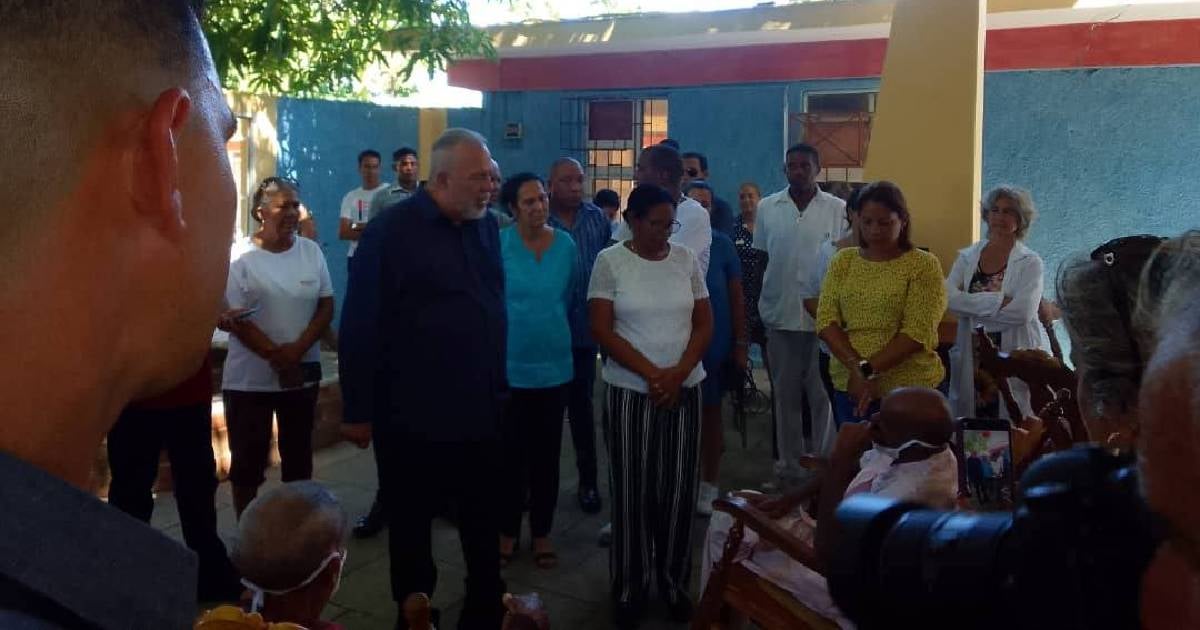
The Cuban Prime Minister Manuel Marrero reappeared in Matanzas with a visit to the Rivera San Juan Social Protection Center, an official tour presented as a gesture of “commitment,” while the population faces endless blackouts, overflowing sewers, and entire neighborhoods sunk in neglect.
According to the Facebook page of the provincial telecenter TV Yumurí, Marrero arrived accompanied by the member of the Provincial Committee of the Communist Party Norma Llerena Pérez, the governor Marieta Poey Zamora, and other officials to closely observe the living conditions of individuals with "wandering behavior."
The event was described as a day of "commitment" dedicated to "strengthening social care and well-being in the province."
However, the comments from Cubans themselves on social media revealed a different side. Dozens of users reported that, coinciding with the visit, electricity miraculously reappeared in areas of Matanzas where power outages lasting 15, 20, and even 24 hours are part of daily life.
"How quickly the megawatts appear, that's why we’re in big trouble," wrote a neighbor, who recalled how just a day earlier their circuit had been facing endless blackouts.
Another user jokingly noted that they had been receiving electricity since six in the morning, which is unusual in neighborhoods where power is available for only a few hours.
Others criticized that the set design was dressed up to cover up the daily disaster. “Hiding poorly done things,” commented an internet user, while another asked why Marrero is not made to experience the same hardships endured by the population.
Complaints were repeated: overflowing pits, garbage dumps that grow daily, and burned transformers that leave entire blocks without electricity for several days.
Far from generating trust, the visit reinforced the perception that each official tour is a setup designed to present a false image of reality, while poverty, hunger, and destitution — phenomena that the government itself denied — are multiplying across the country.
At the end of July, Marrero himself visited the care center for homeless individuals in Ciego de Ávila, while the ruler Miguel Díaz-Canel visited the William Darias Social Protection Center in the municipality of Santa Clara on August 22, highlighted as a model for care for homeless individuals.
Such incidents occur amid the controversy surrounding the state's abandonment of thousands of beggars who struggle to survive on the streets of Cuba without real answers and in an effort to counteract the criticism generated by the statements of the former Minister of Labor and Social Security, Marta Elena Feitó Cabrera, who denied the existence of homeless people in the country.
On July 14, Feitó Cabrera stated in one of the parliamentary committees that in Cuba “there are no beggars,” but rather “people in disguise”, whom he also labeled as “drunks” and “frauds.”
His statements denying the existence of hunger on the island and blaming citizens for their poverty sparked a wave of outrage on social media, independent media, and among various sectors of the public.
Hours later, the Political Bureau of the Communist Party of Cuba and the Council of State accepted her resignation, which was submitted, according to official sources, after a “joint analysis” with the government leadership.
Two days later, the government acknowledged that more than 310,000 residents on the island are currently in a state of poverty or social vulnerability, amidst a deep economic crisis.
The Cuban state often glosses over poverty with euphemisms like “street dwellers” and “vulnerable individuals.” Although the government pretends to provide solutions, in reality, the conditions that lead to begging in Cuba are not being addressed, and it puts more effort into how to manage its visibility.
In Matanzas itself, a growing population of elderly, sick, and marginalized individuals survives in the open, just like in the rest of the Cuban provinces, without effective policies to support them or any genuine willingness to help.
This has even been acknowledged by the official press, which in recent reports has showcased that other city beneath the city, the forgotten layer where those who have lost almost everything—home, family, mental health, job—scramble through waste to survive.
The provincial newspaper Girón published on August 1 a journalistic piece that revealed the serious situation faced by dozens of "vagrants" in the Social Protection Center of Jagüey Grande.
The report "Inhabitants of Dust (II): The Land That Was Never Promised" documents the living conditions in this place, which, according to the collected testimonies, seems less like a shelter and more like "a cemetery of living men."
Frequently Asked Questions about the Current Situation in Cuba: Poverty, Blackouts, and Politics
What was the purpose of Manuel Marrero's visit to Matanzas?
Manuel Marrero's visit to Matanzas was presented as a gesture of “commitment” to strengthen social welfare and attention in the province. However, many citizens perceived this visit as staged, as it coincided with the sudden reappearance of electricity in areas that had been affected by constant blackouts, which led to distrust among the population.
What has been the response of the Cuban government to the increasing poverty in the country?
The Cuban government has attempted to counter criticism regarding the increase in poverty through visits to social care centers and official statements denying the existence of begging. Despite efforts to demonstrate a commitment to social issues, the reality is that poverty and homelessness have visibly increased in the country, with no effective solutions in sight.
What is the current situation of the electric system in Cuba?
The electrical system in Cuba is facing an evident collapse, with frequent blackouts affecting the daily lives of citizens. Despite the government's promises to invest in solar parks to improve the situation, concrete results are still not evident and the energy crisis persists.
What impact have the statements made by former minister Marta Elena Feitó regarding poverty in Cuba had?
Marta Elena Feitó's statements denying the existence of begging and extreme poverty triggered a wave of outrage on social media and independent media. The public reaction was so intense that the government was forced to accept her resignation and acknowledge the situation of poverty in the country.
Filed under: