
Related videos:
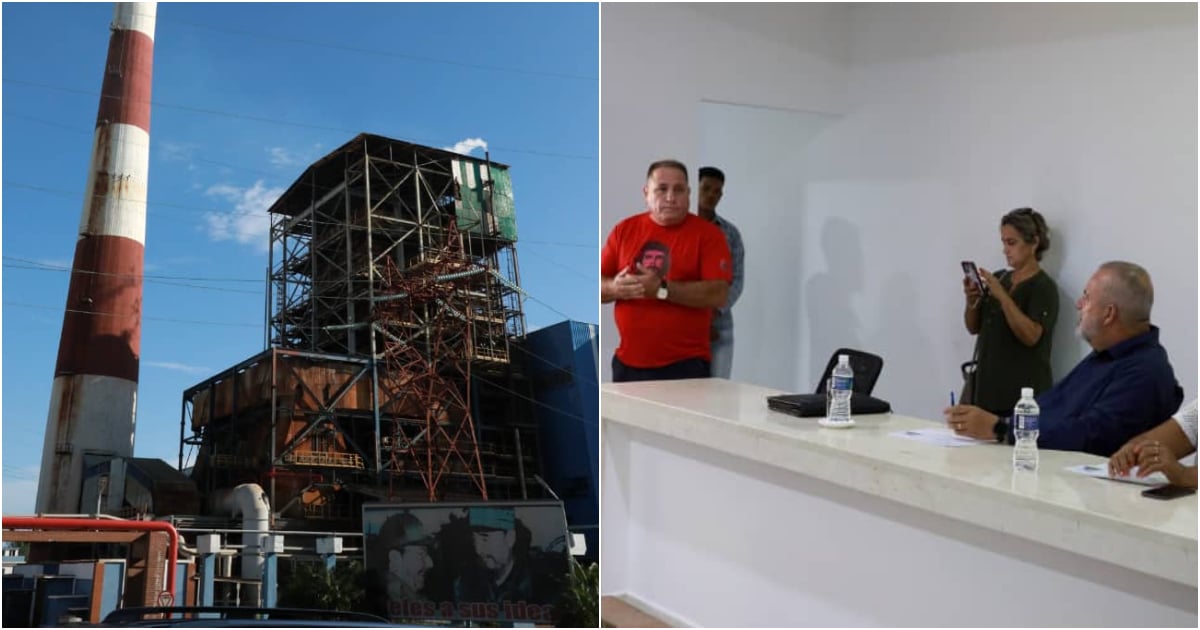
The Prime Minister Manuel Marrero Cruz toured the Antonio Guiteras Thermoelectric Plant (CTE) in Matanzas today, where he praised the sacrifice of the workers and regarded it as "an example of how all workplaces should be" in Cuba.
However, residents of Matanzas reported that the visit coincided with the timely return of electricity and the facade of an energy crisis that shows no signs of easing.
Accompanied by the Minister of Energy and Mines, Vicente de la O Levy, Marrero expressed interest in the preparations for the upcoming major maintenance -the date of which was not specified- of the Guiteras, reported the official newspaper Girón via his profile on Facebook.
The technical problems at the plant, which currently generates 220 megawatts, include breakdowns of the feed pumps and a high consumption of make-up water, necessitating constant shutdowns and keeping the facility in a critical situation.
According to the director Rubén Campos Olmo, the plant is facing several technical issues. Among them, he mentioned the malfunction of the number two feed pump, which is being worked on to be reinstalled next Monday, as its absence immediately limits the loading capacity by half if both operational pumps fail.
He added that the backup oil control pump for the turbine valves will be replaced with a new one that is expected to arrive on September 4, while another one that was inspected at the Cienfuegos refinery is being assembled.
He also pointed out that the unit has a high make-up water consumption of 43 cubic meters, which will necessitate stopping the unit again as soon as possible to service the high-temperature reheater, although he clarified that the leak remains stable and has not increased.
The executive also indicated that the installation of a demineralized water plant is planned, as, according to international practice, this type of industry should not use drinking water, but rather seawater.
During the exchange, Marrero acknowledged that the thermoelectric plant is highly outdated and that it faces “a number of accumulated difficulties due to the lack of resources for capital repairs and maintenance,” although he deemed it necessary to “continue operating it due to its significance for the country.”
Meanwhile, on social media, the comments were unanimous in highlighting the manipulation behind these official visits.
Residents of Matanzas reported that, after two days of near-total blackouts, electricity returned just as the Prime Minister arrived. “They give us five hours of power as if by magic, what a coincidence,” joked a user.
Other residents of Matanzas recalled that the province faces power outages lasting more than 20 hours while Havana receives priority in electricity distribution. “La Guiteras is here, but it belongs to allá; it doesn't benefit the province at all,” lamented a neighbor, who criticized how the plant is presented as a source of pride when it leaves its surroundings communities immersed in endless blackouts.
The discomfort intensifies in light of what many describe as a repeated cycle of "expensive patches and unfulfilled promises."
Users pointed out that, despite the announced capital maintenance, blackouts will continue and may even worsen. “At the end of the day, with Guiteras operating, we have 20 hours of blackout; when it comes back from maintenance, it will be 24,” wrote a reader.
Instead of long-term solutions, the perception among the population is that the energy crisis is only worsening.
"What they need to do is build new thermoelectric plants, not keep painting ruins with makeup," claimed another user, expressing the frustration of a country that survives amidst blackouts, shortages, and a government that insists on promoting as achievements what the people see as ruins.
In Cuba, blackouts are not resolved with speeches or planned visits: they are resolved with real solutions, and those never arrive.
The CTE Guiteras, with a nominal capacity of 220 MW, is the largest single unit of electricity generation in the country. However, its main boiler has not received major maintenance since its inauguration in 1989, making it a highly vulnerable structure.
He successfully reconnected to the National Electric System (SEN) at midnight on Friday, August 1, after completing a start-up process characterized by caution and uncertainty.
In the streets and on social media, the discontent among Cubans is growing due to the frequent power outages, the lack of transparency, and the feeling that the entire energy system hangs by a rusty thread.
Frequently asked questions about the energy crisis in Cuba and the Antonio Guiteras Thermoelectric Power Plant
What is the current situation of the Antonio Guiteras Thermoelectric Power Plant?
The Antonio Guiteras Thermal Power Plant is in a critical situation due to its obsolescence and multiple technical failures, such as pump breakdowns and a high water replacement consumption. Despite maintenance efforts, the plant continues to face frequent issues that affect its power generation capacity.
Why did Prime Minister Manuel Marrero's visit to Guiteras cause discontent among the population?
The visit of Prime Minister Manuel Marrero to Guiteras caused discomfort because it coincided with a specific resumption of electricity, which many Cubans interpreted as an attempt to cover up the energy crisis. Citizens reported the manipulation behind the official visit, as, generally, electricity only returned during the visit, while blackouts continue to impact the population.
What impact do the Guiteras issues have on the electricity supply in Cuba?
The issues at Guiteras exacerbate the energy crisis in Cuba, as this plant is the largest single block of electric generation in the country. Its inability to operate at full capacity contributes to the prolonged blackouts affecting the population, worsening social discontent and the perception of government ineffectiveness in addressing the crisis.
What solutions have been proposed to improve the situation at Guiteras and the Cuban electric system?
The government has announced capital maintenance plans for Guiteras and other power plants, as well as an increase in distributed generation. However, these measures have not succeeded in addressing the underlying problem due to technological obsolescence and a lack of resources. The population is calling for structural solutions, such as the construction of new thermoelectric plants and more effective management of energy resources.
Filed under: