
Related videos:
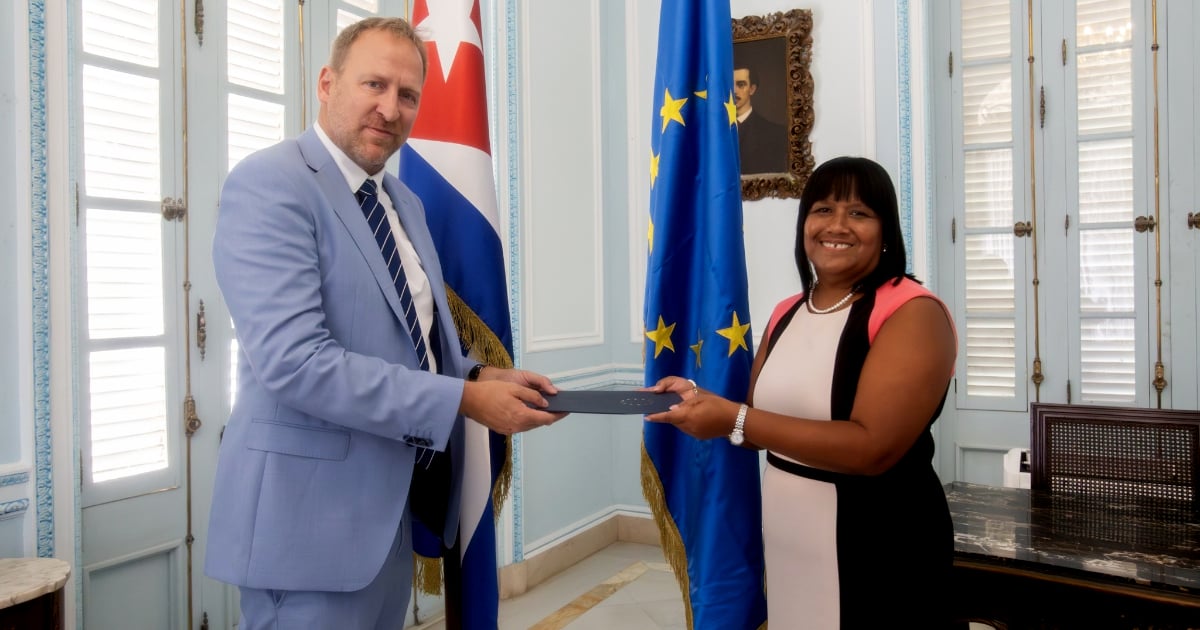
The Deputy Minister of Foreign Affairs of Cuba, Anayansi Rodríguez Camejo, received this Tuesday the new ambassador of the European Union (EU), Jens Urban, who presented the Letters of Credence that certify him as the representative of the community bloc to the Cuban regime.
The protocol event, announced by the island's Foreign Ministry, marks the beginning of a diplomatic effort that will unfold in a particularly complex context for relations between Brussels and Havana.
Urban's appointment coincides with a situation in which the EU has intensified its criticisms of the Cuban regime for the repression against dissent, the imprisonment of over a thousand political prisoners, and the allegations regarding the sending of Cuban citizens to fight as mercenaries in Russia's war against Ukraine.
In recent months, the European Parliament has approved resolutions condemning the recruitment of Cubans by the Russian army and urging the European Commission to suspend the Political Dialogue and Cooperation Agreement (ADPC), signed in 2016 and supported by some sectors in Brussels as a means of dialogue, but questioned by MEPs, European governments, and Cuban activists for its ineffectiveness.
The arrival of the new ambassador comes after repeated requests from MEPs and civil society organizations for the EU to impose direct sanctions against officials and repressive structures on the island.
In July, more than 25 European parliamentarians called for the activation of the democratic clause of the ADPC and demanded the cessation of funding for projects that, in their view, ultimately benefit the Cuban repressive apparatus.
The debate has intensified since 2022, when evidence began to circulate regarding the recruitment of thousands of Cubans to bolster the ranks of the Russian army in Ukraine, with the apparent complicity of Havana.
In parallel, organizations such as Prisoners Defenders have reported that the number of political prisoners in Cuba reached 1,155 in April of this year, including opposition leaders like José Daniel Ferrer and Félix Navarro, whose immediate and unconditional release has been repeatedly demanded by the European Parliament.
The figure of the former EU Human Rights Rapporteur, Eamon Gilmore has also been central to the bilateral agenda. His visit to Havana in November 2023 was marked by complaints from opponents and letters from political prisoners urging him to witness firsthand the conditions of confinement.
Since August 1 of this year, the new Special Representative of the EU for Human Rights is the Dutch Kajsa Ollongren, former Minister of Defense of the Netherlands, who inherits an agenda marked by denunciations of repression in Cuba and calls for Brussels to adopt a firmer stance against the regime.
Her management will be scrutinized by activists and Members of the European Parliament who demand that the dialogue with Havana does not translate into impunity for violations of fundamental rights.
Although the European Commission has insisted that the ADPC allows for addressing these sensitive issues, Cuban activists like Carolina Barrero and Rosa María Payá have pointed out that the agreement only serves to legitimize the regime, without improving the situation of fundamental rights.
The controversy even reaches member states. Sweden and other countries have called for a review of the Agreement, while former Vice President of the European Parliament, Dita Charanzová, strongly advocated for its suspension and direct support for Cuban civil society, following the brutal repression unleashed against the protesters on July 11 in Cuba.
In contrast, the High Representative Kaja Kallas has defended maintaining the dialogue framework, arguing that it is the only way to raise demands regarding democracy and human rights, but it has proven to be unsuccessful since the initial efforts to build a broad framework of relations with the Havana regime, which date back to 1995.
Surprisingly, Kallas' position – an official experienced in the threats from Moscow – aligned with that of her predecessor in the role, the Spanish Josep Borrell, who, during his visit to Cuba in May 2023 adopted a dialoguing stance with the Havana regime.
Despite reaffirming the European stance on the Russian invasion of Ukraine—reminding Havana of its multilateral responsibility as president of the G77 and emphasizing that “Ukraine is the victim and Russia is the aggressor”—Borrell defended the ADPC as a crucial mechanism to support processes of modernization and human rights, and to facilitate contacts with civil society.
In a crucial moment for the EU integration project and its identity as a "normative power" –challenged by a more unstable global context marked by unilateral aggression from major powers– the new ambassador Jens Urban will therefore undertake a diplomatic mission filled with challenges.
His administration will be characterized by the need to balance the relationship with a regime that continues to repress the internal opposition, restrict freedoms, and align itself with Moscow amid the ongoing war against Ukraine, while in Brussels, the call for harsher sanctions and the suspension of an Agreement that, according to many critics, has become a lifeline for Havana is growing.
The ceremony for the delivery of Style Copies took place without public statements from the European diplomat, but attention will be focused on the next steps the EU will take in its relationship with Cuba.
Urban will have to deal with a landscape in which international pressure for the release of political prisoners, the end of repression, and accountability for involvement in the war in Ukraine will inevitably take a central place on the agenda.
Filed under: