“We had two victories, and they were two victories for life,” asserted this Friday the president of the National Defense Council and president Miguel Díaz-Canel, referring to the confrontation with Hurricane Melissa and the vote at the UN regarding the United States embargo against Cuba.
The leader noted that both events demonstrate the "dignity of the Cuban people" and the strength of the Revolution, in statements reported by state television during his visit to Santiago de Cuba, in order to assess the damage caused by the devastating climatic phenomenon.
The United Nations General Assembly approved on Tuesday, with 165 votes in favor, seven against, and 12 abstentions, the resolution calling for an end to the economic, commercial, and financial embargo of the United States against Cuba.
Although Chancellor Bruno Rodríguez Parrilla celebrated the outcome as a “victory for the peoples,” the data revealed a drastic decline in international support for the Cuban regime, with the lowest backing for the project in over 10 years.
The president highlighted that several countries and agencies of the United Nations system are sending donations to support recovery efforts.
"We must take satisfaction in the fact that we have endured, that we are alive, and that our people have triumphed once again," he added.
A day earlier, Díaz-Canel stated on his account on X that the survival of the population in the east after the passage of the hurricane “is not a miracle,” but the result of “preparation, organization, discipline, and solidarity” of the people.
During the National Defense Council meeting, the leader stressed that the priority remains "preserving life" in the affected areas, although no details were provided about the material damages or the actual extent of the disaster.
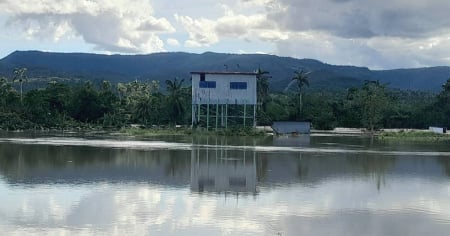
The intense rains and strong winds caused by Hurricane Melissa led to severe damage in the provinces of Guantánamo, Santiago de Cuba, Granma, and Holguín, where severe flooding has been reported in several areas, along with damage to the electrical network, telecommunications, roads, and numerous homes.
The U.S. Secretary of State, Marco Rubio, announced on Thursday Washington's willingness to provide "immediate" humanitarian aid to Cubans affected by Melissa, as long as the donations do not go through official government institutions on the island, a position that Havana usually considers as an act of interference.
The Cuban government assured this Friday that the United States "has not made any concrete offer of aid" for those affected by Hurricane Melissa, despite the announcement by the U.S. Secretary of State regarding the dispatch of humanitarian assistance to the island.
According to Johana Tablada, Deputy Director General of the United States Department at the Ministry of Foreign Affairs (Minrex), the Cuban embassy in Washington contacted the State Department "regarding what was published."
"So far, the United States has not made any concrete offers nor responded to the questions raised," he emphasized.
Filed under: