
Related videos:
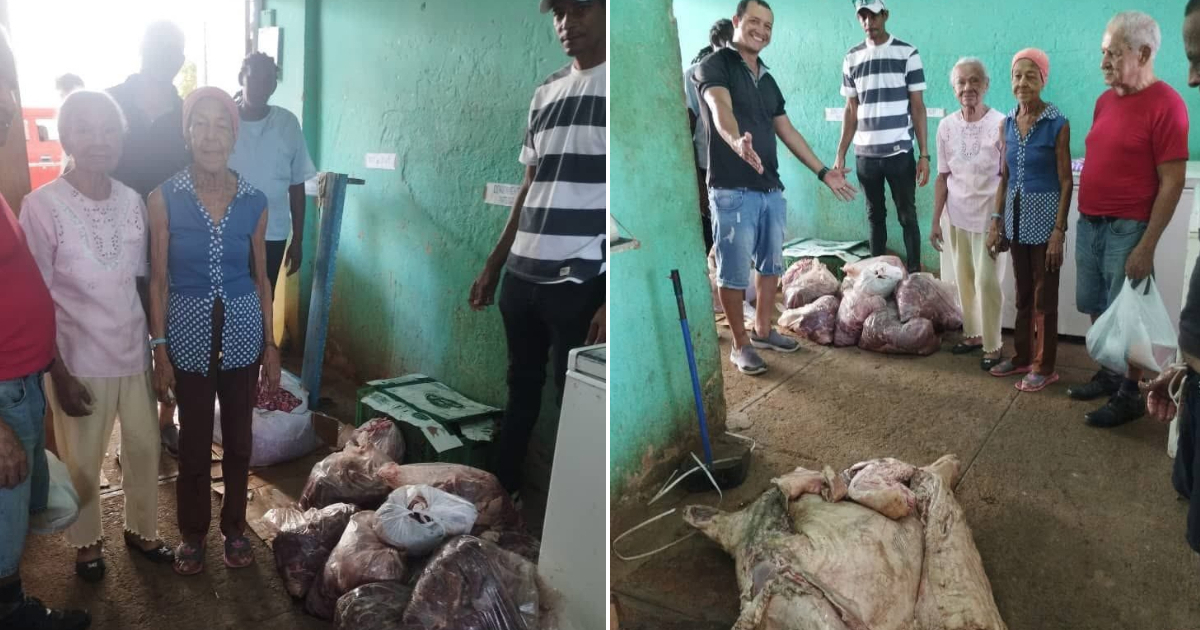
An official publication from the Provincial Health Directorate of Santiago de Cuba regarding a meat donation to the América Labadí Elderly Home has sparked a wave of rejection and comments of outrage among Cubans, following the circulation of photos depicting raw meat on the floor and elderly individuals in a visibly deteriorated environment.
In the post, the authorities described the delivery as a "selfless and ennobling action" carried out by the micro, small, and medium enterprise Almirante, from the province of Holguín, for the benefit of the residents of the home. However, the images published by the state institution itself show pieces of meat piled on the floor, without refrigeration, without gloves, and lacking minimum hygienic conditions.
After the release of those photos, the contrast between the official narrative and the reality depicted in the images ignited social media. On the profile of CiberCuba Noticias, where the content was shared, the comments reflect outrage, sadness, and disgust.
Many users rated the scene as "a total disrespect" and "a humiliation to the Cuban people." "What a shame to show that as if it were something good; it looks like a slaughterhouse," wrote one person, while another lamented, "Poor old folks, just look at those walls, look at the floor… it’s painful to see that."
Other messages coincided in denouncing the lack of hygiene and the deterioration of the place. "Meat lying on the ground, without refrigeration or hygiene—that's a crime," expressed one person. Another comment stated, "Even dogs don't eat like that. It's a total lack of respect." There were also direct criticisms aimed at the authorities for proudly displaying what many considered a degrading scene: "They proudly publish what should make them ashamed. They showcase misery as if it were an achievement," wrote one user, while another declared, "That's not help; that's humiliation. The elderly deserve dignity, not handouts like that."
The overall tone was one of condemnation towards the official publication. "They should be ashamed to post those photos; the neglect and the filth are evident," remarked one person, while another added, "Look at the surroundings, the walls, the floor... and they still call it a selfless act." There were also comments that reflected despair over the country's situation: "They have no heart or shame. Publishing that is a denial of the reality they have imposed on the people" and "Nothing surprises us in Cuba anymore, but this hurts. These are our grandparents, treated like animals."
Some expressed distrust regarding the true fate of the donated meat: "And who checked that meat? I'm sure it doesn't even reach the elderly; they divide it up beforehand," while others emphasized the lack of humanity throughout the process: "The problem isn't the donation; it's the lack of hygiene and respect. Everything is rotten." One reader summarized the general sentiment with a phrase that was repeated multiple times: "The height of cynicism: portraying poverty as if it were solidarity."
Only a few comments attempted to defend the initiative, stating that “at least someone wanted to help,” but they were vastly outnumbered by messages of repudiation. The prevailing feeling was one of helplessness, rage, and shame in response to the reality that the authorities themselves chose to present as an achievement.
The images not only highlight a hygiene issue but also reflect the institutional neglect suffered by thousands of elderly people in Cuba. Homes like this one survive with few resources, lacking maintenance or genuine oversight, while authorities attempt to present as achievements what truly reveals the misery of the system.
The episode takes place amidst a growing food and health crisis spreading across the country. In Santiago de Cuba, residents recently reported the sale of spoiled picadillo that was meant for children after Hurricane Melissa, with testimonies warning of “rotten” and “unsafe for human consumption” products.
Also in Havana, the population has criticized the distribution of peas with bugs and foul odor, as well as the months-long delays in the delivery of basic food items such as rice or oil, which has led to widespread discontent throughout the country.
Additionally, on other occasions, there have been reports of the sale of beef bones without meat or refrigeration right in the street, an image that reflects the precariousness and daily desperation.
The photographs of the América Labadí nursing home, far from conveying the idea of a “gesture of solidarity”, expose the reality of a collapsed system, where elderly individuals survive in precarious conditions, and where acts of “donation” are presented as achievements, even when they reveal lack of hygiene, poverty, and institutional neglect.
Amidst so many hardships, this episode reminds us that true solidarity is not measured in kilos of meat or official speeches, but in respect for human dignity. The elderly in Cuba deserve more than improvised donations; they deserve care, respect, and a country where aging is not synonymous with abandonment.
Filed under: