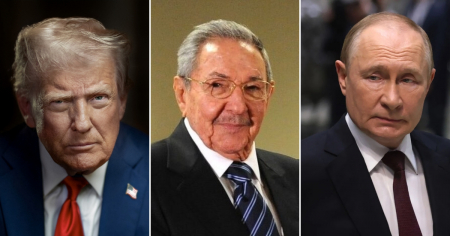
The President of the United States, Donald Trump, stated that there is a strong desire among Cubans living in that country to return to the Island to contribute to its recovery.
"You have a lot of people in this country who want to return to Cuba, to help Cuba... they came with nothing, they had nothing, they became very wealthy in our country, and they want to come back and help Cuba," he stated during a press conference.
Trump emphasized that this willingness of the diaspora is a unique element that sets Cuba apart from other countries.
"That's something Cuba has that many other places don't," he added, referring to the relationship between exiles and their homeland and the potential they could represent for national rebuilding.
Alongside Trump, Secretary of State Marco Rubio delved into the diagnosis of the Cuban situation.
He stated that the current leaders of the Island face a dilemma between moving towards "having a real country, with a real economy, where its people can prosper" or continuing with a failed dictatorship.
Rubio stated that the fundamental problem of Cuba lies in being "led by incompetent people" who do not understand how an economy functions, and he affirmed that for decades the regime prioritized political control over the establishment of a functioning economy.
He emphasized that the Cuban system has been sustained for over 60 years thanks to external support, first from the Soviet Union and more recently from Venezuela.
That scheme, he indicated, has come to an end. "That support is gone," stated the Secretary of State, who warned that continuing with the current model will lead to "a systemic and social collapse".
In his opinion, it is "a very strong and dramatic choice" for the regime.
Moreover, he stated that the United States has no interest in a destabilized Cuba, but attributes any potential destabilization to the Cuban government's refusal to allow economic and political freedoms.
Trump, for his part, reiterated that Cuba is going through an especially difficult phase after losing external support.
"Cuba is in a dire situation. Cuba relied on Venezuela for oil and for money… they are doing very poorly, completely third world,” he stated, and recalled that the Island will no longer have income related to Venezuelan crude oil.
In an interview with Fox, the president promised that his administration will seek ways to support Cuban residents in the United States who have suffered under the Castro regime.
Although he did not specify concrete programs or policies, his statement set a tone of support for the exile communities that have denounced persecution and human rights violations on the Island for decades.
Trump also insisted on Cuba's historical dependence on Venezuela. "Cuba has always depended on Venezuela for money and for oil, and it provided protection to Venezuela. That was always the deal," he stated.
He added that this dynamic has changed in the context of the U.S. intervention in Venezuela and the capture of dictator Nicolás Maduro, a process that has placed Washington in a dominant role and has put the traditional energy relationships that sustained the Cuban regime under review.
The statements from Trump and Rubio come in a regional context marked by the collapse of former external support for Havana and by growing diplomatic and political pressure, as both officials describe the Island as a country on the brink of a historic turning point.
Filed under: