
Related videos:
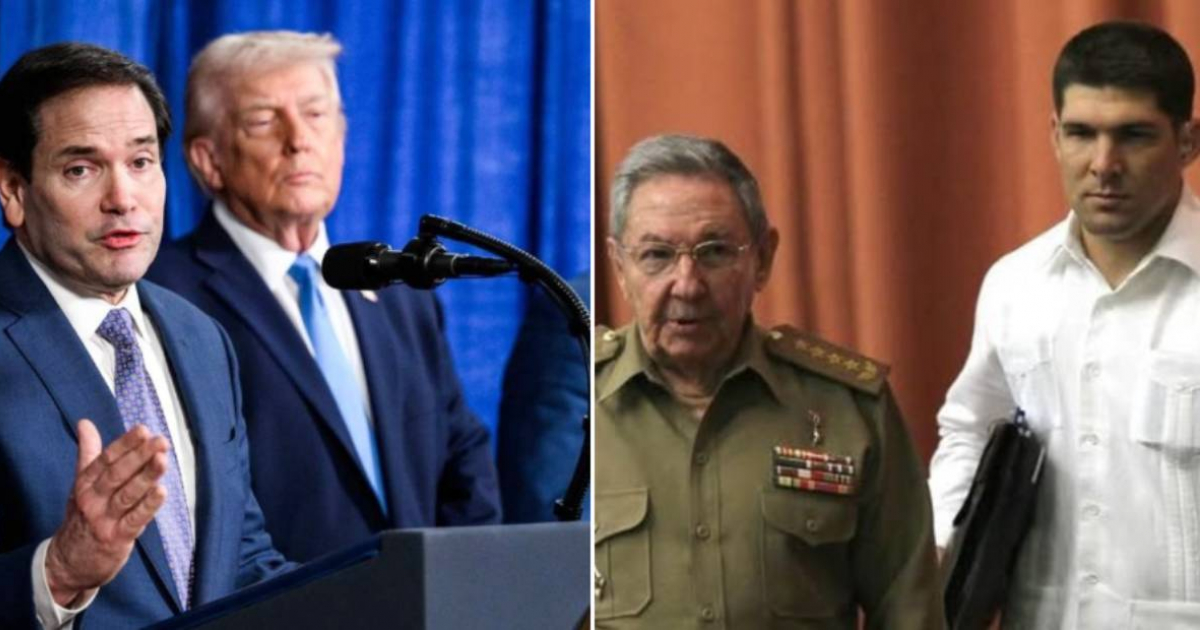
Reports regarding alleged conversations between Secretary of State Marco Rubio and Raúl Guillermo Rodríguez Castro, the grandson of Raúl Castro known as “El Cangrejo,” have sparked a debate within the Cuban exile community about the boundaries of political transition in Cuba.
Axios reported that Rubio has had recent contacts with Rodríguez Castro. The exchanges are ongoing and do not involve the ruling Miguel Díaz-Canel, but instead focus on the circle that Washington considers to be the real power in Havana.
Reactions and rejection in Miami to the negotiations between Rubio and Castro
The news of the dialogue generated questions among members of the exile community. Analyst Andy Gómez stated that “Raúl learned something very significant from his brother Fidel: do not trust anyone.”
That would be the reason why the Army General chooses his grandson, El Cangrejo, for these conversations with Rubio. He is his right-hand man and a person he trusts completely.
Eloy Viera, an analyst at the platform elTOQUE, remarked that “the Trump administration is trying to engage with the real power rather than with bureaucratic structures that could serve as reference points or shields.”
He added that, in a potential transition scenario, some actors might try to "preserve important economic assets or, at the very least, impunity for those who remain alive."
This aspect creates friction within the more radical sectors of the Cuban exile community, who have been waiting for years for the moment to judge the Castros.
The commentator Miguel Cossio's stance was categorical: “No one from the Castro family could be part of that political change process in Cuba.”
In the same vein, analyst Sebastián Arcos Cazabón stated that "an Alejandro Castro or a Raúl Guillermo" would also be unacceptable, because the father, the son, and the grandson are all the same.
The debate comes just a few days before the 30th anniversary of the shooting down of the Brothers to the Rescue planes, which occurred on February 24, 1996, resulting in the deaths of four men.
On February 13, 2026, Cuban-American congress members Mario Díaz-Balart, María Elvira Salazar, Carlos A. Giménez, and Nicole Malliotakis sent a letter to President Donald Trump requesting that the Department of Justice consider formally charging Raúl Castro for his alleged involvement in the attack.
“The bullies who have oppressed, tortured, and killed must face justice, and accountability must begin at the top,” stated Díaz-Balart.
Rubio, Trump, and the Dilemma of Justice and Political Transition in Cuba
The revelations from Axios place Marco Rubio at the center of a delicate moment for both countries. The Secretary of State must explore all options in the policy towards Cuba and find the most effective way to achieve their goals.
Washington maintains a clear stance: the regime must relinquish power if substantial changes do not occur, such as the release of political prisoners and democratic and economic openness.
The connection between Marco Rubio and the circle of Raúl Castro is one of the most sensitive moves of his career, as it concerns a topic with significant symbolic weight for exiles in Miami and within U.S. politics.
Beyond his historical positions regarding the Cuban regime, Rubio is acting within an administration that is evaluating various scenarios, in a context of economic pressure and international isolation for Havana.
Any potential understanding that includes members of the Castro family could spark a new debate between those who prioritize accountability before justice and those who consider other possible formulas for political transition in Cuba, more aligned with the realities of the 21st century.
In that scenario, and under the final guidance of Donald Trump in decision-making, the question that arises in South Florida is whether the exile community will wholeheartedly support Rubio or demand that the Washington government ensure that justice prevails over any political considerations.
Filed under: