
Related videos:
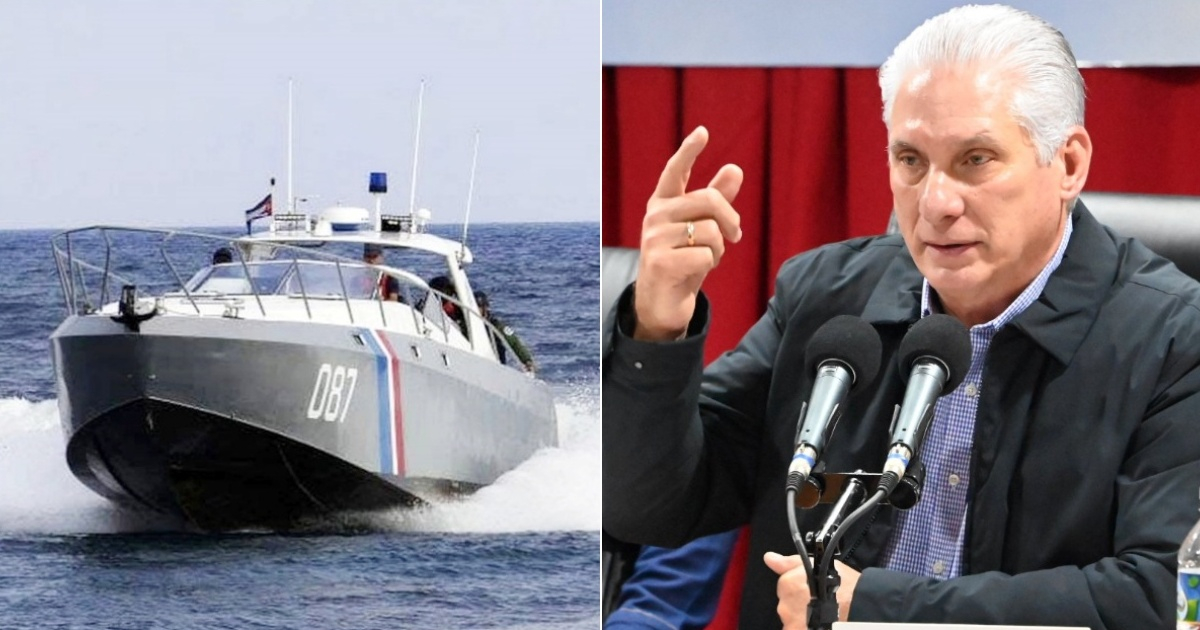
After several hours of silence in the Cuban power structure, the leader Miguel Díaz-Canel publicly reacted to the armed confrontation that took place on the morning of February 25 in the territorial waters of the island, which resulted in four deaths and several injuries.
In a message posted on his social media, Díaz-Canel warned that Cuba will always "defend itself with determination and firmness."
“#Cuba does not attack or threaten. We have stated this repeatedly and reaffirm it today: Cuba will defend itself with determination and firmness against any terrorist and mercenary aggression that seeks to affect its sovereignty and national stability”, the leader wrote on his social media.
The statement comes after hours during which neither he, nor Prime Minister Manuel Marrero Cruz, nor Foreign Minister Bruno Rodríguez Parrilla made any comments about an incident that not only resulted in fatalities but also involves Cuban citizens residing in the United States and a vessel registered in Florida.
Bruno Rodríguez speaks of "rigorous research."
Shortly before Díaz-Canel's message, Chancellor Bruno Rodríguez Parrilla announced on Thursday morning via his X account that a “rigorous investigation” is underway to clarify what happened.
"Cuba has had to face numerous terrorist and aggressive infiltrations from the U.S. since 1959, resulting in a high cost in lives, injuries, and material damages," stated the Minister of Foreign Affairs.
In the same message, he added: “A thorough investigation is being conducted to clarify the facts” and emphasized that “the defense of Cuban coasts, national territory, and national security is an inescapable duty.”
The confrontation in the waters of Villa Clara
According to a statement from the Ministry of the Interior (MININT), a suspected "fast boat" registered in Florida (FL7726SH) was detected navigating within Cuban waters, approximately one nautical mile northeast of the El Pino canal, in Cayo Falcones, municipality of Corralillo, Villa Clara province.
According to the official version, a surface unit of the Border Guard Troops—consisting of five personnel—approached the vessel to identify it.
At that moment, according to the statement, the "infringing" boat opened fire on the Cuban military.
In the exchange of gunfire, the commander of the Cuban vessel was injured. The official report stated that four individuals were killed on board the boat and six were injured, who were evacuated and received medical attention.
The MININT stated that the vessel was carrying ten armed individuals who intended to enter the national territory with "terrorist purposes," according to preliminary statements from the detainees.
Among those arrested are Amijail Sánchez González, Leordan Enrique Cruz Gómez, Conrado Galindo Sariol, José Manuel Rodríguez Castelló, Cristian Ernesto Acosta Guevara, and Roberto Azcorra Consuegra.
Additionally, Duniel Hernández Santos was arrested in Cuban territory, allegedly linked to the group’s reception.
Authorities reported the seizure of assault rifles, handguns, homemade incendiary devices, bulletproof vests, telescopic sights, and camouflage uniforms. They also noted that some of those involved have criminal records and that two of them appeared on national lists related to prior investigations.
The names of Amijail Sánchez González and Leordan Enrique Cruz Gómez also appear on the list that the regime updated last July and presented to the UN as part of its national list of individuals considered terrorists.
From initial silence to political reaction
The public reaction from Díaz-Canel and Rodríguez Parrilla comes after an initial period in which the narrative was limited to statements from the MININT.
As analyzed by CiberCuba in a previous work, the lack of statements from the highest leadership fits a recurring pattern: in sensitive episodes - social protests, migration crises, or high-impact violent events - the initial reaction of the political power is often silence, while the security agencies establish the official version of events.
Only later do the political statements come, framing the event within the historical narrative of the regime.
In this case, the official discourse frames the confrontation within the context of "aggressions" and "terrorist actions" coming from the United States, reinforcing a rhetoric of defending national sovereignty.
Reactions in the United States
The incident provoked an immediate reaction in Washington and South Florida.
The Secretary of State, Marco Rubio, stated that the U.S. government will verify what happened "independently" and will utilize official channels—including the embassy in Havana—to accurately determine the events that occurred.
Other figures such as the Miami-Dade County tax collector, Dariel Fernández; Mayor Daniella Levine Cava; and Congresswoman María Elvira Salazar urged U.S. authorities to urgently clarify what happened.
While Washington announces independent verifications and politicians in South Florida demand transparency, Havana frames the situation as an attempt at "terrorist and mercenary" aggression and claims its right to armed defense of its shores.
Díaz-Canel's message - "Cuba will defend itself with determination and firmness against any terrorist and mercenary aggression" - raises the political tone of the incident and places it within the historical narrative of confrontation with the United States.
Filed under: