
Related videos:
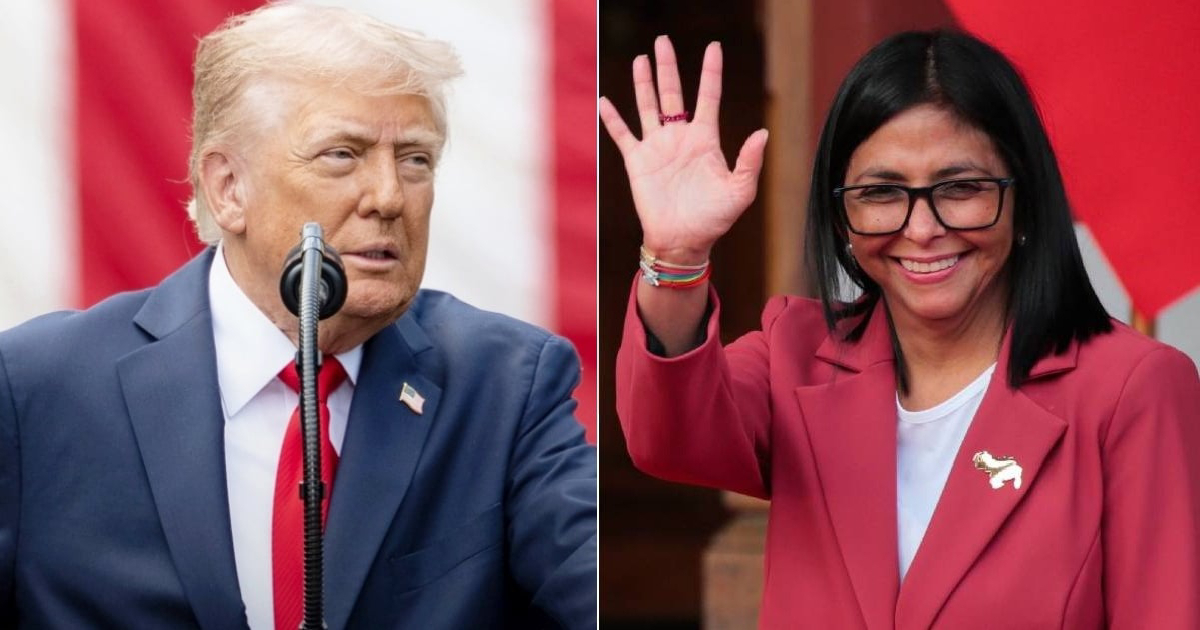
The government of Donald Trump notified the U.S. Justice Department this Wednesday of the official recognition of Delcy Rodríguez as the authority of Venezuela, in the context of an ongoing litigation related to that country, in a move that strengthens the de facto and de jure legitimization that Washington has been granting to its engagement with Caracas.
The information was reported this Wednesday by Bloomberg, which noted that the recognition was communicated in a judicial setting and represents "another step" in the validation of Rodríguez's authority by the U.S. Administration.
The person in charge of Latin America at the State Department, Michael Kozak, sent a letter to Attorney Jay Clayton asking him to inform the court that the U.S. recognizes Delcy Rodríguez as the sole head of state, "capable of acting on behalf of Venezuela."
EFE reported in a note on the subject that in the letter, Kozak clarified that the United States has not recognized Maduro as head of state since January 23, 2019, and that "this lack of recognition continues to the present."
"Maduro is an accused narcoterrorist awaiting trial in a U.S. federal court for his crimes," he said, as reported by EFE.
Decisive steps
The judicial decision announced on Wednesday follows several prior political steps taken by the White House.
In early March, the United States and Venezuela agreed to restore diplomatic relations, a clear sign of Trump's willingness to work with the leadership established in Caracas following Nicolás Maduro's departure.
Two days later, Trump himself publicly announced the formal recognition of the government led by Rodríguez, according to reports that cited his statement and the subsequent response from the Venezuelan leader.
Following Maduro's capture in a U.S.-backed operation, various sources reported that Delcy Rodríguez was sworn in or assumed her role as acting president, while the Trump Administration began to treat her as a central figure in the transition or in dealings with the Venezuelan state apparatus.
According to Bloomberg, the notification this Wednesday in a court filing may have direct effects on specific lawsuits, legal representation, and property disputes.
The rapprochement between Washington and Caracas began to take shape after the capture of Nicolás Maduro on January 3, 2026, in an operation supported by the United States, an event that altered the regional political landscape and opened a new phase of transition in Venezuela.
In this context, Delcy Rodríguez took on a central role in the new political landscape, while the Donald Trump Administration promoted diplomatic and economic contacts with the authorities established in the Venezuelan capital.
In the following weeks, there were increasing signs of cooperation between both governments, especially in the energy sector, which is deemed crucial for the economic stability of the South American country and for the strategic interests of United States.
U.S. officials began visiting Caracas and exploring agreements related to the oil industry and the hydrocarbons sector, amid a political process aimed at stabilizing the institutional situation following the collapse of Maduro's leadership.
On March 8, 2026, Delcy Rodríguez celebrated progress on the energy agenda with the United States during an event with U.S. Secretary of the Interior, Doug Burgum.
The Venezuelan leader described the meeting as a "productive workday" and emphasized the strengthening of cooperation in areas such as oil, gas, and mining, in what she described as an effort to build a collaborative agenda between both countries.
The statements reflected the marked shift in the relationship between Caracas and Washington after years of political confrontation.
The approach, which included high-level contacts and preliminary agreements in the energy sector, was interpreted by analysts as part of a strategy aimed at stabilizing Venezuela's political transition and reactivating the country's oil industry with international participation.
Filed under: