
Related videos:
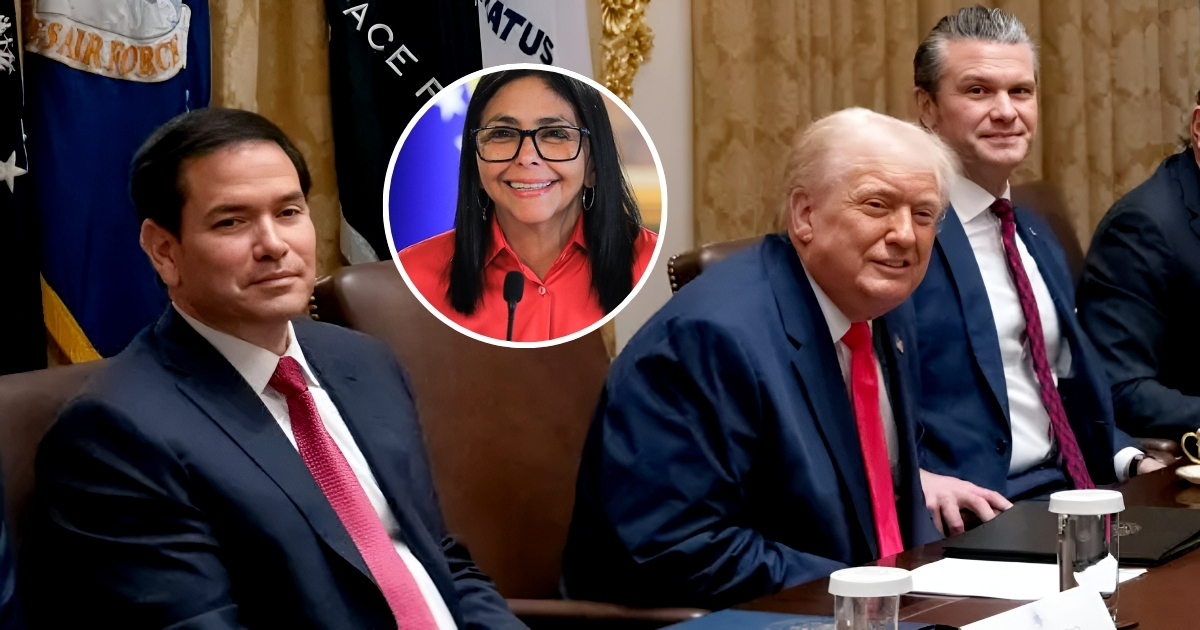
President Donald Trump has requested Defense Secretary Pete Hegseth to participate in overseeing Delcy Rodríguez and to exert control over the mechanisms of the chavista regime in Venezuela, a role that until now has primarily been the responsibility of Secretary of State Marco Rubio. The information was reported this Tuesday by journalist David Alandete on ABC.es and generated significant impact on social media, with over 166,000 views on X.
According to Alandete, Trump asked Hegseth to, just like Marco Rubio already does, participate in the oversight of Delcy Rodríguez and also exert control over the mechanisms of the Chavista regime. This movement signifies an expansion of the circle of U.S. officials directly involved in managing the Venezuelan transition.
Since Delcy Rodríguez began cooperating with the U.S. following the capture of Nicolás Maduro, Washington has maintained an ambiguous yet functional relationship with the Chavista leader. Rubio was the primary interlocutor in that initial stage, crafting what he described as a phased plan to stabilize Venezuela.
Hegseth had already praised the deterrent effect of the U.S. military operation in Venezuela during a cabinet meeting, indicating his growing involvement in Venezuelan affairs. His formal inclusion in the oversight of Rodríguez confirms that the Pentagon is gaining influence in Washington's strategy toward Caracas.
The White House has maintained a dual stance: on one hand, Trump sees Delcy as "useful" for managing the mechanisms of the Venezuelan state, while considering María Corina Machado an "indispensable" figure for the democratic legitimacy of the process.
Relations between Trump and Rodríguez have had notable moments. In January, Trump had a "fantastic" phone conversation with Delcy Rodríguez focused on Venezuelan oil, a sign that Washington was committed to keeping channels open with the Chavista leader despite internal criticism.
Not everyone in the American political spectrum has supported this approach. Former Vice President Mike Pence
In the economic sphere, Venezuela opened PDVSA to foreign capital in February 2026 following pressures from Washington, marking one of the most significant concessions made under U.S. oversight. At the same time, Rodríguez dismissed the Cuban Minister of Tourism and removed Alex Saab, movements interpreted as signs of distancing from Chavismo allies under scrutiny by the U.S.
On March 9, Trump took a significant step by announcing formal recognition of Delcy Rodríguez's government, strengthening Washington's commitment to a transition managed from within the chavista apparatus under U.S. supervision.
In parallel, Trump has maintained close contact with the Venezuelan opposition. After a second meeting with María Corina Machado at the White House on March 7, the U.S. president spontaneously called her days later from Miami to express his support, in a gesture that highlighted the importance Washington places on the opposition leader within the Venezuelan transition process.
Filed under: