
Related videos:
It was expected. The United States Secretary of State, Marco Rubio, has expressed dissatisfaction with the latest economic reforms in Cuba, which he describes as "insufficient", while insisting that a regime change is necessary on the Island. The matter continues at the highest level.
Less than a week ago, Miguel Díaz-Canel publicly acknowledged the conversations with the neighbor to the north and instructed his ministers to begin reporting on the “transformations” that should promote changes in the Cuban economy. On Monday, the Deputy Prime Minister Oscar Pérez-Oliva Fraga appeared first before NBC and then in a press conference to discuss the reform of the foreign investment policy to attract capital from the diaspora, from the “worms” scorned by the very regime that has been in power for 67 years. Immediately after, Marco Rubio questioned this approach, calling it “insufficient.” Now, if the game continues, it is up to the regime to play again and either bet or show their cards. And it seems they do not have a good hand and may end up bluffing before getting started.
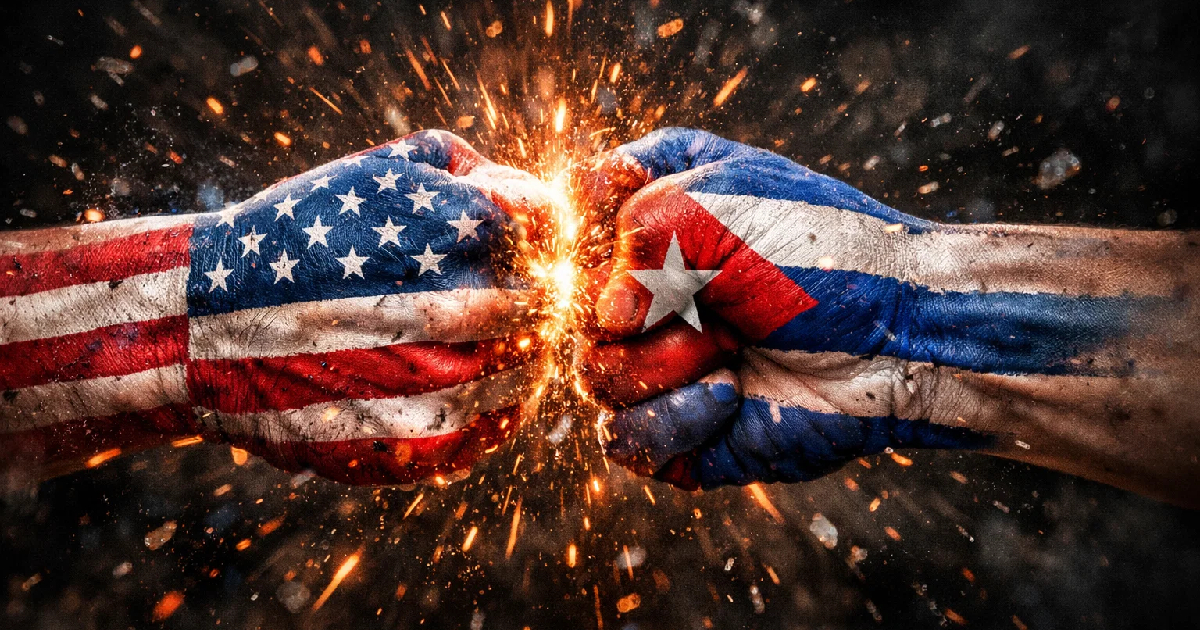
Everything happened during a meeting in the Oval Office on Tuesday morning, when Secretary of State Marco Rubio, in the presence of President Donald Trump and Irish Prime Minister Micheál Martin, told reporters that the economic reforms announced by Díaz-Canel, which allow Cuban-Americans to invest in businesses on the island, are insufficient, while also announcing his Administration's determination to achieve a regime change in Cuba. This is a matter that President Trump had previously addressed when he spoke about "take Cuba," adding that "we are going to do something very soon with Cuba."
In an attempt to discredit the Castro movement regarding diaspora investments, Rubio emphasized that the regime has a political and governmental system "that cannot be fixed; the economy isn't working, so they must change drastically," making clear the position of the United States Administration. At the same time, he pointed out that "what was announced on Monday is not drastic enough; it won't resolve the situation, so they must make important decisions regarding trade," indicating to the regime's leaders the direction in which they must move from now on.
As evidence of the disqualification of the measures announced by Pérez-Oliva Fraga, Rubio insisted once again that “the economy is not functioning; it’s an economy that has survived” and stated that there is no longer any revolution, and all they have experienced is “living off the subsidies from the Soviet Union and later, from Venezuela, but they no longer receive those subsidies.” He concluded by saying that “they have a lot of problems, and those in charge do not know how to solve them, so there must be other people.” Based on this statement, he once again made a “call for a change of regime,” which is emerging as the position advocated by the United States Administration in discussions with the regime.
From this movement, where Cuba is showing changes in investments from exiles and Rubio insists on regime change, it is evident that the positions of both sides are very far apart, and it will be very difficult to come closer and seek a convergence that ensures, at the very least, a consensus result, when neither side achieves all its positions but settles for a few that it considers essential.
All of this suggests that the process, the departure, may take longer than anticipated and, knowing the style of the Castro regime, could even be indefinitely delayed, buying time and pushing issues forward to see how events unfold. In fact, they have already launched the first attacks from the communist state press. Cubadebate, for example, has reported on statements made by Díaz-Canel in which he says: “In the worst-case scenario, Cuba is accompanied by one certainty: any external aggressor will face an impenetrable resistance.”
Once again, the strategy of conflict, when in reality the issue is that the humanitarian crisis in Cuba has reached horrific proportions and the population could erupt at any moment (the protests and pot-banging demonstrations are on the rise), and on the other hand, the Trump Administration is known for its determination. These are not the best conditions to waste time. Therefore, we must stay alert for what may happen.
What is undeniable is that this first move by the regime has left Oscar Pérez-Oliva Fraga, the Vice Prime Minister and Minister of Foreign Trade and Investment of Cuba, burned for the future. He is the great-nephew of brothers Fidel and Raúl Castro. His proposals to attract investment from the diaspora have been an absolute failure and a bad joke that nobody appreciated. This gives us an idea of what the leaders under Díaz-Canel's administration can offer at this time.
It is not surprising that the New York Times cited, from sources informed about the negotiations, that there have been attempts to marginalize the communist leader from the conversation process due to his obstructive attitude. Meanwhile, if such a move ultimately takes place, the issue for Pérez-Oliva Fraga is that he may have passed into oblivion, and his chances of participating in a future democratic scenario have dissolved like sugar in very hot coffee. This is the consequence of trying to swim while also wanting to keep one’s clothes dry.
Some people miss opportunities to become something and burn out without realizing it. What is clear is that the parade has begun; even better, the casting of potentially useful Castroist leaders for the transition. The hard core linked to the family has been ruled out, so someone must emerge who offers some kind of guarantees for change, similar to what happened in Spain during the 1975 transition. Pérez-Oliva Fraga may try again, as he has announced that the Castro government is open to allowing trade with U.S. companies. It seems that being the great-nephew of Fidel and Raúl Castro may not be as advantageous as one might expect. However, he certainly does not want to be left out of the power transition. He has a good track record of actions to undertake in the stagnant Castroist economy, and for that reason, he will remain in the game. You'll see.
Filed under:
Opinion article: Las declaraciones y opiniones expresadas en este artículo son de exclusiva responsabilidad de su autor y no representan necesariamente el punto de vista de CiberCuba.