
Related videos:
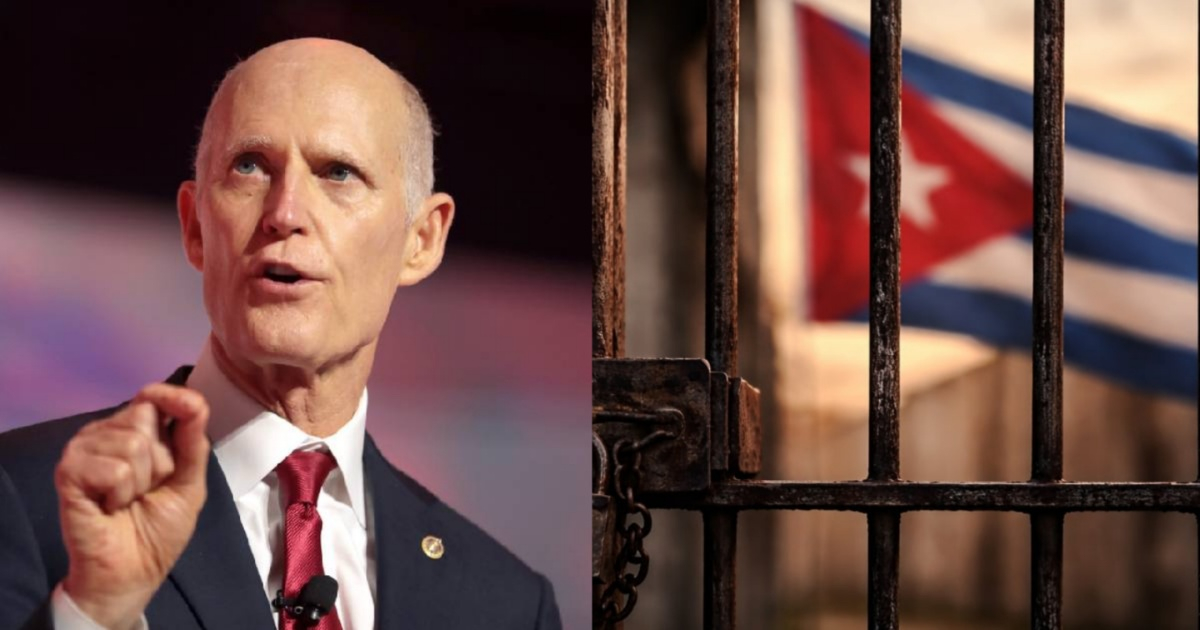
The Republican Senator from Florida, Rick Scott, denounced this Saturday that the mass pardon announced by the Cuban regime for over 2,000 prisoners did not include a single political prisoner, and he described the measure as merely a "scheme to save money."
Scott was unequivocal in his message published on X: "The illegitimate communist regime in Cuba announced a 'mass pardon' for over 2,000 prisoners during Holy Week, but not a SINGLE political prisoner has been released. In fact, the repression and persecution by the brutal regime Castro/Díaz-Canel are only worsening. ENOUGH! Publish the complete list of political prisoners and release them all immediately, including the activists from July 11, NOW."
The senator was equally straightforward in rejecting any favorable interpretation of the measure: "Let’s be clear: The United States WILL NOT be deceived by your scheme to save money while innocent Cubans remain imprisoned for demanding freedom."
The regime announced the pardon on Thursday, April 3, citing Article 90 of the Cuban Constitution and presenting it as a humanitarian gesture in the context of Holy Week, benefiting 2,010 inmates including young people, women, elderly individuals over 60, the sick, and foreigners.
However, the measure explicitly excludes those who have committed crimes against authority —a category that the regime systematically applies to protesters and opponents— thereby leaving out the vast majority of recognized political prisoners.
The first releases began this Saturday at La Lima prison, in Havana, involving common prisoners for offenses such as theft or bribery. Among those released are three American citizens convicted of common crimes, but no political prisoners were set free.
Scott was not the only legislator to reject the pardon. Cuban-American Congresswoman María Elvira Salazar stated that "this is not a humanitarian gesture, it is a tactic to cling to power and create headlines", and demanded the release of figures like Maykel Osorbo and Luis Manuel Otero Alcántara. Congressman Carlos Giménez, for his part, called the regime's announcement a distraction to divert the attention of the international community and insisted on the immediate freedom of all political prisoners.
From Cuba, opposition voices also rejected the measure. José Daniel Ferrer, from the Patriotic Union of Cuba, accused the regime of using the pardon as a way out of its predicament and publicly inquired about prisoners like Félix Navarro, Sayli Navarro, Maykel Osorbo, and Luis Manuel Otero Alcántara. Activist Alina Bárbara López pointed out that the measure aims to "counteract the campaigns for the amnesty of political prisoners".
The organization Prisoners Defenders, led by Javier Larrondo, documented 1,214 political prisoners in Cuba by the end of February 2026, while Justicia 11J estimated at least 760, including 358 detained during the protests on July 11, 2021. Larrondo warned that this pardon is the smallest since 1998 and is a response to a financial crisis facing the State, not a genuine act of mercy. The regime also did not publish an official list of those benefiting, which adds to the opacity of the process.
This is the fifth pardon since 2011 and the second in less than a month: in March 2026, the regime released 51 prisoners following a dialogue with the Vatican, of which only between 19 and 27 were political prisoners according to independent organizations. Meanwhile, the political prisoner Luis Manuel Otero Alcántara was completing his sixth day of total hunger strike in the Guanajay prison, after receiving death threats from State Security officials on March 27.
Filed under: