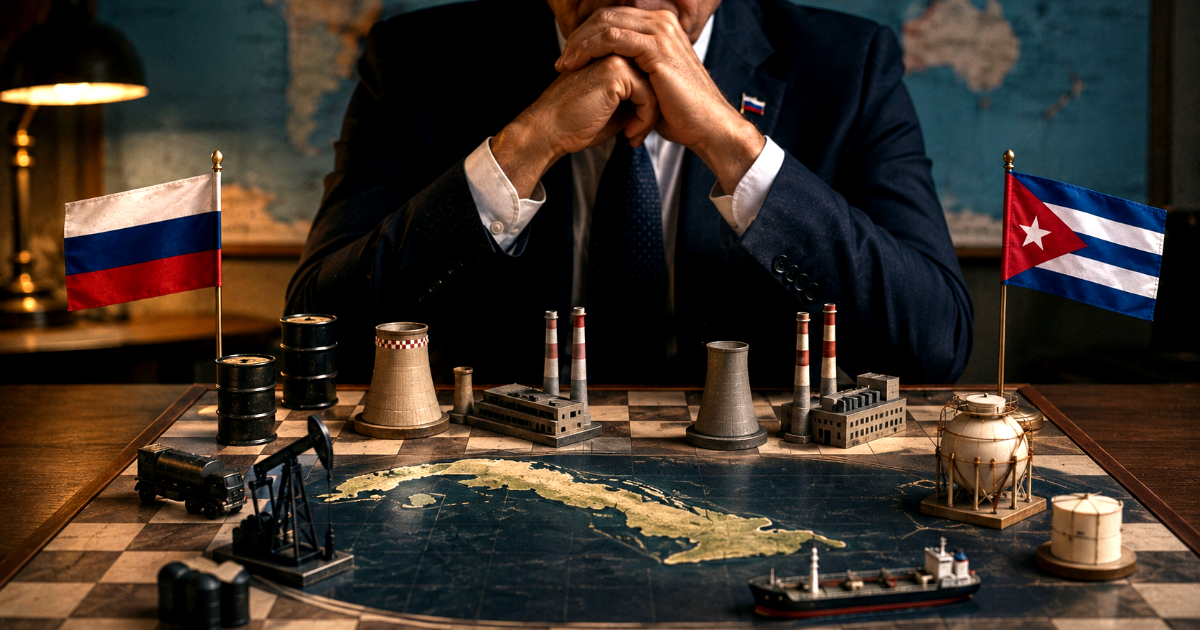
The statements of a Russian energy expert regarding the possibility of Moscow assisting in the reconstruction of Cuba's deteriorating electrical system convey a message that extends beyond Havana's lack of funds.
In statements to Finanzas Mail reported this Friday by Gazeta.Ru, Igor Yushkov explicitly referred to the possibility that a political change in Cuba could pose a risk that Russia should consider before making significant investments on the island.
Yushkov, an expert from the Financial University affiliated with the Russian government, suggested this week that Russian companies have the capacity to build power plants in Cuba, supply gas or coal, and even explore a nuclear power plant project.
But, in addition to harshly questioning the Cuban regime's ability to pay, he introduced a political variable.
According to the specialist, the current moment in relations between Havana and Washington poses a risk for Russian investments because, if Cuba’s political direction changes, Moscow might not recover the invested resources.
The observation is particularly significant in the current context: a Russian expert is openly incorporating potential changes in the political direction of Havana into the scenarios that companies from his country should consider before committing long-term capital to Cuba.
Yushkov did not claim that the Kremlin expects a regime change nor did he speak on behalf of the government of Vladimir Putin. His words, however, reveal that this scenario is beginning to emerge, at least in Russian analysis, as a possibility with concrete economic consequences.
The approach contrasts with the public discourse that Russia has maintained in recent months regarding the Cuban situation and the pressure from the United States.
Moscow has repeatedly portrayed Washington as responsible for a significant part of the difficulties facing the island and has publicly defended the continuity of the Cuban government.
At the end of January, the spokesperson for the Russian Ministry of Foreign Affairs, María Zajárova, accused the Administration of Donald Trump of implementing a strategy aimed at "economically suffocating" Cuba through new sanctions.
A few weeks later, the Russian ambassador in Havana, Viktor Koronelli, assured that Moscow would continue to provide political and material support to Cuba and stated that Washington intended to "suffocate the Cuban revolution and change the government."
The discourse shifted directly to the energy crisis.
In May, Koronelli described the U.S. sanctions as “a completely unjust blockade” and “a criminal blockade” and characterized the arrival in Cuba of the Russian tanker Anatoly Kolodkin as a breach of the “energy fence” imposed by the United States.
That same month, Foreign Minister Serguéi Lavrov reaffirmed to his counterpart, Bruno Rodríguez Parrilla, Russia's readiness to provide political, diplomatic, and material support to Havana in the face of United States pressure.
In that context, another aspect of Yushkov's statements stands out: when he explained why Cuba suffers from constant blackouts, he did not mention the embargo or U.S. sanctions.
The Cuban energy system is in a very deteriorated state, which is why power outages occur regularly on the island. At the same time, consumption continues to grow, while large-scale modernization is not taking place and practically no new generation capacity is being added," he stated.
His diagnosis highlights structural issues: deterioration of facilities, lack of modernization, increased consumption, and insufficient new generating capacity.
This does not mean that Yushkov has dismissed U.S. sanctions as a factor affecting the Cuban energy sector. Simply, he did not include them among the reasons he listed to explain the blackouts, a significant omission compared to the usual rhetoric of Russian and Cuban authorities.
The difference becomes even more relevant because the specialist was specifically analyzing what Russia would need to do to resolve the issue.
The change in perspective is remarkable.
While Russian diplomacy has been presenting its support for Cuba for months as a response to U.S. pressure, Yushkov approaches the relationship from a much more pragmatic perspective: how much it would cost to rescue the Cuban electrical system, who would finance the investment, and what would happen to that money if the political orientation of Havana changes.
"Cuba is an insolvent actor. Let them first find a way to pay us. Then we can discuss the matter." the expert stated.
His reasoning thus introduces two different risks for Moscow.
The first is financial: Cuba currently lacks sufficient resources to undertake large-scale energy projects.
The second is political and potentially more significant: a Russian investment made today would have to endure the possible changes that may occur tomorrow in Havana.
Related videos:
Filed under: