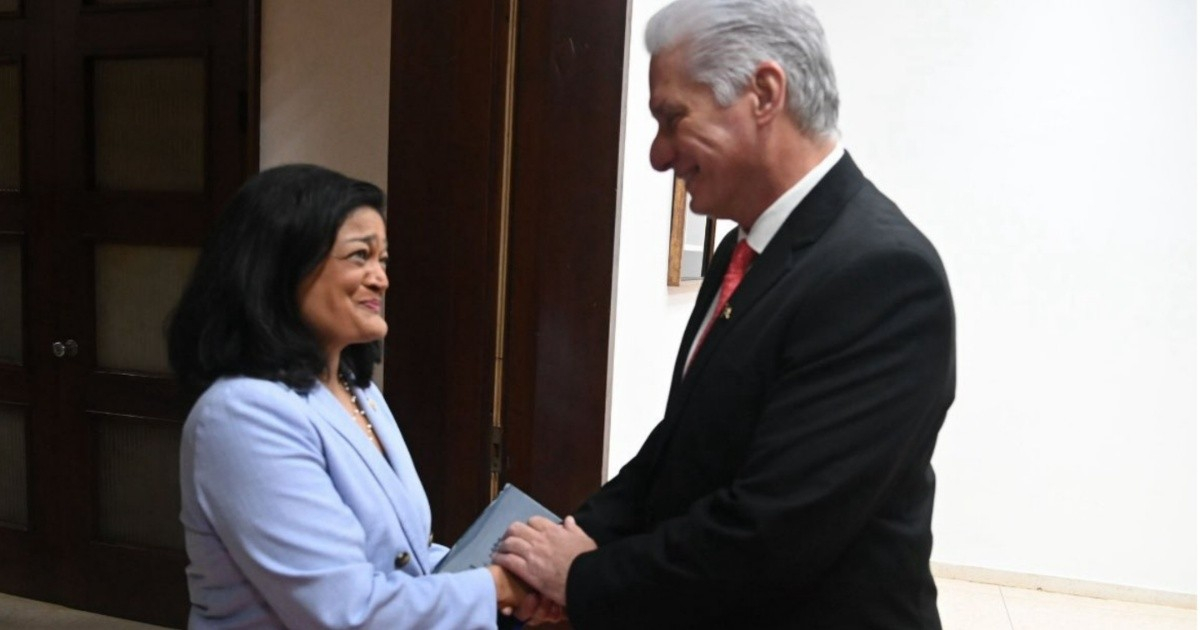
The Democratic congresswoman Pramila Jayapal stated this Sunday that Washington should engage in "real negotiations" with Havana and advocated for "deep diplomacy" as a way to promote change in Cuba,
In an interview granted to the newspaper El País, which reignites the debate over U.S. foreign policy towards the island, Jayapal, representative from the state of Washington and one of the most influential voices of the progressive wing of the Democratic Party, acknowledged that Cuba is facing a "humanitarian crisis" and vividly described what she witnessed during her stay in April.
"There is a shortage of medications, basic necessities, and food. The streets were almost empty. And this was right after a Russian tanker docked with a full load of fuel. We weren't even in the worst phase, which is happening now," he specified.
The congresswoman visited Cuba in April along with Congressman Jonathan Jackson, marking the first documented visit by U.S. lawmakers to the island in 2026, and met with Miguel Díaz-Canel, Foreign Minister Bruno Rodríguez Parrilla, and members of the Cuban Parliament.
"The U.S. government has mismanaged the crisis since the beginning of the embargo. We should have implemented deep diplomacy so that Cuba could connect with the rest of the world and changes would come naturally," stated the lawmaker.
Despite that diagnosis, the congresswoman placed the blame on the U.S. embargo rather than on the dictatorship that has ruled the island for over six decades.
"It has not worked and will not work to impose collective punishment on the Cuban people to force a change," he stated, adding that the "real negotiations" he is demanding have not taken place "since the Obama administration," noting that Biden "also did not take advantage of that momentum."
The legislator also mentioned that during her visit, she met with families of political prisoners and with "dissidents who had openly protested against the Government," although those references took a back seat to her criticism of the embargo.
April's trip earned her harsh criticism from Republican congress members and sectors of the Cuban exile community, who accused her of "whitewashing" the regime. After returning, Jayapal unsuccessfully sought to facilitate the shipment of oil to Cuba through third countries, including contacts with the Mexican ambassador.
Jayapal's words stand in stark contrast to the position of the Trump administration, which maintains maximum pressure on Havana. Secretary of State Marco Rubio stated on Friday to Axios that Washington's goal is to ensure the Cuban regime has no "way out": "Every time they create a new mechanism to try to escape the noose, we simply tighten it."
In that same context, as revealed by The New York Times, the CIA created a special group for Cuba aimed at creating rifts within the regime's leadership, while the Trump administration seeks to identify a "pragmatic" Cuban official who could take over the government in Havana.
Rubio was emphatic about the horizon that Washington is pursuing: "My level of confidence is that, when this Administration ends, at the very least, Cuba will be on an irreversible path towards a different future."
Related videos:
Filed under: