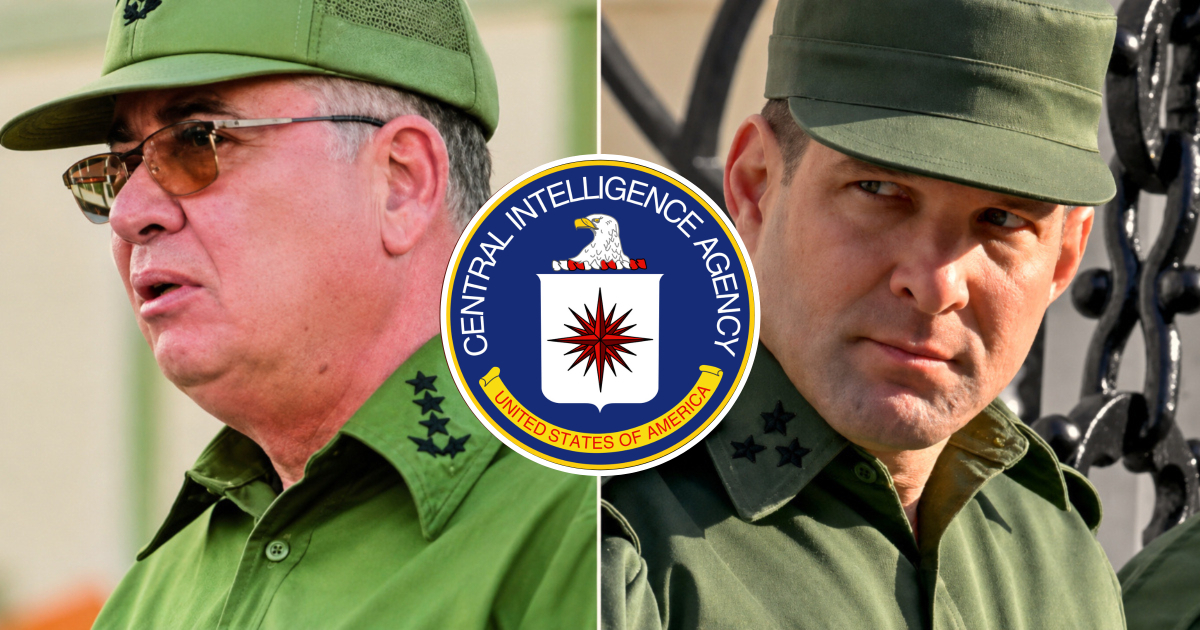
The revelation by The New York Times that Raúl Guillermo Rodríguez Castro, "El Cangrejo," and the Minister of the Interior, Lázaro Alberto Álvarez Casas, could be deemed acceptable to U.S. officials in a potential transition scenario in Cuba contains an apparent contradiction.
None respond, due to their known trajectory, to the conventional profile of a figure expected to lead a democratic opening.
«El Cangrejo» is the grandson of Raúl Castro, he was for years his bodyguard and is part of a family closely connected to the political, military, and economic power in Cuba.
Álvarez Casas presents an even greater contradiction: he heads the MININT, which includes the State Security, the Revolutionary National Police, and a large part of the repressive apparatus.
The Cuban-American journalist Nora Gámez Torres from the Miami Herald publicly expressed her surprise at the information from the Times and recalled that Washington has denounced the activities of Cuban services and .
"Is it also an acceptable counterpart?" Gámez Torres wondered on his social media before proposing a hypothesis: "Perhaps it is simply to sow distrust."
The United States sanctioned Álvarez Casas and the MININT in January 2021 under Executive Order 13818, linked to the Global Magnitsky Act.
Washington held the organization responsible for serious human rights abuses and specifically pointed out the harassment and surveillance of journalists, dissidents, and activists, including members of the San Isidro Movement.
Then came the protests of July 11, 2021.
The Revolutionary National Police and the special forces known as Black Berets, both under the MININT, participated in the repression of the protests. The United States ended up imposing sanctions on those structures and several of their officials as well.
"Four years after the brutal repression by the Cuban regime against the protesters, the Department of State is restricting visas for the regime's leaders, Díaz-Canel, López Miera, Álvarez Casas, and their associates for their role in the brutality of the Cuban regime against the Cuban people," wrote Marco Rubio in July 2025 on his social media.
For this reason, it is striking to imagine the head of that apparatus as a potential figure to initiate a democratic transition that would necessarily have to guarantee political freedoms, release political prisoners, and transform precisely the repressive structures that they currently lead.
The American logic could be different.
The Times reports that the Trump administration is looking for a sort of "Cuban Delcy Rodríguez": someone from within the regime, with enough power to ensure the state continues functioning and willing to cooperate with Washington.
From that perspective, Álvarez Casas and "El Cangrejo" have an obvious asset. One controls the internal security apparatus. The other has direct access to Raúl Castro's family core.
But having enough power to lead a transition does not mean being willing to dismantle the system from which that power originates.
There is no public evidence that anyone has shown the willingness to prioritize Washington's demands over the political, economic, and family interests related to the regime's survival.
A fact adds even more interest to these two names: both met in Havana with the CIA director, John Ratcliffe, during his visit to Cuba on May 14th.
According to the information published at that time by Axios, Ratcliffe also had contacts with "El Cangrejo". According to the NYT, he conveyed to both that Washington viewed their Cuban interlocutors as significant adversaries, but also as potential future partners.
The head of the CIA also warned that the regime was running out of time to make the "fundamental changes" demanded by Trump. The meeting demonstrates that both have, at the very least, direct channels of communication with Washington, although it does not prove that the United States considers them real candidates to lead Cuba.
Here, the question posed by Gámez Torres becomes particularly interesting.
The New York Times revealed this week that the CIA has created a special group for Cuba aimed at creating rifts within the political elite, displacing sectors deemed more hostile to the United States, and favoring more pragmatic figures.
The unit is integrating specialists in sourcing recruitment, cyber operations, and covert influence operations.
In this context, the fact that one of the most powerful men in MININT and Raúl Castro's grandson appear publicly as potential interlocutors for the United States can have significant effects within a political structure where loyalty is fundamental.
That does not prove that the information from Times is an influence operation. It could very well be true.
But the possibility that certain names circulate to also stir suspicions within the leadership is consistent with the goal of exploiting their internal divisions.
There are also reasons to exercise caution regarding the leaks about the U.S. strategy toward Cuba.
Just remember that Marco Rubio recently refuted another report from the New York Times based on knowledgeable sources about the contacts between Washington and Havana.
The Secretary of State then stated that those speaking with the press were not part of the process and assured that they did not know what was really happening.
The White House reinforced the message by stating that Trump and Rubio were the ones who knew the details of the strategy.
That episode does not prove that the new revelations are false. However, it does remind us that there is a difference between what anonymous officials convey to the press and the decisions ultimately made by the White House.
Washington may be looking for a Cuban "Delcy" and needs real power brokers within the regime for that. However, considering an interlocutor useful does not mean choosing them as a future ruler.
And if the CIA's parallel objective is to create rifts within the leadership, the mere suspicion that Álvarez Casas or "El Cangrejo" might be among the individuals with whom Washington would be willing to negotiate already holds considerable political value in itself.
Perhaps that is one of the keys to interpreting such a surprising revelation.
Related videos:
Filed under: