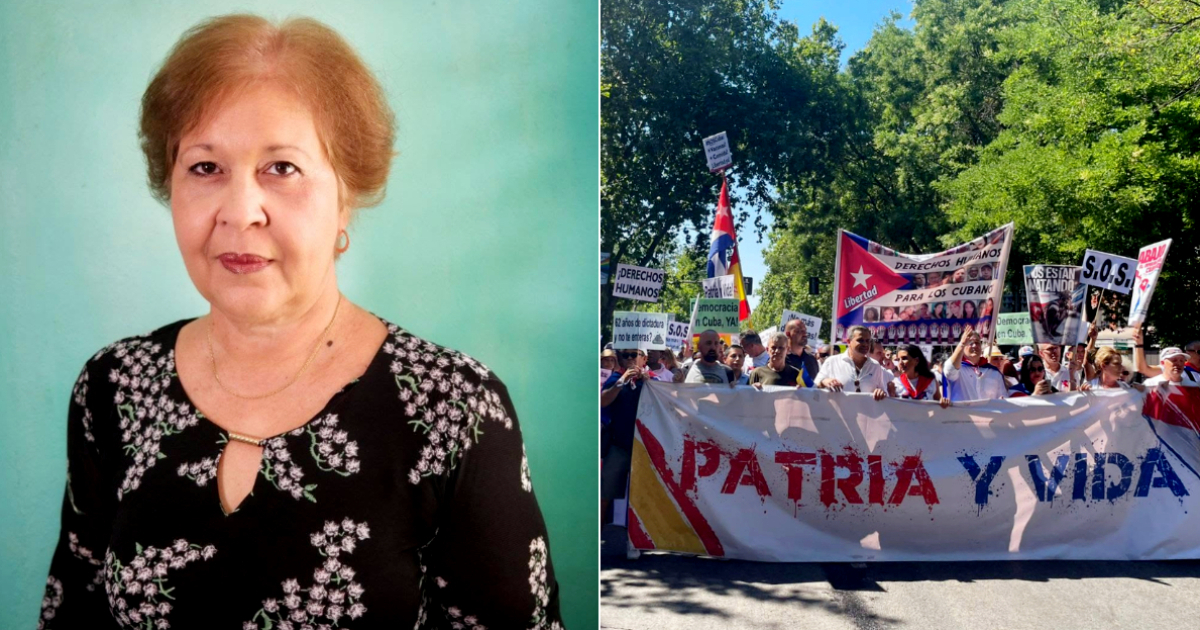
In her essay "Cubans Are Leading Change from Within," published in Journal of Democracy, Cuban historian Alina Bárbara López Hernández poses a fundamental question: Is civil society prepared to lead a democratic transition when there is an opening of the political system?
Their diagnosis combines hope and concern. The economic crisis, blackouts, repression, and growing citizen discontent have eroded the foundations of the regime's stability. However, the opposition remains fragmented and lacks sufficiently entrenched structures to turn protest into an organized alternative for power.
The warning is relevant: the weakening of a dictatorship does not guarantee the emergence of a democracy.
But the essay inadequately develops two decisive issues: the political role of Cuban exiles and the various circumstances under which a transition could occur, from a negotiation with the regime to its collapse or a rupture precipitated by international factors.
In a country whose history is marked by decades of forced emigration, political persecution, and the dispersion of its professional elites, it is challenging to analyze the democratic reconstruction without considering the skills accumulated beyond its borders.
Cuban civil society does not end on the Island
López Hernández does not propose to exclude the exiled nor does he deny their legitimacy. His argument is more precise: a transition needs organizations with a territorial presence, community ties, and the ability to represent those who suffer daily from the consequences of authoritarianism.
The argument is valid. The international visibility of an opposition leader does not equate to a democratic mandate, just as having diplomatic contacts or financial resources does not automatically grant the authority to govern.
But residence within the country does not, by itself, constitute a superior source of representative legitimacy.
It is important to distinguish between the ability to drive political change, the right to participate in it, and the legitimacy to exercise power. These are related dimensions, but not equivalent.
The distinction takes on special significance in Cuba, where the regime itself has contributed to the expulsion of opponents, journalists, lawyers, academics, and activists from the country. Turning their residence abroad into a reason to assign them a secondary role could extend the political consequences of that exclusion.
Exile is not merely an external ally of Cuban civil society; it is also a part of that society, geographically displaced but connected to the nation through familial, political, cultural, and economic ties.
Its ideological and strategic diversity does not invalidate that belonging. Rather, it poses the challenge of building representation mechanisms capable of integrating citizens who live under very different conditions.
Transition projects already exist
López Hernández's concern about the lack of political articulation finds a counterpoint in the numerous transition projects developed over decades by opposition organizations and Cuban specialists.
A CiberCuba investigation published in August 2026 reconstructed initiatives ranging from Concilio Cubano, La Patria es de Todos, and Proyecto Varela to Cuba Decide, Cuba Próxima, D'Frente, the Council for Democratic Transition, and the Liberation Agreement.
His proposals differ substantially: plebiscites, constitutional reforms, negotiations with power sectors, political break, provisional governments, and constituent processes.
The historian herself acknowledges several of these projects. Her objection points to the gap between the roadmaps and the communities that should support them. However, this difficulty does not imply that the opposition lacks institutional thinking or organizational resources.
The Cuban American Bar Association (CABA) has crafted a Fundamental Law of Transition that addresses the organization of public powers and the legal continuity of the State. Cubalex has developed proposals on guarantees of rights, judicial independence, and transitional justice. Cuba Próxima has worked on constitutional alternatives and negotiated opening mechanisms.
In February 2026, the conference Cuba: The Day After Tomorrow, held at Florida International University, brought together specialists to examine the political, legal, and economic challenges of the day after.
The absence of a common direction remains a real issue. But the fragmentation of the opposition should not be mistaken for a lack of intellectual, technical, or institutional readiness.
South Africa and Chile: transitions also built from exile
The historical references in the essay allow for a nuanced emphasis on territory.
López Hernández contrasts the experiences of Poland and South Africa, where there were organizations capable of sustaining political negotiations, with those of Libya and Syria, where fragmentation and violence hindered the consolidation of democratic alternatives.
However, South Africa provides precisely an example of the interplay between internal resistance and exiled leadership.
While Nelson Mandela was imprisoned, Oliver Tambo led the African National Congress (ANC) from the outside, developed diplomatic relations, mobilized international support, and maintained connections with organizations that were confronting apartheid within the country.
The South African transition was not solely the result of a territorially organized civil society, but rather of the convergence between labor unions, community movements, imprisoned leaders, and political structures in exile.
Numerous opposition members who had lived abroad also returned to Chile to participate in the democratic reconstruction. Ricardo Lagos and Michelle Bachelet, both exiled during the dictatorship of Augusto Pinochet, would eventually hold the presidency.
These precedents do not establish that the exile must lead a transition. They demonstrate that geographical location does not, by itself, determine political legitimacy or leadership capacity.
What is crucial is the coordination between organizations, social recognition, and the existence of democratic procedures to resolve representation disputes.
An opposition with international dialogue
The international dimension takes on particular importance in the Cuban case, where the United States exerts a decisive influence over the economic and geopolitical conditions of a potential opening.
Various opposition leaders in exile maintain direct relations with governments, parliaments, and international organizations.
In June 2025, Marco Rubio met with Rosa María Payá, whose efforts in defending human rights he publicly supported. In November of the same year, the Secretary of State met with José Daniel Ferrer, with whom he discussed repression, political prisoners, and the humanitarian situation in Cuba.
Ferrer appeared in May 2026 before committees of the European Parliament, while activists such as Carolina Barrero and Amelia Calzadilla have held meetings with European representatives regarding the policy towards Cuba.
Rosa María Payá, for her part, was elected as a member of the Inter-American Commission on Human Rights, an independent institutional responsibility that should not be confused with the formal representation of the opposition.
In March 2026, organizations led by Orlando Gutiérrez-Boronat and Payá presented a Liberation Agreement in Miami that outlines provisional government structures and a democratization process. Its promoters have also established political contacts in Europe.
These relationships do not make their protagonists exclusive representatives of the Cuban people. However, they represent concrete political capabilities that a transition might require: diplomatic dialogue, the pursuit of international guarantees, institutional cooperation, and resource coordination.
The Cuban-American business community adds another dimension.
Jorge Mas Santos has presented an economic roadmap for the day after, with proposals regarding private property, investments, infrastructure, and productive reconstruction. His connections with Donald Trump and Marco Rubio highlight the existence of communication channels that go beyond traditional opposition organizations.
None of these projects replace the will of the citizens or represent an already guaranteed investment. However, rebuilding a country with deteriorated infrastructure, public services in crisis, and significant capital shortages will require expertise, funding, and management capabilities that are also found outside of Cuba.
A civil society that is territorially rooted can be essential for a democratic transition, though it may not be sufficient to meet all its demands.
There is no single path to transition
López Hernández's essay seems to favor a scenario in which internal social pressure leads to a negotiated opening and civic organizations gain the capacity to guide it.
However, transitions can arise from very different circumstances: negotiations between government and opposition, fractures within the ruling elites, institutional collapses, or international events that abruptly disrupt the balance of power.
Each scenario demands different capabilities.
A negotiated transition would require interlocutors capable of reaching compromises and establishing guarantees. A crisis of ungovernability would necessitate maintaining essential services, preserving public safety, and organizing humanitarian assistance. A breakdown of the state apparatus could initially place decision-making in the hands of actors with access to institutions, administrative resources, and international support.
The possibility of foreign military intervention cannot be excluded from the analysis, especially following the U.S. operation that led to the capture of Nicolás Maduro in Venezuela on January 3, 2026, and the subsequent warnings from Washington regarding the need for changes in Cuba.
During this year, reports on planning exercises by Southern Command and contingency preparations by the Pentagon have fueled the debate. They do not demonstrate that there is a decision to intervene militarily, but rather place that possibility within the strategic context surrounding the Island.
The debate is not limited to specific opposition leaders. An independent digital survey conducted in May 2026, with 42,263 valid responses, recorded 60.9% support for a direct military intervention by the United States and 64.9% in favor of overthrowing the regime by any means, including armed methods. The voluntary participation makes it impossible to extrapolate the results to the entire Cuban population.
On the other hand, a survey conducted for the Miami Herald among 800 Cubans and Cuban-Americans in South Florida found that 79% supported some form of U.S. military intervention. This is a different population, and their opinions cannot be confused with those of residents in Cuba.
Both results indicate that the military option is part of the political debate among sectors of the Cuban citizenry. However, they do not resolve their issues of legality, legitimacy, and consequences.
The humanitarian crisis adds another dimension.
The reports documenting torture, arbitrary detentions, and political persecution have sparked a discussion about the possible commission of crimes against humanity in Cuba. If the legal elements required for this classification are confirmed, the controversy could extend to the realm of international responsibility to protect the civilian population.
The doctrine known as the Responsibility to Protect (R2P) encompasses protection against genocide, war crimes, ethnic cleansing, and crimes against humanity. However, neither a humanitarian emergency nor the potential existence of the latter automatically authorizes unilateral military intervention. The United Nations Charter sets forth limits and procedures for the use of force.
This is a legal controversy that goes beyond the scope of this analysis, although it cannot be considered unrelated to the changing scenarios being discussed for Cuba.
In any case, a foreign intervention capable of causing the fall of a government does not, by itself, guarantee a democratic transition. The Venezuelan experience of 2026 compels us to distinguish between the replacement of a leader, the continuity of regime structures, and the effective construction of a new political order.
That is precisely why it is important to differentiate who can contribute to triggering a rupture, who is in a position to temporarily manage the State, and who has the legitimacy to govern on behalf of the citizens.
The precedent of the first Republic
Cuban history itself provides a revealing precedent.
Tomás Estrada Palma, the first president of the Republic, had carried out much of his political activity in the United States, where he succeeded José Martí as the delegate of the Cuban Revolutionary Party.
After the Spanish-American War and during the military occupation of the Island, he was elected president in 1901 and took office on May 20, 1902.
The first head of state of republican Cuba, therefore, came from exile.
The precedent does not serve as an unquestionable model. The election took place under conditions of limited sovereignty, and Estrada Palma's subsequent trajectory led to a political crisis that resulted in a second U.S. intervention in 1906.
But precisely that experience demonstrates both the possibility that exiled leaders can play a decisive role in the formation of a new state and the risks of confusing external support, political authority, and democratic legitimacy.
A political nation to be rebuilt
The main merit of López Hernández's essay lies in reminding us that a democracy does not automatically emerge from the collapse of a dictatorship. It requires organized citizens, representative institutions, and the ability to prevent a power vacuum from leading to a new authoritarian concentration.
But that warning should lead to a broader understanding of Cuban civil society, not to a functional separation between those who would drive change from within and those who would merely support it from the outside.
Internal mobilization provides social grounding. Opposition organizations can develop political representation. Jurists and specialists prepare institutions. The business sector contributes potential resources for reconstruction. International networks facilitate diplomatic dialogue and cooperation. None of these capabilities replaces the others.
The problem identified by the historian —the gap between political projects and the communities that should support them— is real. But its solution does not have to consist of subordinating the capacities developed in exile to an exclusively territorial leadership.
The question is how to integrate them into representative, accountable structures that are capable of acting collaboratively.
This integration would require addressing specific issues: the political rights of emigrants, their electoral participation, the return of exiles, the involvement of professionals in national reconstruction, and the mechanisms through which citizens, regardless of their residence, can contribute to defining the political future of the country.
After decades of emigration and exile, a democratic transition would also provide the opportunity to rebuild the bonds of a nation divided by authoritarianism.
The challenge is not to determine whether change should come from within or without, but rather how to articulate a dispersed political community so that none of its parts can claim, without democratic mandate, the representation of the whole.
López Hernández is right to warn that the opportunity for a transition could be lost if Cubans lack the necessary organization to seize it. However, that organization neither begins nor ends at the borders of the Island.
The Cuban democracy will have to be built in Cuba. This does not mean that only those who live there today can build it.
Related videos:
Filed under: