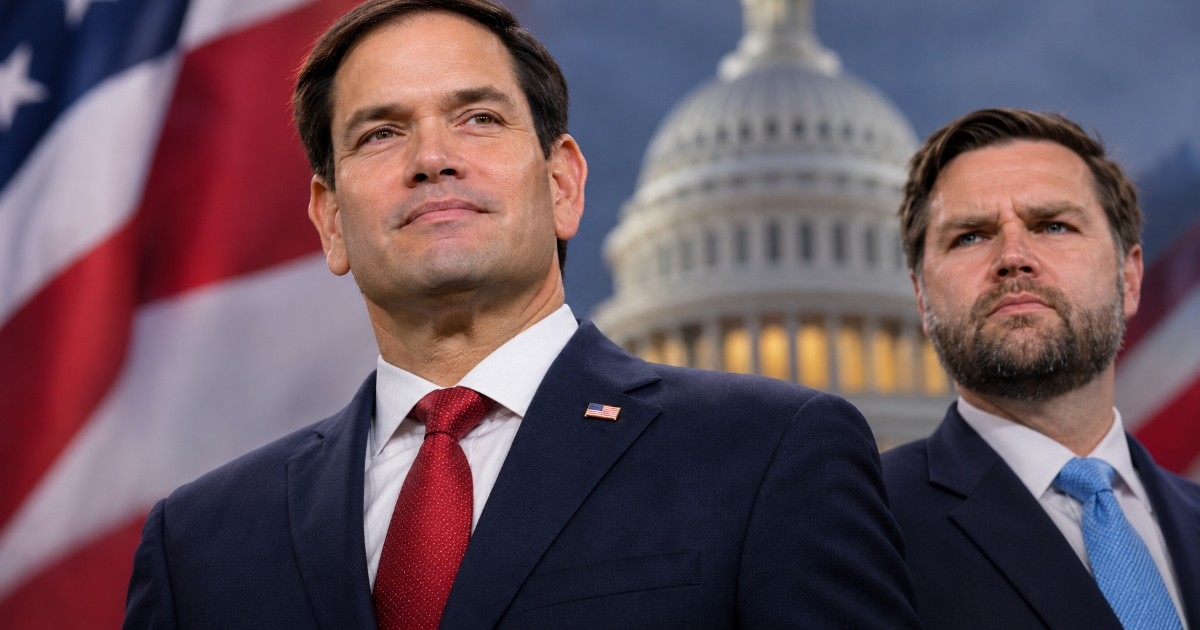
The Secretary of State of the United States, Marco Rubio, surpassed Vice President JD Vance by 20 percentage points in a new poll regarding the possible Republican presidential nomination for 2028.
The Cuban-American politician received 44% of the preferences, compared to 24% for Vance, in a result that reflects a significant shift compared to the measurements taken a year ago.
The data corresponds to a national survey by Emerson College published this Thursday, conducted between November 14 and 16, 2026.
The study included 1,000 American voters and examined, among other matters, the preferences of Republicans to succeed President Donald Trump.
When participants were given a list of potential candidates, Rubio led the preferences with 44%, followed by Vance with 24%. The Governor of Florida, Ron DeSantis, came in third with 9%, while Donald Trump Jr. reached 6%.
The results also favored Rubio when respondents were able to mention freely the politician they preferred, without receiving a list of names. In that scenario, the Secretary of State received 36% and the Vice President 20%.
DeSantis, Congressman Thomas Massie, and Donald Trump himself were mentioned by 7% of the participants each, although the president cannot be elected for a third presidential term due to the Twenty-Second Amendment to the U.S. Constitution.
The change is particularly noteworthy when compared to another poll from Emerson College conducted in November 2025, when Vance was leading the Republican preferences with 54%, while Rubio barely reached 6% in an open-ended question.
In that measurement, the vice president was ahead of the secretary of state by 48 points. A year later, Rubio surpasses him by 16 points in the same type of question.
The New York Post highlighted this Thursday the shift in Republican preferences, at a time when both officials are among the most mentioned names to lead the party's presidential candidacy.
The Emerson poll has an approximate margin of error of three percentage points for the total of 1,000 participants, although the institution itself warns that the margin is larger when analyzing smaller groups, such as voters from a specific party.
The advantage recorded by Rubio is not reflected in all recent polls. A study by Echelon Insights conducted between November 12 and 16 placed Vance ahead, with 40% support compared to 26% for Rubio.
The average of polls published by RealClearPolling this Thursday placed both politicians nearly tied, with 35.4% for Rubio and 34% for Vance.
The differences between the measurements show that Republican preferences still vary depending on the survey, especially when none of the main leaders has formally announced a candidacy.
Rubio had already achieved a favorable outcome in a poll by Reuters/Ipsos released in mid-November.
In that research, 36% of Republicans and party supporters considered him an excellent presidential candidate, compared to 34% who gave that rating to Vance, although the difference was within the margin of error.
In Florida, support for the Secretary of State has also been substantial among Republican Hispanic voters. A poll among Hispanics in the state indicated that he has 57% of the preferences in a hypothetical Republican primary, compared to 25% for DeSantis and 10% for Vance.
Rubio's rise in the polls coincides with the growing interest of donors, legislators, and Republican leaders in a possible candidacy of the Secretary of State, according to a CNN report published this Thursday.
The report indicates that Rubio has begun to give more serious thought to the possibility of running in 2028, although he has not yet made a decision.
The official has also refrained from publicly reiterating his previous commitment to support Vance if the vice president decides to run.
Recently consulted by CNN during a G7 meeting in Paris, Rubio declined to discuss his presidential plans and stated that it is a decision he can make, but on which he does not wish to comment for now.
Vance has also not confirmed his candidacy. According to reports published by Axios regarding the vice president's plans, he may wait until spring 2027 to announce whether he will seek the nomination, partly to avoid an early campaign interfering with his political relationship with Trump.
The discussion about who will succeed the current president gained momentum after the legislative elections on November 3, in which the Republicans lost control of both chambers of Congress.
The consequences of that defeat and the divisions within the party regarding U.S. foreign policy have influenced the discussions about their potential candidates for 2028.
Trump, for his part, has avoided publicly committing to either of the two leaders. In October, he explicitly mentioned Rubio and Vance when journalists asked him who might run for president in 2028.
"We have big names. We have JD, Marco, and many others. We have a great group of candidates," the leader stated, without indicating a favorite.
Trump has also privately consulted with close associates about which of the two politicians they would prefer as a candidate. In February, Axios revealed that the president had posed that question to several advisors and allies, who described a potential joint ticket of Vance and Rubio as an option being considered within his circle.
Related videos:
Filed under: