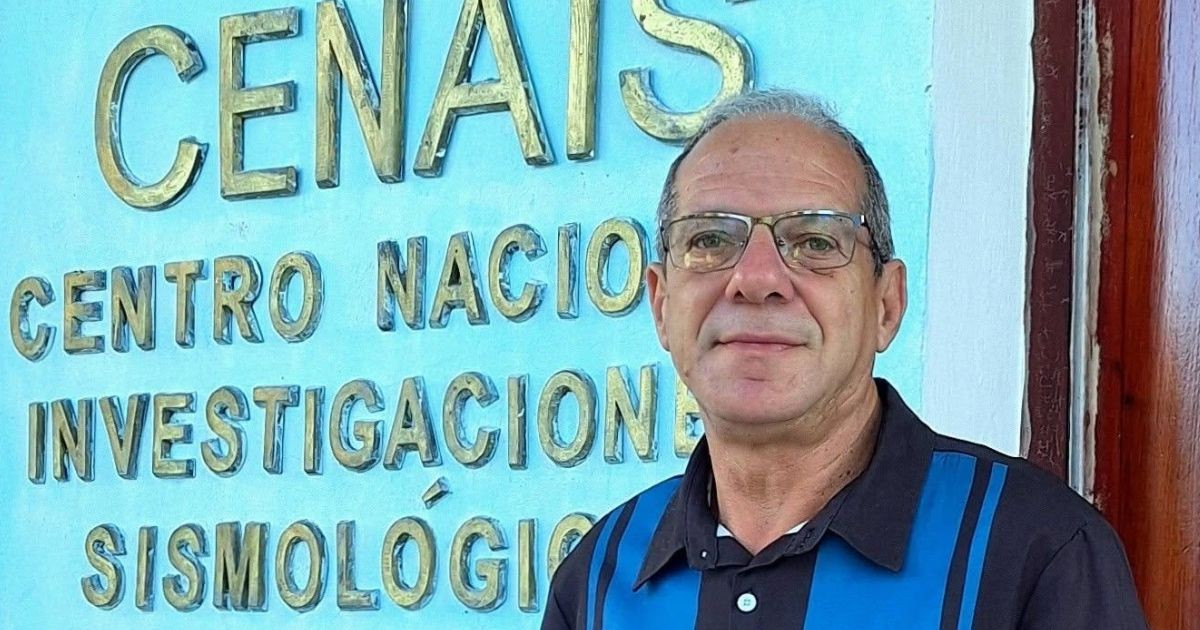
The head of the National Seismological Service of Cuba, Enrique Diego Arango Arias, announced this Sunday a partial restoration of earthquake monitoring in the country, after ETECSA restored the satellite connection of a station in Santiago de Cuba.
However, he warned that the network continues to operate with serious limitations and that it still does not have enough connected stations to properly locate the epicenters.
In a Facebook post, the specialist from the National Center for Seismological Research (CENAIS) reported that on Saturday, ETECSA had configured the VSAT antenna at the Río Carpintero station, which allows for the recovery of some necessary information to monitor seismic activity.
«Yesterday, ETECSA configured the VSAT (satellite) antenna at the Rio Carpintero station, which allows for some monitoring of seismic activity. However, one station alone is not enough to accurately locate the epicenter of an earthquake, but it's a start,” he explained.
The restoration of that connection marks an improvement compared to the situation reported in the previous days, when a large number of stations across the country had stopped transmitting their recordings due to power outages and disruptions in communications.
Arango specified that there are still significant connections to be restored in eastern Cuba, the region with the highest seismic activity in the country.
Among the pending tasks, he mentioned the installation of a VSAT antenna in Las Mercedes, Granma; connecting at least one of the three existing stations in Guantánamo to the central station; and restoring the link in Pinares de Mayarí, in Holguín.
The lack of sufficient connected stations makes it difficult to accurately determine where an earthquake occurs. To locate an epicenter, specialists need to compare the arrival times of seismic waves recorded by different equipment, something that cannot be done properly with only one station.
A false report of a 5.1 magnitude earthquake caused alarm
The specialist also provided explanations regarding an incident that occurred on Saturday, when the seismic map on the official page displayed a reported earthquake of magnitude 5.1 in the central region of Cuba.
According to Arango Arias, the information published was erroneous and caused concern among social media users.
“We apologize for this error that caused concern and alarm on social media,” he expressed.
The expert explained that the incident was due to a failure of the automatic location system used on the website, specifically related to the lack of signals from Cuban seismological stations.
The 5.1 magnitude report should not be interpreted, therefore, as confirmation of an earthquake that occurred in the center of the country.
The clarification also shows how connectivity issues can affect not only the monitoring of seismic movements but also the information received by the population.
Power outages, communication issues, and thefts are impacting seismic monitoring
The update this Sunday comes after Arango warned about a critical situation in the seismic monitoring of Cuba, primarily caused by the lack of electricity in communication towers and ETECSA centers.
The specialist then explained that the failures were preventing the data from numerous stations from reaching the processing center located in Santiago de Cuba.
The disconnection and reprogramming of satellite antennas had affected key installations such as Río Carpintero in Santiago de Cuba; El Yarey in Granma; Camarioca in Matanzas; and Cascorro in Camagüey.
The situation worsened due to the damage suffered at scientific facilities in Holguín. On Friday, Arango reported the theft of electrical and communication connections at the provincial headquarters of the Ministry of Science, Technology, and the Environment (CITMA), where departments related to seismology and meteorology were operating.
The damages left several institutions without electricity or connectivity and forced the relocation of equipment from CENAIS to Santiago de Cuba.
Related videos:
Filed under: