
Related videos:
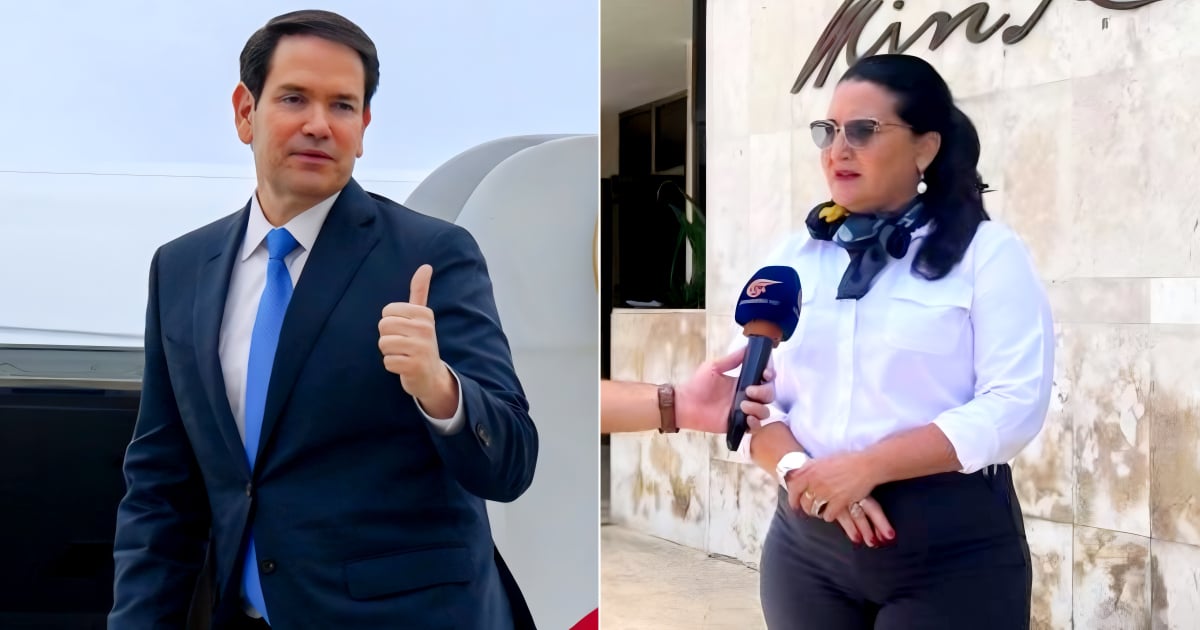
The recent controversy surrounding the statements of Johana Tablada de la Torre, a diplomat from the Ministry of Foreign Affairs of Cuba (MINREX) and recently appointed ambassador, has once again strained relations between Havana and Washington.
After admitting in an interview that Cuba can “buy all the chicken it wants” in the United States, the official faced strong criticism from the State Department, which labeled her a “puppet of the Cuban dictatorship”.
In a message shared on social media platform X, the Office of Western Hemisphere Affairs at the State Department stated that "Cuban regime officials now openly admit what we have always known: there is no blockade."
The text pointed directly at Tablada de la Torre, whom it cited as an example of the alleged contradiction of the Cuban government in acknowledging food purchases from the United States.
“The regime is what holds the country back. It is time for true economic freedoms for the Cuban people, not for companies run by security services,” the U.S. State Department added, in a statement that also included Prime Minister Manuel Marrero Cruz, regarding his plans to transform the island into a regional logistics hub for the Eurasian Economic Union.
The response of Tablada
Tablada de la Torre reacted strongly. In a lengthy message posted on Facebook, she accused Washington of manipulating her statements and creating a misleading narrative to "justify the economic war against Cuba."
Neither I, nor the President, nor any Cuban official has ever said that the blockade does not exist. This publication from an official U.S. media outlet is lying once again, in a very misleading and twisted manner,” he stated.
The diplomat denounced what she called a "media lynching" and stated that the U.S. government resorts to "distortion and absolute lies" to discredit officials from the island.
He also shared the full interview he gave to the official video podcast Alma Plus, where he clarified that, although the laws allow for the purchase of food in the North American market, these transactions are subject to "onerous" conditions and regulations that complicate trade.
" Cuba can purchase chicken from the United States, but under a prepayment scheme, with additional costs and financial restrictions that make these transactions much more complicated and expensive," he explained.
The economic background
The controversy erupts amid the supply crisis affecting the Cuban population. Chicken, the main product imported from the United States, is one of the most scarce staple foods on the island.
According to the Economic and Trade Council of the United States-Cuba, food and agricultural product exports to the island increased by 16.6% in the first half of 2025, reaching 243.3 million dollars.
In June alone, sales totaled 38.4 million, an increase of 10% compared to the same month in 2024. Fifty-four percent of these transactions corresponded to chicken meat, which remains the most in-demand product in the Cuban market.
These transactions are carried out under the framework of the Trade Sanctions Reform and Export Enhancement Act of 2000 and the Cuban Democracy Act of 1992, which authorize direct cash sales of food and agricultural products to the island.
While Havana maintains that the embargo remains a central obstacle to its finances and foreign trade, Washington argues that the real hindrance lies in the Cuban economic system, dominated by state and military enterprises that limit opportunities for citizens.
Political and narrative clash
The controversy reflects a long-standing point of friction between the two governments: the interpretation of the impact of the U.S. embargo.
For the Cuban regime, the sanctions policy constitutes an "economic war" that hinders any possibility of development.
For Washington, on the other hand, the embargo contains exceptions that prove that the causes of the island's economic collapse do not lie in the sanctions, but in the prevailing political model.
In his publication, Tablada thanked those who expressed solidarity by denouncing what he referred to as a "coordinated attack" against him.
However, the diplomat's words once again brought to the forefront the internal contradictions of the official discourse: while she acknowledges that Cuba can purchase large volumes of food in the U.S. market, she insists on blaming the embargo for the deep supply crisis affecting the country.
The media and diplomatic dispute between Tablada and the State Department adds a new chapter to the long-standing confrontation between Havana and Washington, against the backdrop of an increasingly deteriorated Cuban economy and a population that continues to suffer from shortages of basic goods.
Filed under: