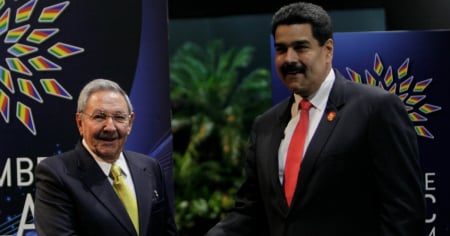
In the midst of a growing wave of public discontent over the recent tariff hike by ETECSA, the Cuban regime once again relied on political and military symbolism as a strategy to quell social pressure.
This Friday, Army General Raúl Castro Ruz reappeared at an official event accompanied by Miguel Díaz-Canel, where the promotion of the Minister of the Interior, Lázaro Alberto Álvarez Casas, to the rank of Army Corps General was announced.
Currently, three key figures hold the rank of Army Corps General in active service in Cuba, consolidating the core of military power: Álvaro López Miera, Joaquín Quintas Solá, and Roberto Legrá Sotolongo.
López Miera, Minister of the Revolutionary Armed Forces (FAR), is regarded as the main military strategist of the regime and one of Castro's most trusted men.
Joaquín Quintas Solá, at 86 years old, continues as deputy minister of the FAR and head of the Central Strategic Region, recently participating in exercises such as Meteoro 2025 and the Bastión drill. Roberto Legrá Sotolongo (70), chief of the General Staff, completes the trio of the high command of the Cuban regime's army.
The active presence of these three generals reflects not only loyalty to the Castro legacy but also the regime's commitment to maintaining a command structure based on loyalty, seniority, and tight control over the armed forces.
The event on Friday, held to mark the 64th anniversary of the Ministry of the Interior (MININT), is not a coincidence within the political calendar of the ruling elite. The reappearance of the historical leader of the so-called "Cuban revolution" aims to reaffirm, in front of an increasingly disenchanted citizenry, the image of traditional power as a guarantor of stability.
But beyond the military choreography, the rise of the minister responsible for security and internal repression is an unmistakable sign (sanctioned by the United States): the regime is reinforcing its coercive apparatus just when critical voices are growing, especially among university students and urban sectors affected by rising prices in telecommunications services.
A rise with a message
According to the National Television News (NTV), the promotion was granted due to “the results achieved by the Ministry of the Interior under his leadership, the level of preparedness and combat readiness attained by his forces, as well as their loyalty to the Party and the legacy of Commander-in-Chief Fidel Castro Ruz.”
In other words, military ranks are awarded for the repressive role that MININT plays in controlling social discontent, particularly at times when protests and public expressions of disobedience, although localized, have begun to resurface on the island.
During the ceremony, other high-ranking officials were also promoted, and a letter of congratulations signed by Raúl himself was read, reinforcing the regime's belligerent narrative.
The first colonel Hugo Morales Karell took the floor on behalf of those promoted and reaffirmed his loyalty to the Party and the defense of the "internal order."
Morales Karell, second in command of the General Directorate of the Revolutionary National Police, is a notorious repressor who has appeared on television threatening Cubans during times of widespread discontent and spontaneous protests.
Context of protests and social unrest
The backdrop of this institutional movement cannot be ignored. Since ETECSA announced its new tariff scheme — which effectively increases the cost of access to the internet and mobile phone services — university students, professors, and citizens in general have expressed their opposition on social media and, in some cases, in public spaces.
At the University of Havana and other educational institutions in the country, there have been student demonstrations demanding the repeal of the fare increase.
This phenomenon, unusual in the Cuban context, has raised concerns within the political apparatus and has been followed by an escalation of surveillance, summonses, and control by the MININT.
El régimen, fiel a su estilo, no responde con rectificaciones, sino con gestos de autoridad. La reaparición de Raúl Castro, cuidadosamente presentada como respaldo a la "continuidad revolucionaria", pretende proyectar fortaleza.
Meanwhile, the rise of Álvarez Casas serves as a reminder that those in power still have the tools they have developed over six decades of totalitarian rule to neutralize any hint of rebellion.
Legitimacy in Crisis
Although the Government strives to display cohesion and control, the social reality is becoming increasingly difficult to contain with symbols and military promotions.
Raúl's "prestige" no longer has the same effect on a young population that largely does not identify him as a political reference. Moreover, the use of force, rather than calming tensions, can become fuel for a citizenry exhausted by the economic crisis and the lack of freedoms.
The event this Friday makes it clear that the regime is not willing to yield to discontent; instead, it is doubling down on repression as a means of control.
But, in a Cuba where legitimacy erodes day by day, the return of the old dictator and the promotion of the repressive chief are nothing more than a sign of weakness disguised as strength.
Raúl Castro as a symbolic resource in times of crisis
In recent years, the Cuban regime has systematically relied on the figure of Raúl Castro to strengthen the image of "continuity" and stability amidst growing social discontent and economic crisis.
The most recent public appearance of Army General
These public appearances by the general are not coincidental, but rather part of a deliberate strategy to bolster the legitimacy of Díaz-Canel's government, whose popularity has been declining.
One of the most notable appearances occurred in January 2025, when Raúl participated in the traditional March of the Torches in Havana. His presence aimed to support Díaz-Canel in a context of food shortages, blackouts, and repression, which had led to growing social discontent and a massive exodus of young people and those of working age.
Previously, in December 2024, the general led the so-called "March of the Fighting People", organized by the regime amidst the serious crisis affecting the country.
The event, which was also attended by Díaz-Canel, was called to "condemn the economic blockade policy of the United States and Cuba's inclusion on the list of state sponsors of terrorism," but it also served as a show of strength in response to the growing public discontent.
These carefully orchestrated public appearances of the general of the army aim to project an image of unity and strength of the Cuban government in critical moments. However, for many Cubans, his presence highlights the regime's need to resort to historical figures due to the lack of popular support for the current leaders.
Filed under: