
Related videos:
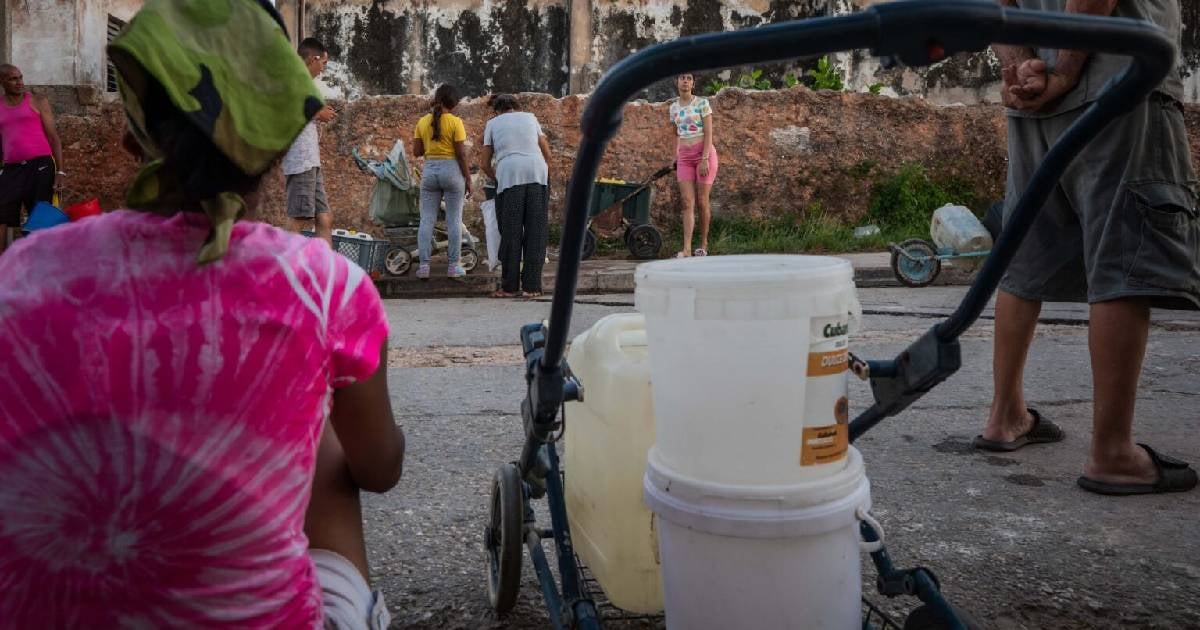
While authorities in Matanzas discuss future investments and “actions to mitigate” the water crisis, hundreds of residents turn to contaminated springs, recycled pumps, buckets with sensors, and private water tankers that charge up to 6,000 pesos to fill a tank.
The supply through official channels is inconsistent, inadequate, and in many cases, non-existent, acknowledged in an extensive report by the official newspaper Girón.
In areas such as Daoiz, San Severino, or Manzano, water has stopped flowing for weeks. Idanea Fernández explains that her husband, who was recently operated on, has to carry buckets from the springs of Pompón. “After that, we have to wait in line at the church or at the Seminary for drinking water. It’s a struggle and a considerable effort to dedicate hours to something that should be an essential basic service,” Fernández lamented.
Viviana, a resident of San Severino Alley, claims that the water truck was only sent twice in two months, while private services are unaffordable. Ariel, in Manzano, has to travel by motorcycle to Naranjal with 20-liter tanks to secure the essentials.
Others who provided their testimony, such as José Luis, choose to make their own devices to avoid wasting a single drop. His homemade turbine automatically activates when water enters a bucket, even if it comes in the early morning. Ángel, after 50 days without service, decided to report his situation on social media due to the silence of the Water and Sewer Company (EAA).
El Pompón, a spring renowned for its supposed purity, is now a source of contaminated water. According to specialists, this spring is receiving waste from septic tanks and poorly managed drainage systems. Although it appears clear, it is not safe for human consumption, even if boiled or chlorinated, as it contains hazardous chemicals.
Just like the famous spring, other sources of "escape" for some residents of Matanzas in light of the marked deficit of this vital liquid have been the rivers. “They are not even recommended for cleaning the house, because instead of cleaning, they might actually be making it dirtier,” pointed out Dr. José Evaldo Guerra, a specialist in the Department of Community Hygiene at the Provincial Center of Hygiene, Epidemiology, and Microbiology.
Hypochlorite, essential for water purification, is also in short supply. Although it is produced locally, distribution suffers from a lack of transportation and bottles. Pharmacies sell it for 1.00 CUP, but the bottle costs the company 4.50 CUP, leading to losses and limiting supply. As a result, "we request that the population, the CDR, and mass organizations cooperate in the recovery of bottles," said Dr. Pedro Tanquero Riaño, provincial director of Pharmacies and Optics.
Electrical "shots" are identified as the main cause of the instability in the pumping system. According to the EAA, just one minute without electricity can lead to an hour without water. Additionally, there is the collapse of the power network and the deterioration of equipment, many of which must be repaired resourcefully, without spare parts and with materials collected outside the province.
Meanwhile, the consumption of the Antonio Guiteras Thermoelectric Power Plant and the industrial zone has increased, exacerbating the shortages in residential areas. The city is also facing 91 registered leaks, some of which cannot be addressed due to the inability to stop the flow of water to key sectors such as industry.
The state water trucks, as acknowledged by the officials themselves, are insufficient. Their frequency is monthly in some areas, and in others, not even that. Sometimes hospitals and schools are prioritized, leaving entire communities without a single drop for weeks. District delegates have taken control of some water trucks to distribute based on need, but without enough fuel or a sufficient fleet, the effort is limited.
According to Antonio Hernández Martínez, delegate of Hydraulic Resources in the area, an investment is being made with the support of the French Development Agency, as part of a five-year contract. This includes new pumping equipment, valves, and improvements to the pipelines. However, its impact is not yet being felt in most homes. The Pastorita neighborhood will be the first to experience improvements, while others are left waiting without a defined timeline.
According to the news outlet, the company responsible for repairing the pumps —UEB Electromecánica— is dealing with constant breakdowns, a shortage of materials, and an incomplete workforce. At least two failures in the pumping system are reported each week. Repairs depend on the ability of local technicians to improvise solutions with minimal resources.
The Provincial Government also acknowledges that some citizens have drilled through the pavement to illegally connect to the system, which exacerbates the leaks and jeopardizes electrical networks. They promise "exemplary" sanctions, but no viable alternatives are presented to those affected.
Finally, new strategies are being implemented to protect areas with pumping or booster stations using electricity, such as MI1451, which benefits Armando Mestre. The situation at the Kilometer "involves an increasingly inequitable distribution of energy in the province, with outages exceeding 20 hours daily in non-prioritized circuits," emphasized Girón.
The province of Matanzas is facing one of its worst water supply crises in years, with pumping equipment out of service, collapsed hydraulic networks, constant blackouts, and an infrastructure at its limit despite being, ironically, a territory with abundant groundwater reserves.
In a city where a family of four requires nearly 5,000 liters of water per week, survival has become a test of endurance. In Matanzas, water has ceased to be a public service. It is now a privilege, a daily struggle, and for many, a health risk.
Frequently Asked Questions about the Water Crisis in Matanzas
What is the current situation of the water supply in Matanzas?
The water supply situation in Matanzas is critical. The official provision is inconsistent, deficient, and even nonexistent in many areas. Residents have to resort to alternative solutions such as contaminated springs and expensive private water trucks, as the distribution system is severely affected by power outages, malfunctioning pumping equipment, and collapsed hydraulic networks.
Why are the springs in Matanzas contaminated?
The springs like El Pompón, which were once considered pure, are now contaminated due to septic tank waste and poorly managed drainage. Even by boiling or chlorinating the water, it is not suitable for human consumption due to the presence of hazardous chemicals.
What are the main causes of the water crisis in Matanzas?
The water crisis in Matanzas is due to a combination of factors, including the collapse of the pumping system due to power outages, the shortage of hypochlorite for water purification, and a deteriorating hydraulic system. Additionally, excessive water consumption by the Antonio Guiteras Thermoelectric Plant worsens the situation in residential areas.
What measures are being taken to improve the water supply in Matanzas?
According to the authorities, investments are being made with the support of the French Development Agency to improve the water distribution system, including the installation of new pumping equipment and valves. However, the impact of these improvements is not yet felt in most households, and access to water remains a daily issue for many residents.
Filed under: