
Related videos:
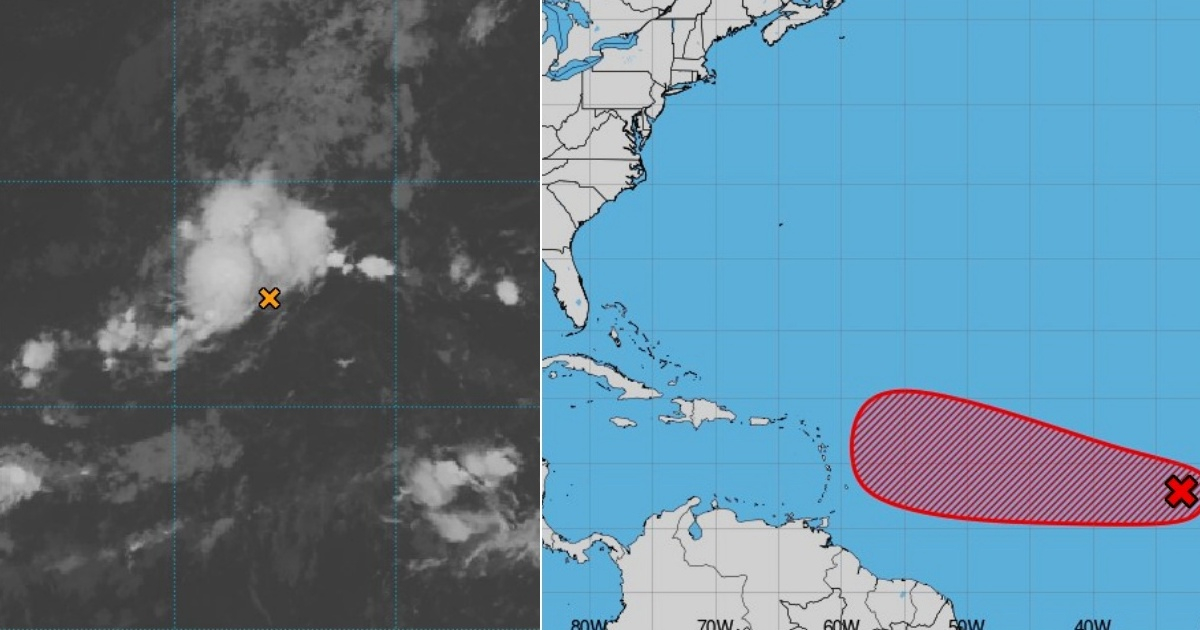
The National Hurricane Center (NHC) has raised the chances of development for a tropical wave that is slowly moving through the eastern Atlantic toward the Caribbean.
The system, which in recent days showed scattered signs of organization, has begun to consolidate and presents an increasingly favorable scenario for it to transform into a tropical depression.
The most recent official report from the NHC estimates a 50% chance of cyclonic formation in the next 48 hours.
The odds increase to 80% within a span of seven days, making this system the disturbance with the highest development potential in the Atlantic basin at the moment.
According to the latest report from the NHC, the tropical wave is located several hundred miles west-southwest of the Cape Verde Islands.
In the satellite images, an increase in areas of rain and thunderstorms is observed, indicating that the atmospheric circulation associated with the phenomenon is gaining strength.
Experts warn that the environment is conducive to the disturbance continuing to strengthen.
Factors such as warm ocean temperatures, low wind shear at high atmospheric levels, and the presence of humidity in the region provide the necessary conditions for cyclonic development.
Short- and medium-term forecast
NHC meteorologists estimate that a tropical depression could form by the end of this week, as the system slowly moves to the west-northwest at a speed of between 5 and 10 miles per hour (8 to 16 km/h).
Subsequently, the phenomenon is expected to accelerate its movement towards the west or west-northwest, which would lead it towards the waters located east of the Lesser Antilles by the middle of next week.
This means that the islands of the Caribbean arch must remain alert to its development, as it could approach with greater organization and strength in the coming days.
This announcement is set against a backdrop of a hurricane season that has already demonstrated a high level of activity.
The central and eastern tropical Atlantic is one of the most closely monitored regions by specialists, as many of the cyclones that develop there often strengthen into storm or hurricane force before approaching the Caribbean and North America.
Meteorologists reiterate that it is still early to determine the intensity this system could reach or whether it will directly impact any Caribbean territory.
However, the current conditions serve as a reminder of the need for constant vigilance and the importance of preparedness plans in the region.
The current hurricane season in the Atlantic is at its most active stage. In fact, September has historically been a critical month for the impact of hurricanes in Cuba.
In recent days, Cuban meteorologist Christian Jesús Muñiz Carrillo recalled that between 1950 and 2023, nine hurricanes made landfall on the island during September, including the powerful Ike (2008), Irma (2017), and Ian (2022).
Irma holds the record as the only Category 5 hurricane to have impacted Cuba with that intensity.
Filed under: