
Related videos:
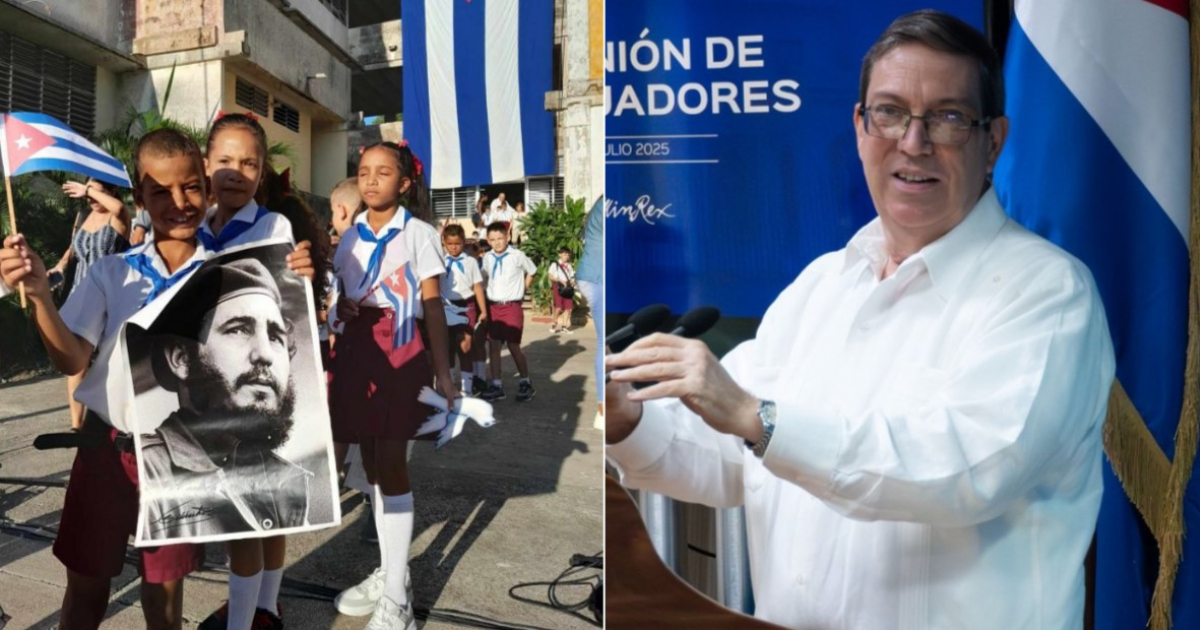
The Cuban regime's chancellor, Bruno Rodríguez Parrilla, said that "joy floods the Cuban schools" as the new school year begins this Monday in the island.
“Today, joy floods Cuban schools once again. The new school year begins, with more than 1,530,000 students from different levels of general education joining,” he stated on his X account.
"We extend a special welcome to the students of ISRI, whom we wish success," he wrote, referring to the Higher Institute of International Relations that trains the regime's diplomats.
While the Cuban regime insists on presenting each school year as a "victory of the Revolution," families on the island experience a very different reality, characterized by material precariousness and uncertainty.
The return to school, which should be a source of excitement, has become for many parents an obstacle course that reveals the deep cracks in the educational system.
In secondary school classrooms, a notebook must serve for two subjects. This practice, officially dubbed "adjusted norm," requires splitting notebooks in half or dividing their pages—a measure intended to mask the shortage of supplies, which ultimately has a direct negative impact on students' learning.
Those who cannot afford the nearly 200 pesos that a notebook costs on the black market must resign themselves to this makeshift measure.
The issue of uniforms is not minor. The state managed to produce only 2.3 million of the 3.6 million pieces needed, which means that barely 20 percent of students will have new clothing for this school year.
The rest will have to reuse inherited uniforms, patched ones, or those bought at exorbitant prices: in the informal market, a set can exceed 5,000 pesos, an amount that exceeds the budget of most households.
The school infrastructure is not spared from the crisis. Thousands of schools opened their doors under deplorable conditions, with roofs that leak, broken windows, and insufficient furniture.
There are plenty of scenes of students sitting on the floor due to a lack of desks or classes that are interrupted by power outages, with teachers and students forced to conduct lessons in dim light or wait for the arrival of a generator.
The shortage of teachers further exacerbates the situation. Matanzas, for example, started the school year with more than 2,000 vacant positions, and nationally, there is a lack of about 24,000 teachers, which amounts to one out of every eight positions unfilled.
Low salaries, professional burnout, and migration to other sectors have left classrooms in the hands of insufficient staff, and in many cases, without the proper training.
The so-called "free education" has become a heavy burden for families. A primary school notebook can cost up to 1,400 pesos in a private store, an unaffordable amount for most. Additionally, there are backpacks, shoes, snacks, and other expenses that turn each school year into a financial ordeal.
Amid the triumphalist discourse of the regime and the epic narratives crafted by state media, which speak of “rivers of innocence” and “silent deeds,” lies the true story of September: that of parents battling inflation and scarcity so their children can attend school with the bare necessities.
This is the other side of the start of the school year in Cuba, the one that propaganda never shows.
Frequently Asked Questions About the Start of the School Year in Cuba 2025
How does the "adjusted norm" affect the Cuban educational system?
The "adjusted standard" implies that students must share a single notebook between two subjects, which reveals the precariousness and lack of basic supplies in the Cuban educational system. This measure directly affects students' learning and reflects the deep cracks in the educational system on the island.
What is the situation with school uniforms in Cuba?
The State only managed to produce 2.3 million of the 3.6 million necessary items, which means that only 20% of students will have new clothing for this school year. The rest will have to reuse inherited uniforms, patched ones, or those purchased at exorbitant prices on the black market.
How does the teacher shortage affect education in Cuba?
The teacher shortage in Cuba is significant, with 24,000 vacancies nationwide, which equates to one in every eight positions unfilled. This negatively affects the quality of education, as classrooms are managed by insufficient staff, often lacking proper training.
What challenges do Cuban students face at the beginning of the school year?
Cuban students face numerous challenges at the beginning of the school year, including the shortage of basic materials such as notebooks and uniforms, deteriorated infrastructure, blackouts, and a critical shortage of teachers. These factors make the return to school a financial and emotional burden for families.
Filed under: