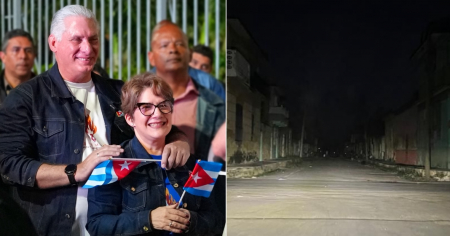
The Cuban user @gelylaflaki shared a new video on TikTok in which she ironically and resignedly describes how blackouts are an inseparable part of the daily routine for those living on the island.
"The first thought of a Cuban when going to bed and when waking up is the same: what time will they cut off the electricity?" she says at the beginning of the video, accompanied by her young daughter. "Well, of a Cuban still here on the island," she clarifies.
The young woman recounts how she even tries to check the blackout schedules, although she admits she no longer trusts them: “You see, I'm one of those people who checks the schedules to see when the power will be cut, but I don't even look at that anymore because in the end, they turn it off whenever they want.”
It also recalls a conversation with a relative in the United States, who mocked the phrase "it's our turn," referring to the scheduling of power outages: "He, laughing hysterically, says: ‘Oh, so it’s your turn because of the ration book?’”
The impact of blackouts has become a part of daily life, as noted, "Cubans right now are looking for money, bringing things from other countries to sell here. There are three essential items... well, two: portable chargers, portable fans, and generators.”
"My life, because Cubans are good people, but one thing we do sometimes is take advantage," he adds while discussing the speculation on basic necessities. "They lose the bread and sell it to you for 500... they don’t just double the price, they triple it, and it’s the same with eggs and everything else."
The post has generated multiple reactions from Cubans both inside and outside the country. While some users share messages of support and solidarity, others express disbelief at the magnitude of the energy crisis. “It's a very sad reality,” comments one internet user. “They already let you have the girl on live,” asks another, concerned about the exposure of minors on social media. From Venezuela, one user writes: “We are living that, they cut off our electricity all the time, but we have faith that everything will change.”
This new testimony adds to another video in which she states that many times she has had to only give rice to her daughters and mentions that she has had to forgo snacks, toys, and basic necessities in order to prioritize food and electricity.
He also described how it has become normal to rely on electric stoves, portable fans, or charcoal, and to live amidst power outages and water cuts: “You have electricity but no water; the power goes out and the water comes back… it's absolutely crazy."
The user also shared the difficulty of accessing foods like eggs: “Before, eggs were a common item, but now not everyone can eat them, my life.”
These testimonies reflect a widespread reality: the combination of prolonged blackouts, inflation, food shortages, and general precariousness, which forces millions of Cuban families to reorganize their daily lives based on the available electricity and to prioritize survival above all other needs.
Frequently Asked Questions about Power Outages and the Energy Crisis in Cuba
What is the current situation of blackouts in Cuba?
The situation of blackouts in Cuba is critical and affects millions of families on the island. Power outages are frequent and prolonged, lasting up to 40 hours in some areas. The uncertainty about when electrical service will be restored is a constant in the daily lives of Cubans.
How do blackouts impact the daily life of Cubans?
Power outages deeply impact daily life in Cuba, forcing families to reorganize their activities based on the available electricity. Power cuts make essential tasks such as cooking, food storage, and resting difficult, especially in homes with small children and the elderly. Furthermore, the scarcity of resources and rising prices further exacerbate the situation.
What solutions or alternatives are Cubans using to cope with power outages?
To cope with power outages, Cubans have turned to practical solutions such as the use of generators, portable chargers, and rechargeable fans. Additionally, the use of charcoal stoves has become an alternative for cooking in the absence of electricity. However, these solutions can be expensive and are not accessible to everyone.
What measures has the Cuban government taken to address the energy crisis?
The Cuban government has announced renewable energy projects, such as the inauguration of solar parks, but the population has not noticed significant improvements in electricity supply. The lack of fuel, the deterioration of energy infrastructure, and insufficient maintenance continue to be critical unresolved issues.
Filed under: