
Related videos:
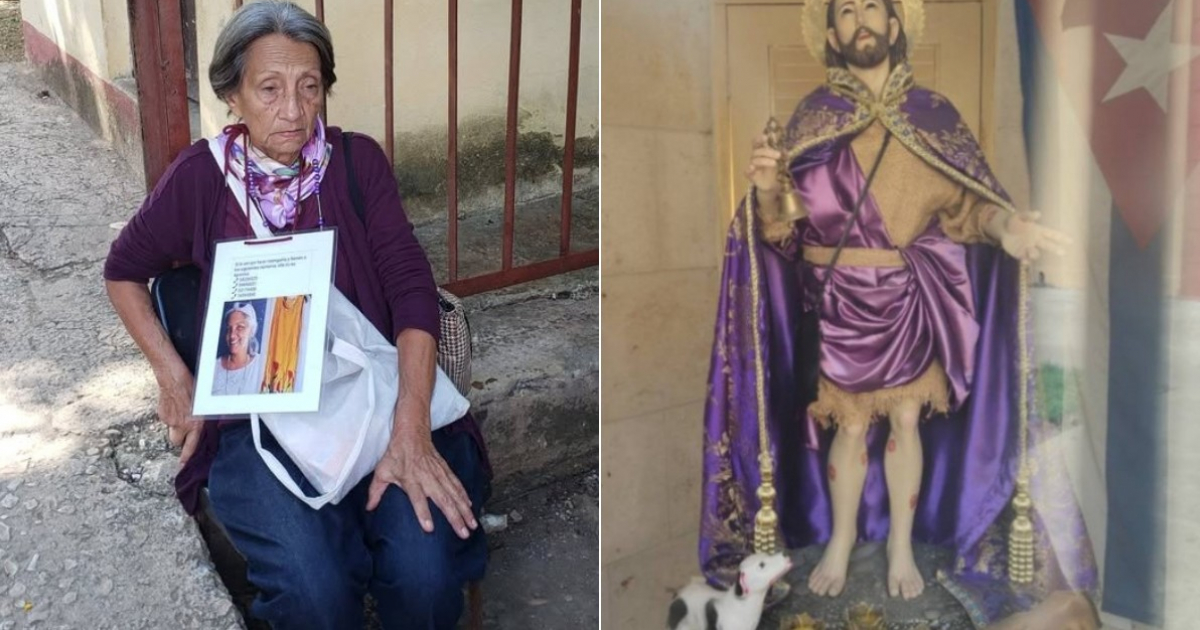
The image speaks for itself: a woman with a shattered heart, carrying a sign on her chest that bears the face of her missing daughter.
That woman is Maura Vázquez, mother of Doraiky Águila, who this week embarked on a visit to the National Sanctuary of San Lázaro, in El Rincón, with the hope that faith will illuminate the path that leads her to reunite with her daughter.
His presence there was shared on Facebook by user Damián Rodríguez Consuegra on social media, who called for solidarity to "provide a small grain of hope to a mother who is searching tirelessly."
Maura arrived at a place considered one of the most significant spiritual spaces for Cubans, where thousands of believers pilgrimage each year to give thanks or request what they feel is impossible to achieve through other means.
With her daughter's photo pinned to her chest, the woman carried only one plea: that a miracle happens and Doraiky returns home alive.
Her visit, shared and replicated on social media, symbolizes the persistence of a mother who has not given up for a single day since her daughter's disappearance.
"Poor lady! You can see the suffering on her face; may God and the miraculous Saint Lazarus grant a miracle and her daughter appear soon," commented a woman from Havana on the post.
"The old man Lázaro will guide you on the path so you can find your daughter, Saint Lázaro is powerful," another one affirmed.
Doraiky Águila Vázquez disappeared on March 15 in Havana. Since then, there have been no official reports explaining what happened, where she might be, or if there is any real progress in the investigations.
Her mother has not only searched for her on the streets; she has also taken her plea to every available space on the Internet.
In October, seven months after the disappearance, Maura wrote on Facebook: "My great fortune would be to find my daughter. I urgently ask for help." Her words were shared by neighbors, strangers, and users who insist on not letting the case be forgotten.
In another of her messages, the elderly woman described the helplessness of the daily search, in which she, Doraiky's husband, and other family members combed entire areas without finding any leads. She cried out for divine and human help, pleading for the chance to embrace her daughter again.
Later, his call became a cry directed at the entire population: "Search every house, every neighborhood, every province. It’s about saving a life, a family."
Relatives reported that Doraiky is the mother of two children, has tan skin, gray hair, and hazel eyes.
She has a medical condition that requires attention and suffers from episodes of transient memory loss, a detail that has heightened the distress of those who love her.
In fear that her life may be in danger, her family offered a reward of 350,000 CUP to anyone who provides verifiable information about her whereabouts.
The pain has intensified as they are forced to confront rumors and misinformation.
In early October, reports circulated claiming that Doraiky had been found deceased. The family promptly denied that content to stop the damage caused by speculation and sensationalism.
In the face of official silence, relatives have turned to feminist collectives and civic networks. The organization Yo Sí Te Creo en Cuba and the Gender Observatory of Alas Tensas activated the Alerta Yeniset, a mechanism used in prolonged cases of missing women.
However, although these groups help to raise awareness, they do not have the legal capacity to investigate. The responsibility falls on state institutions, and the response has been painfully slow.
Despite the fact that the state media mentioned the case in July, there is no evidence of any real progress.
The family asserts that the investigation has not yielded concrete results, and that, without public assistance and social pressure, cases like Doraiky's run the risk of fading into silence.
That’s why Maura insists. That’s why she walks, pleads, traverses neighborhoods, knocks on doors, shares posts, corrects rumors, and keeps imploring again and again.
And now, she also becomes a pilgrim. She knows that when institutions operate slowly and without resources, the people become a network of search.
In a country where many families have found social media to be their only tool for seeking help, Maura relies on faith and collective solidarity.
"My life is slipping away while I wait for my daughter", she wrote a few days ago.
That wait, which is now measured in months, is what led her to the Rincón. There, where thousands ask for miracles, she left her own at the feet of San Lázaro: that Doraiky return home.
Filed under: