
Related videos:
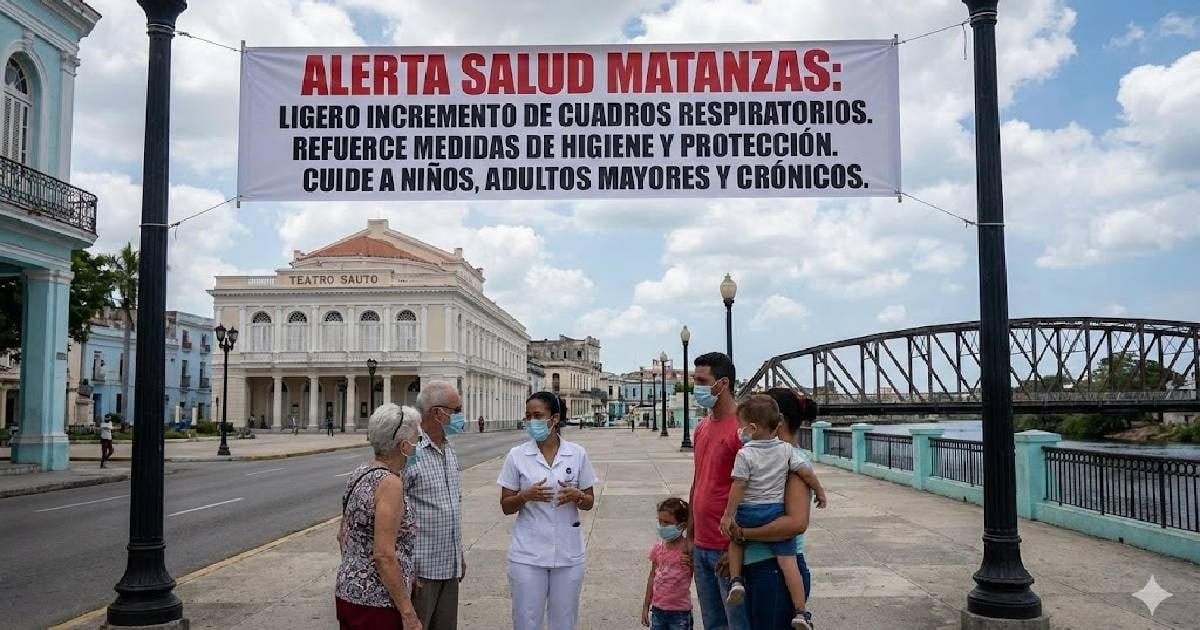
While Cuban hospitals continue to operate amidst shortages, a lack of resources, and increasing pressure on healthcare services, the government insists on conveying a sense of calm in the face of rising respiratory illnesses and other ailments affecting the population.
The official version, released by the newspaper Girón, once again employs an optimistic tone that contrasts sharply with the reality of a deteriorating healthcare system and a population living without basic medications, with assistance centers in ruins, and an exhausted and reduced staff.
In his post on Facebook, Girón stated that there is "strict monitoring" in Matanzas regarding the recent increase in respiratory diseases, citing Andrés Lamas Acevedo, director of the Provincial Center for Hygiene, Epidemiology, and Microbiology.
According to the official, although there has been an increase in recent weeks, "the figures remain below the number of cases handled in consultations last year" and the province "is not in an epidemic."
Nevertheless, he assured that the care centers are "preparing" for a possible increase in patients.
The message seeks to project control at a time when many Cubans are denouncing the lack of responsiveness of the healthcare system.
Amid structural deterioration and a shortage of supplies, the idea of "preparation" becomes difficult to reconcile with overcrowded hospitals, clinics without staff, and a population experiencing weeks of symptoms without access to adequate treatments.
Vaccination for children and older adults, but without clarifying actual availability
Lamas Acevedo explained that children between 6 months and 6 years old are currently being vaccinated against the flu, a process that includes about 19,000 minors.
Adults over 75 years old are also being vaccinated in nursing homes and psychopedagogical centers, prioritizing individuals with comorbidities.
Although the note highlights that the vaccine does not prevent common colds but reduces the risk of severe pneumonia, it does not mention whether there is sufficient availability to cover all vulnerable groups in a province with serious logistical and supply issues.
Decrease in dengue, according to the government, but persistence of health risks
The official also stated that reports of suspected fever cases of arboviral infections show a "notable decrease," dropping from 5,240 cases at the peak of the epidemic to just 266 last week, figures that the outlet presents as a health achievement.
He also stated that dengue reactivity has decreased, attributing the decline to health measures, the community, the authorities, and temperature changes.
However, the decrease in cases does not erase the precariousness experienced in neighborhoods where fumigation is inconsistent, where there are not enough resources, and where solid waste accumulates for weeks.
Lamas Acevedo himself acknowledged a setback in waste collection due to a fuel shortage, a factor that increases infection hotspots and has already resulted in cases of Hepatitis A in Matanzas and Jagüey Grande. The executive warned that these risks could trigger a larger outbreak.
The official statement celebrates the use of a "sprayer with significant residual effect" for blocking fever cases, without mentioning that the actual fumigation capacity is limited and that the population has been reporting irregularities in the service and a lack of follow-up in vulnerable areas for months.
Clinical trial with Jusvinza in Matanzas amid the healthcare collapse
Alongside the increase in respiratory diseases and arboviral infections, the Government has started a clinical trial with the medication Jusvinza, developed by the Center for Genetic Engineering and Biotechnology (CIGB) in Matanzas, to assess its efficacy against the joint sequelae of chikungunya.
The study began at the Comandante Faustino Pérez Provincial Clinical Surgical Hospital and includes 120 patients aged between 19 and 80 years with a confirmed diagnosis of chikungunya and residual polyarthritis lasting more than three months.
The volunteers were divided into two groups: one that will receive Jusvinza in addition to conventional treatment and another that will continue only with standard therapy. The plan includes nine subcutaneous doses over six weeks, administered on an outpatient or inpatient basis.
The drug—a peptide anti-inflammatory authorized for emergency use during the COVID-19 pandemic—has been described by the director of CIGB, Dr. Eulogio Pimentel, as safe and potentially useful for chronic inflammatory diseases.
Researchers expect a clinical improvement of over 70% in treated patients. If these results are achieved, the use of the medication could be expanded to more cases of post-viral polyarthritis.
A valuable essay, but insufficient in light of the magnitude of the crisis
Although the study with Jusvinza represents a significant scientific effort, it comes at a critical moment.
Matanzas—and Cuba in general—is simultaneously confronting the active presence of chikungunya, dengue, and Oropouche, while thousands of people lack access to diagnostics, pain relievers, and basic preventive measures.
The trial once again demands a leading role from Cuban biotechnology, but it also highlights the gap between high-level research and a healthcare system that fails to meet the most basic needs of the population.
The lack of transparency in official reports and the opaque handling of epidemiological data amplify public distrust at a time when many families are experiencing illness without institutional support.
A weary country awaits real answers
The official discourse insists on highlighting small victories but avoids acknowledging the structural deterioration of the healthcare system and the actual scale of the diseases that are currently spreading in the country.
While Girón speaks of "strict monitoring," citizens face endless lines to obtain antibiotics, clinics without doctors, uncontrolled mosquitoes, and an epidemic that the government itself has had to acknowledge, albeit without clear or verifiable figures.
Matanzas may be "below last year," as stated in the government publication, but the population is below its capacity for resilience.
In a context where preventable deaths, recurring infections, and institutional neglect affecting millions are accumulating, triumphalist statements do not alleviate the precarious situation: they only highlight the gap between the official narrative and the reality of the country.
Filed under: