
Related videos:
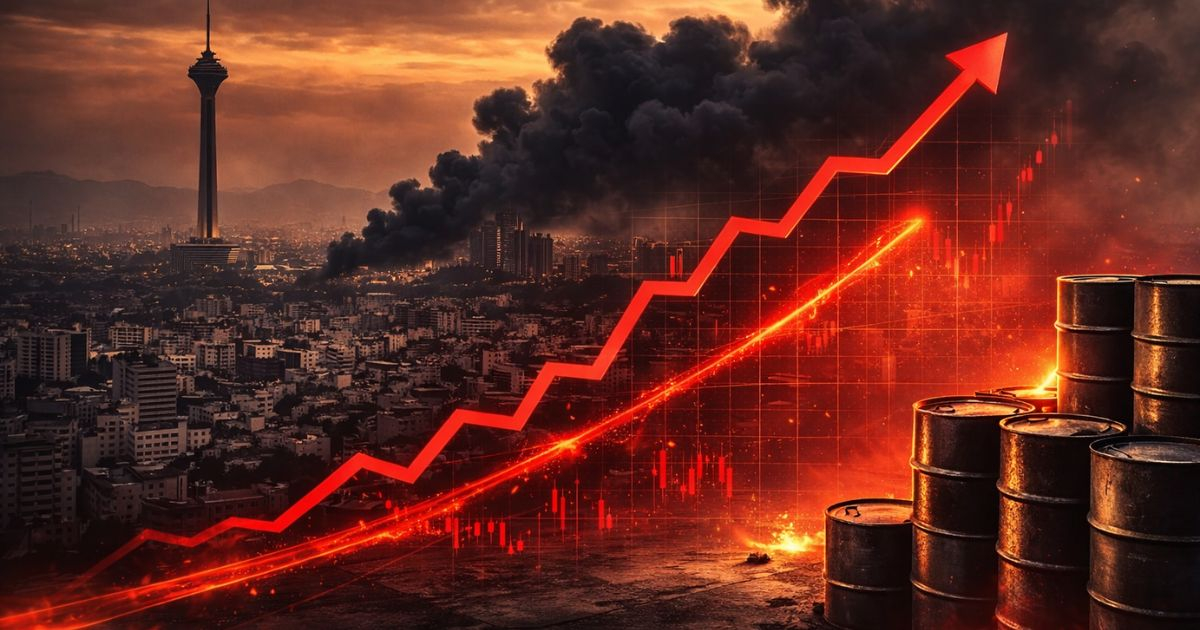
The joint attack by the U.S. and Israel against Iran on Saturday, February 28, is shaking global energy markets.
Brent, the global benchmark for crude oil, closed on Friday, February 27, at $72.87 per barrel, already incorporating a geopolitical risk premium of between $4 and $6 due to tensions with Iran, according to analysts from Mirae Asset Sharekhan. Futures linked to oil on decentralized platforms that operate over the weekends have already risen more than 5% following the announcement of the attacks.
But the worst may be yet to come. The Iranian Revolutionary Guard issued a radio warning to ships in the Hormuz Strait: "No vessel is permitted to pass." Although Iran has not formally confirmed the closure, the mere announcement has raised all alarms. Through this strait, between Iran and Oman, around 20 million barrels per day transit, equivalent to 20% of global crude oil consumption and a fifth of the world's liquefied natural gas.
The Swiss bank Lombard Odier estimates that a prolonged blockade of the strait could push the price of oil above 100 dollars, while some cryptocurrency traders are already considering scenarios of 120 to 150 dollars in the event of a total shutdown. According to strategist David Roche from Quantum Strategy, if the conflict turns into a regime change campaign lasting three to five weeks —as hinted by Trump— the markets would "react very poorly."
Analysts from OilPrice.com agree that a significant "war premium" will be incorporated into crude oil when markets open in Asia on Sunday night. A flight to safe assets is also expected: an increase in the dollar, gold, and a decrease in global stock markets by between 1% and 2%, according to CNBC.
Iran, in addition to controlling the Strait of Hormuz, is the fourth largest producer in OPEC and exports around 1.5 to 1.9 million barrels per day, mostly to China. According to Axios, markets will be particularly attentive to whether the conflict affects the terminal on Jarg Island, through which nearly all of Iran's exported oil flows. In fact, data from RSM shows that exports from Jarg tripled in the second half of February, reaching 3 million barrels per day, in what appears to have been an Iranian attempt to maximize sales before an anticipated conflict.
The direct impact on Cuba: more blackouts, more hunger, more crises
For Cuba, which is already experiencing the worst energy crisis since the "special period" of the 1990s, the escalation in the Middle East is another blow to an economy in freefall.
The island needs about 110,000 barrels of oil daily to function and only produces around 40,000. Following the fall of Maduro and the cut of Venezuelan oil, along with the blockade from Washington on any oil shipments to the island, Cuba has stopped receiving imported oil. Mexico, under pressure from Washington, has also halted shipments. President Díaz-Canel acknowledged that the island has not received a single barrel of foreign crude in 2026 so far.
The consequences are already devastating. According to data from the Union Eléctrica itself, blackouts leave up to 64% of the island without electricity simultaneously, with outages lasting up to 20 hours. Eight of the 16 thermoelectric units are out of service and distributed generation — which provided 40% of the electricity — has been halted since January due to a lack of fuel. A Bloomberg analysis using satellite images reveals that nighttime lighting in eastern provinces such as Santiago de Cuba and Holguín has decreased by 50%. The workweek has been reduced to four days, universities have shifted to virtual mode, airlines like Air Canada have suspended flights to the island, and Germany has advised against all non-essential travel.
In that context, oil priced at 100 dollars or more has several direct implications for Cuba:
It makes any energy rescue more expensive. If Russia or any other country attempted to send oil to Cuba in defiance of Washington's pressures, the cost per barrel would be significantly higher. China has approved 80 million dollars in aid and rice, but has not sent oil. Russia promised crude oil, but the shipments have not materialized. Every dollar that the barrel rises makes any rescue operation more difficult and costly. Ironically, a report from the U.S. government revealed that Cuba resold 60% of the oil it received from Venezuela, sending about 40,000 barrels daily to Asia while its people suffered blackouts.
Impact on remittances. A oil shock fuels global inflation, reduces the purchasing power of the Cuban diaspora, and, as a result, the volume of remittances flowing to the island—one of its few sources of foreign currency.
Tourism is suffering even more. Cuba has already seen a decline of more than 40% in arrivals of Cubans from the U.S. in January 2026, according to figures analyzed by CiberCuba. With flights canceled due to a lack of jet fuel, hotels closed, and now a war that may increase airfares globally due to rising aviation fuel costs, the 2026 tourist season is practically over.
Weaken the regime's alliance axis. Iran is one of the most important geopolitical partners of the Cuban regime. Venezuela has already fallen. If the Iranian regime wobbles or collapses, Cuba loses another pillar of its network of alliances, which includes Russia—mired in Ukraine—and China, which offers symbolic help but no oil. As we analyzed in CiberCuba, each ally that the Cuban dictatorship loses leaves it more exposed and isolated. Meanwhile, even the UN has requested a humanitarian exemption to send oil to Cuba, a sign of the extreme seriousness of the situation.
What comes next?
It all depends on the duration of the conflict and the Strait of Hormuz. If the attacks are brief and the strait remains open, markets could stabilize quickly, as happened during the Twelve Days War in June 2025. However, if the operation extends for weeks —as suggested by Pentagon sources to CNBC— and the strait is effectively closed, the world will face the largest oil crisis in decades.
For the 11 million Cubans who already cook with firewood, light their homes with candles, and wait in long lines for hours to get gasoline, the war against Iran is not a distant conflict. It is another twist in a crisis that has already pushed them to the brink.
This is a developing story. The information will be updated as new data about the markets and the conflict is confirmed.
Filed under: