
Related videos:
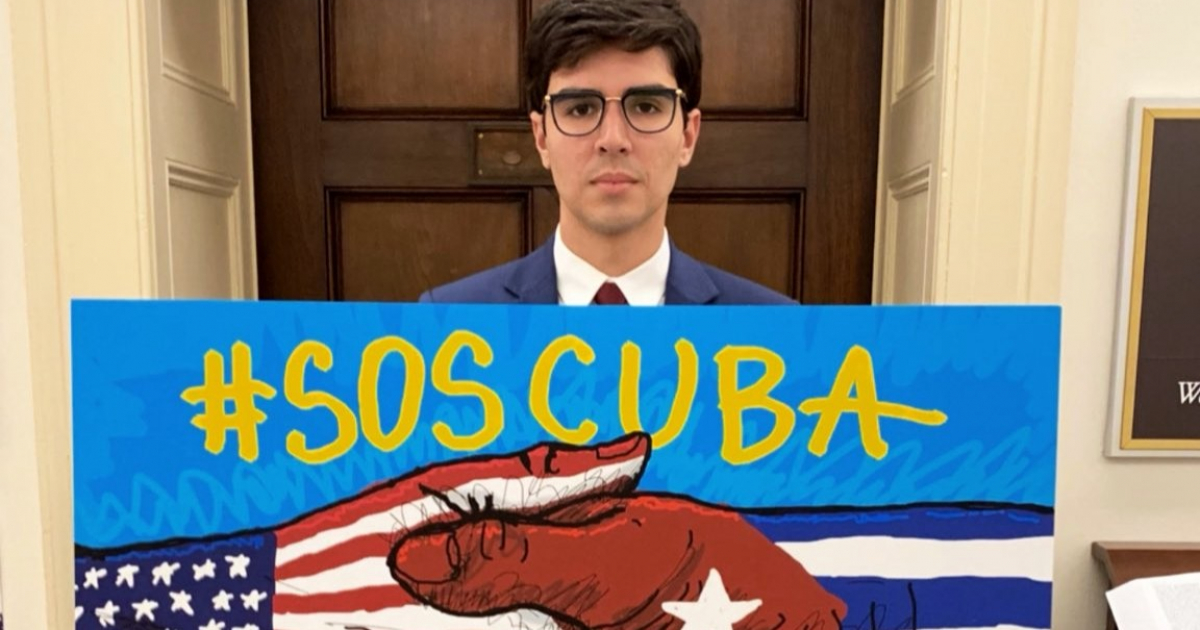
The Miami political consultant Rey Anthony, grandson of four Cuban exiles, stated that his identity and public vocation are deeply connected to his family's history and the exile that has affected several generations of Cubans.
Anthony, who recently took on the role of chief of staff for federal congressman Carlos Giménez, spoke with the agency CubaNet about his political journey, his childhood in South Florida, and the significance of Cuba in his personal life.
In the interview, he stated that "being Cuban makes me a better American," a phrase that encapsulates, as he explained, how his cultural heritage and his experience in the United States intertwine.
In a message posted on the social network X, Anthony also expressed the connection he feels to the Island despite never having visited it.
"I am the grandson of four Cuban exiles. My earliest memories are of Cuba, a place I have never been to, yet it is so deeply rooted in the essence of who I am," he wrote.
In the same message, he added that if one day it is possible to visit "a Cuba free from the regime," it will be thanks to President Donald Trump and Secretary of State Marco Rubio. "Liberators," he said.
An ascending political trajectory
Anthony's appointment as chief of staff for Giménez consolidates a political career that, despite his youth, has included significant positions in Washington and Florida.
Before taking on this role, he served as the senior advisor to Senator Ashley Moody. He was also the director of public affairs for the Florida Attorney General's Office and the communications director for Congresswoman María Elvira Salazar.
From her new position, she participates in coordinating the legislative and political work of Giménez's office, which includes community outreach, management of federal issues, and monitoring matters related to national security, border policy, and the role of international actors in Cuba.
"It is an immense honor to be the chief of staff for a federal congressman like Carlos Giménez," he stated.
"I am from Pinar": identity and family roots
Anthony insists that his identity is not defined solely by his professional career, but by his family's history.
"I say this with great pride: I am from Pinar del Río. I was born in Miami, but I am from Pinar," he said when discussing his roots in the province of Pinar del Río.
According to his account, he comes from a family of farmers and teachers. The women in his family dedicated themselves to teaching, while the men worked the land, growing fruits and vegetables.
He grew up listening to those family stories and, over time, he understood the weight of the exile that his grandparents experienced.
"I am deeply proud to be the grandson of four exiled Cubans," he stated.
The memory of exile
During her childhood, Cuba was a constant topic in family conversations.
Anthony recalls that his grandparents often reminisced about life in the countryside of Pinar del Río, the tropical fruits, and the everyday life before the 1959 revolution. As he explained, those stories were a natural part of family life.
"Cuba was a daily topic, sometimes without them even realizing it," he commented.
He also revealed that one of his grandparents was a political prisoner, a fact he learned about when he was a child. Those stories allowed him to understand over time the harsh circumstances that led his family into exile.
Political vocation from a young age
Anthony claims that his interest in politics emerged very early on.
As he explained, he was always an inquisitive person with an interest in understanding how government decisions are made. Over the years, he realized that instead of merely criticizing, he should get directly involved in the political process.
The situation in Cuba, the stories of his grandparents, and the experience of exile also led him to view politics as a means of active participation.
Cuba as a personal cause
For Anthony, the issue of Cuba is not an abstract or distant matter.
The political advisor explained that he is particularly motivated by the young people on the Island who are raising their voices against the regime. He stated that it is painful for him to see people of his own generation living without the opportunities he had in the United States.
"It hurts me to see young people like myself... living under a cruel dictatorship that humiliates the people," he stated.
He also emphasized the emotional impact that the inability to return to Cuba for decades has had on his family.
He recalled that, while other Latin American families traveled regularly to their countries of origin, his family did not have that option. "We were never able to go back," he emphasized.
Personal dreams and political commitment
Despite the advancements in his career, Anthony insists that his greatest dream is of a personal nature.
The political advisor stated that he wishes to one day travel to Cuba with his grandparents to complete the family circle and walk through the places they knew.
Meanwhile, he assures that he maintains an optimistic outlook despite the frustration caused by the lack of freedoms on the Island.
"The hardest part is seeing that, after 67 years, Cuba is still not free," he commented, although he added that he doesn't lose hope.
When discussing her cultural identity, she emphasized that Miami represents an extension of Cuban culture.
"Miami is Cuba. It is the seventh province," he stated, before summarizing his personal vision with the phrase that titles the interview: "Being Cuban makes me a better American, and being American will make me a better Cuban when the day comes to rebuild our Island."
Filed under: