
Related videos:
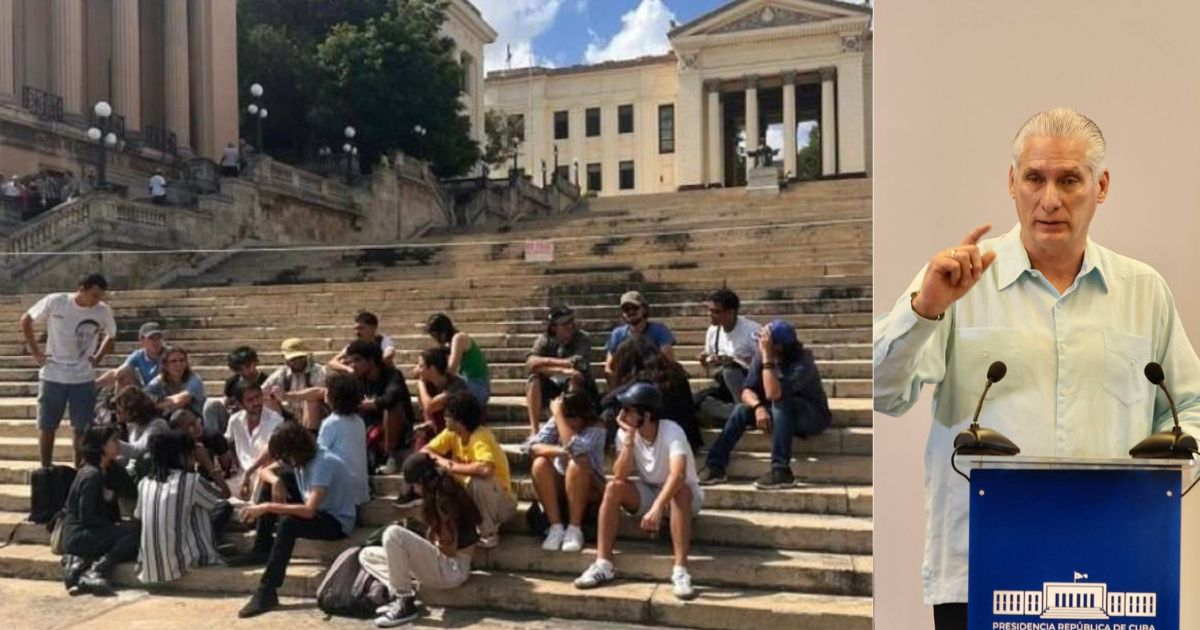
Cuban President Miguel Díaz-Canel stated that the country's universities must adapt to the energy crisis through semi-in-person modalities and reorganization of the teaching process in community settings, requiring more sacrifice and effort from both teachers and students.
During his appearance on March 13, Díaz-Canel addressed the complaints and dissatisfaction of students and families regarding the continuation of the semester amid blackouts and fuel shortages, attributing the problems to the impact of the U.S. "energy blockade."
The official detailed that the situation impacts the functioning of schools and universities due to the lack of electricity, the difficulties in transporting teachers and students, as well as the challenges in ensuring food supplies and the use of technology in the educational processes. "How does a school operate, how does a university operate with power outages, without fuel for the transportation of teachers and students, with a shortage of food?" he questioned during his intervention.
As part of the measures to alleviate the crisis, the Ministry of Education (MINED) and the Ministry of Higher Education (MES) restructured the curriculum design and extended options for blended learning in education. This has not been effective in some areas, as is often the case with makeshift solutions implemented in emergencies in institutions across the country.
Nevertheless, the leader called for more creativity and effort from those involved in the teaching process, especially the educators: “Teachers need to engage more with the community; they must attend to students more directly,” he said.
He added, with a sense of purpose, that "in our process of building socialism, education and higher education are priorities, and we will continue to uphold them as a priority."
However, the difficulties, both material and operational, including censorship due to political ideas, have long been an ongoing issue in higher education institutions on the Island.
Teachers at any level of education not only suffer from extremely low salaries and an overwhelming teaching load due to a shortage of staff in the sector, but they are also constantly subjected to ideological scrutiny to ensure that they do not stray from the political canon imposed by the official narrative in their classes.
Recently, Professor Abel Tablada de la Torre, an architect and tenured professor at the Faculty of Architecture of CUJAE (Technological University of Havana), was removed from the institution after publishing critical texts on Facebook and in the press regarding the situation in the country.
The teacher, who received a wave of support from his students, colleagues, and personalities from the Cuban arts and intellectual community, refrained from providing further details about the case and declared that “the process of claim continues internally within the university and the Ministry of Higher Education.”
Moreover, the protests from Cuban university students, ranging from the teacher strike due to the price increase imposed by the Communications Company ETECSA in June 2025 to the most recent sitting protest at the University of Havana—the latter apparently known and “channeled” in advance by university authorities—have highlighted the dissatisfaction and frustration of young students regarding the conditions for effectively and harmoniously carrying out their educational activities.
In that spirit, this month a medical student from Santiago de Cuba raised awareness about the terrible conditions: food shortages, lack of water, constant blackouts, and nearly nonexistent connectivity that university students in that area are facing.
These shortcomings, which extend beyond the current crisis, have not been met with a critical and consistent evaluation from the authorities and institutions, nor with genuine solutions that go beyond promises and slogans.
Filed under: