
Related videos:
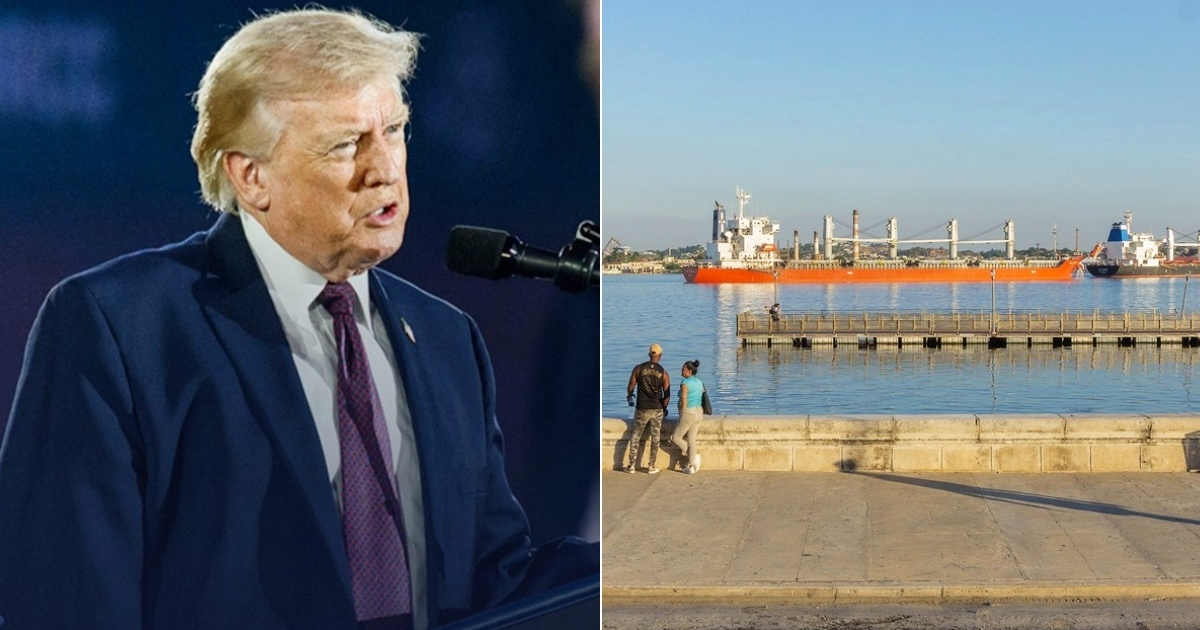
The arrival this Monday of a Russian tanker in Cuba, amid the energy pressure policy promoted by the administration of Donald Trump, has been interpreted by some as a possible relief or contradiction to the U.S. sanctions.
However, the State Department journalist, Eric Martin, believes that the exact opposite is happening.
In a message posted on the social network X, the reporter provided a sharp interpretation of the episode, asserting that the decision to allow the entry of crude oil does not weaken Washington's strategy, but rather strengthens it.
"That Trump allows the Russian tanker to arrive in Cuba does NOT refute the American quarantine," he wrote.
And he immediately reinforced that idea with a categorical statement: “The CONFIRMATION.”
For Martin, the key lies in who has real control over the energy supply to the island.
“The only oil that will arrive in Cuba is the one authorized by the United States,” he emphasized.
The journalist went further by linking this episode to a broader strategy that he had himself anticipated a few days ago in an article published in Bloomberg.
“As I mentioned a month ago: The plan is to make the United States the new protecting state of Cuba…”, he emphasized now.
These statements come after Martin himself revealed - citing his own sources - that Washington reportedly approved the shipment of Russian oil only after a concession from the Cuban regime related to the U.S. embassy in Havana.
According to the explanation, Havana is said to have authorized the import of fuel for the diplomatic mission, a move -not officially confirmed so far- that was described as "an important action that would demonstrate that 'Havana is collaborating, even if just a little'."
The background: A possible "economic protectorate"
Martin's interpretation aligns with a broader analysis he published in Bloomberg a few weeks ago, where he described a strategy from the Trump administration aimed at transforming Cuba into a country financially dependent on the United States.
According to sources cited in that report, the goal would not be a direct military intervention, but rather a gradual process based on economic pressure, energy isolation, and negotiations with actors within the Cuban system itself.
The plan, according to those sources, would seek for the United States to "essentially take the place of its former rival, the Soviet Union, which kept Cuba afloat before its collapse in 1991."
Trump has hinted at this vision in recent statements, where he has said things like "Cuba is going to fall quite soon" or "Cuba is ready, after 50 years."
A conditioned shipment amid the crisis
The sanctioned Russian oil tanker Anatoly Kolodkin, blacklisted by the United States, the European Union, and the United Kingdom, arrived on the island on March 30 with over 700,000 barrels of crude oil, marking the first major supply in more than three months.
Trump himself confirmed this Sunday the decision to allow the operation, stating: "If a country wants to send some oil to Cuba, I have no problem with that."
The leader justified the measure in humanitarian terms, but at the same time continued his rhetoric against the Cuban government: “Cuba is finished. They have a bad regime… very poor and corrupt leadership.”
Despite the immediate impact of the shipment, specialists warn that the volume would barely cover about two weeks of consumption amid prolonged blackouts and a structural energy crisis.
Selective control energy pressure
Far from representing a complete turnaround in U.S. policy, this episode fits into a broader strategy: to restrict the Cuban government's access to oil, while maintaining the ability to authorize supplies under certain conditions.
Since January, the White House has intensified economic pressure on Havana, including a “quarantine” on oil destined for the state, while allowing limited sales to the emerging private sector.
In that context, the timely authorization of the Russian shipment now reinforces the idea that Washington aims to control the energy flow to the island rather than completely block it.
Without invasion, but with sustained pressure
Although there have been speculations in Washington about a possible military intervention—fuelled by statements like that of Senator Lindsey Graham, who said that "Iran is going to fall, and Cuba is next"—sources close to the government assure that this is not the preferred option.
The approach, according to former officials like Kimberly Breier, aims for a gradual transition that avoids chaotic scenarios.
“The administration wants changes, but it does not want them to be chaotic, to encourage mass migration, or to create more opportunities for adversaries,” he explained.
In this context, the arrival of the Russian tanker does not appear as a contradiction, but rather as another element within a framework where Washington aims to manage - rather than simply cut off - Cuba's access to energy resources.
A dynamic that, as Eric Martin warns, could be redefining the bilateral relationship under a key principle: the oil that enters the island would ultimately be what the United States decides to allow.
Filed under: