
Related videos:
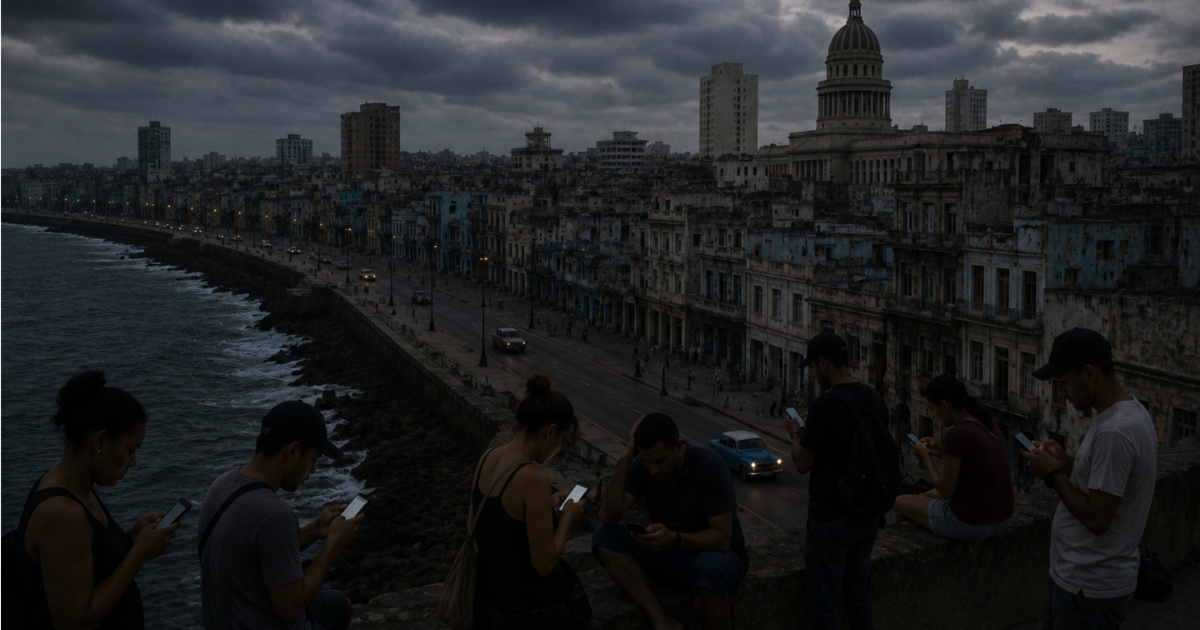
Residents of Centro Habana, Regla, and other areas of Cuba reported severe internet and mobile data outages on Friday, coinciding with the outbreak of new protests against prolonged blackouts.
Residents and Cubans abroad interpret the service outage as a deliberate maneuver by the regime to prevent the dissemination of images and videos of the protests.
According to reports from independent media, the signal issues began right when the first gatherings were announced. Users reported difficulties in accessing mobile data, sending messages, and uploading videos on social media from the areas where the protests occurred.
The immediate trigger was a blackout that lasted over 30 hours in several neighborhoods of Havana. Residents of the so-called Block 1 in Central Havana blocked Escobar Street, between San Miguel and San Rafael, with burning garbage barricades, in a demonstration that took place in broad daylight—something unusual in Cuba, where protests typically occur at night to reduce the risk of identification.
Independent journalist Yosmany Mayeta Labrada shared the first images he received from the scene on Facebook. The videos showed flames and columns of smoke in the middle of the street, while protests and chants against the lack of electricity could be heard.
In parallel, similar protests were reported in Regla, San Miguel del Padrón, La Güinera, and other areas of the capital, featuring burning tires and street closures. The cacerolazo in San Miguel del Padrón and La Güinera added to a day of mobilization that spread throughout Havana.
Cubans residing abroad reported that calls and messages with their relatives "stopped working." Neither ETECSA —the state telecommunications monopoly— nor Cuban authorities have provided public explanations regarding the interruptions.
The phenomenon has a dual interpretation. On one hand, the Cuban regime has a documented history of intentional internet outages during civic mobilizations: during the protests on July 11, 2021, the organization NetBlocks confirmed the blocking of WhatsApp, Facebook, Instagram, and Telegram.
On the other hand, the blackouts themselves are collapsing the telecommunications infrastructure: ETECSA acknowledged on June 17 that its backup batteries only last a few hours, and the power outages are taking out approximately 47.5% of mobile base stations and 56.5% of telecommunications cabinets nationwide.
In May 2026, Cuba ranked only 7.21 Mbps in the global Speedtest index, the lowest position in Latin America.
For its part, the Cuban Observatory of Conflicts recorded more than 1,300 protests in May and over 1,100 in April, with the lack of electricity being the main trigger. In some areas of Matanzas, there have been reports of up to 85 consecutive hours without electricity.
The limitation of communications, whether deliberate or structural, has the same practical effect: it hinders live transmissions, obstructs the documentation of protests and repressive actions, and further isolates the population as a means of social control.
Filed under: