The Cuban regime seems to have turned a non-existent contradiction into one of its main arguments to respond to the new narrative that Washington is promoting about Cuba: Havana asserts that the United States cannot describe the Island as a failed state while simultaneously presenting it as a threat to its national security.
The idea can no longer be attributed to an individual occurrence. The national coordinator of the Committees for the Defense of the Revolution (CDR), Gerardo Hernández Nordelo recently used it to attempt to discredit the warnings from Secretary of State Marco Rubio, as well as the latest analysis from the Media Observatory of Cubadebate which again places it among its main objections to the American discourse.
The repetition reveals that the false dilemma is gaining a concrete function within the official response: if Washington believes that Cuba is economically destroyed and its institutions are undergoing a deep crisis, then —according to that reasoning— it could not simultaneously attribute to it capabilities for espionage, influence, or destabilization.
The problem is that one thing does not exclude the other. A state can fail in some functions while retaining other capabilities
The concept of a failed state is debated, and there is no universal definition. However, the main frameworks regarding state fragility do not require the government to disappear, to completely lose territorial control, or to entirely lack police, military, and intelligence services.
Indicators such as economic deterioration, population exodus, loss of legitimacy, collapse of public services, human rights violations, and the existence of closed elites are part of the analysis of state fragility.
Cuba presents numerous signs of this decline: an energy crisis, shortages of food and medicine, degradation of infrastructure, mass emigration, and an economy unable to provide prospects for a growing portion of its population.
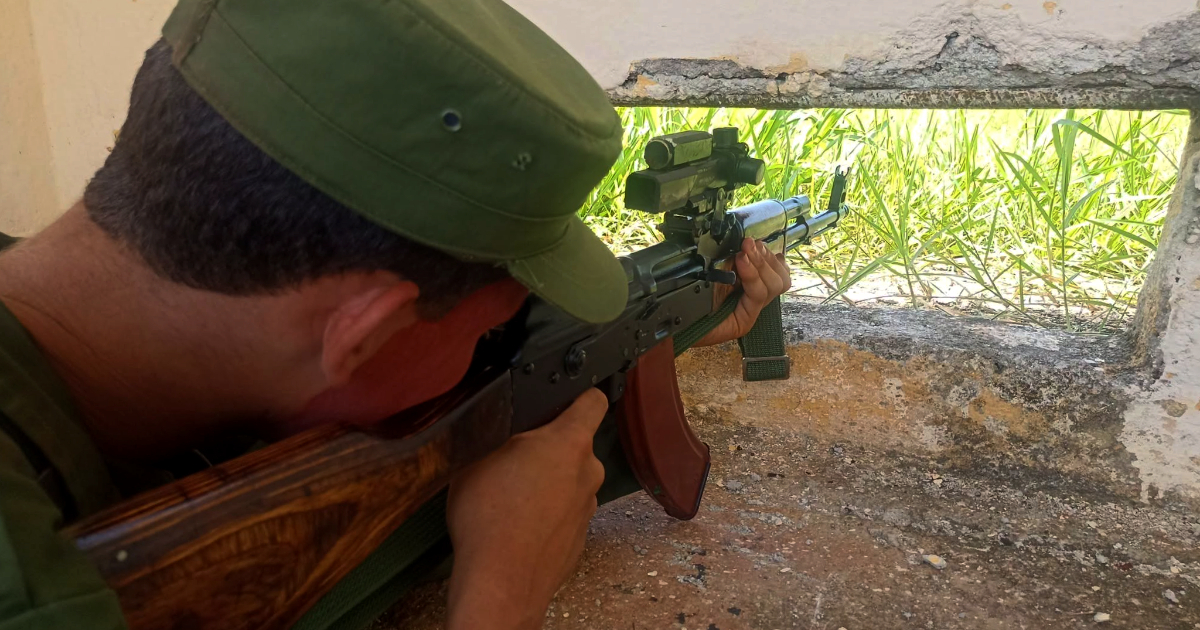
At the same time, the regime maintains considerable coercive power.
The apparent paradox disappears when distinguishing between institutional capacity and coercive capacity. A government can fail to provide electricity, food, transportation, housing, or prosperity and still be effective at monitoring, controlling, imprisoning, gathering intelligence, and protecting its own survival.
In fact, one of the most evident characteristics of the Cuban system is precisely that asymmetry: it has shown far greater ability to maintain power than to effectively manage the country.
Being poor does not mean being harmless
The new American narrative also does not maintain that Cuba constitutes a threat because it can compete militarily or economically with the United States.
That is not the argument put forth by Washington.
The report "Cuba: the capital of communism in the 21st century" aims to shift part of the debate to another area: intelligence, influence operations, relations with adversaries of the United States, and the strategic use of Cuba's geographic position.
The document has a clear political purpose and should not be confused with independent academic research. However, the possibility it suggests—that an economically ruined regime can maintain intelligence capabilities—is not contradictory at all.
There are also judicially verified precedents.
Ana Belén Montes, who held a significant position as an intelligence analyst at the Pentagon, spied for Havana for years. Víctor Manuel Rocha, a former U.S. ambassador, pleaded guilty in 2024 to acting as a covert agent for Cuba for decades.
None of those cases required Cuba to be an economic or military power. They demonstrate something much simpler: the material poverty of a state does not automatically determine the operational capacity of its intelligence services.
Being poor does not mean being harmless.
Fragility can also produce threats
There is another weakness in the official argument: it presumes that international threats can only come from strong states.
International experience shows the contrary. Fragile states can generate risks through migratory crises, human trafficking, illicit economies, regional conflicts, humanitarian crises, or the use of their territory by foreign actors.
In Cuba, mass emigration is the most evident example of how an internal crisis can have consequences beyond national borders. The economic and social deterioration is not confined within the Island: it also impacts the migration systems of other countries and supports human trafficking networks.
Therefore, even before discussing the American accusations of espionage and influence, the premise from Havana already fails: the fragility of a state can indeed be one of the sources of external risks.
A too weak argument to respond to Washington
The regime could challenge the evidence presented in the U.S. report, demand proof regarding certain allegations, discuss its methodology, or highlight the political intent of the Trump administration.
All of this would be part of a reasonable debate. What the new framework of the current administration does not dismantle is the insistence that Washington has to choose between labeling Cuba as a failed state or identifying it as a threat.
Washington is attempting to change the way the Cuban regime is interpreted: not just as a human rights issue, authoritarianism, or a bilateral conflict, but also as a matter of security, intelligence, and geopolitical influence.
Responding to that change requires discussing the concrete evidence that supports that interpretation.
The relevant issue, therefore, is not whether a deeply deteriorated state can maintain capabilities that can affect the interests of another country. History shows that it can.
The issue that must be examined is what capabilities the Cuban regime retains today, how it utilizes them, and to what extent Washington can demonstrate those it attributes to it.
That would be the serious debate.
Continuing to respond with "Failed state or threat" does not resolve any of those questions. It merely turns a false dilemma, easily dismantled conceptually and historically, into one of the defensive pillars of official propaganda against a significantly more complex U.S. strategy.
Related videos:
Filed under: