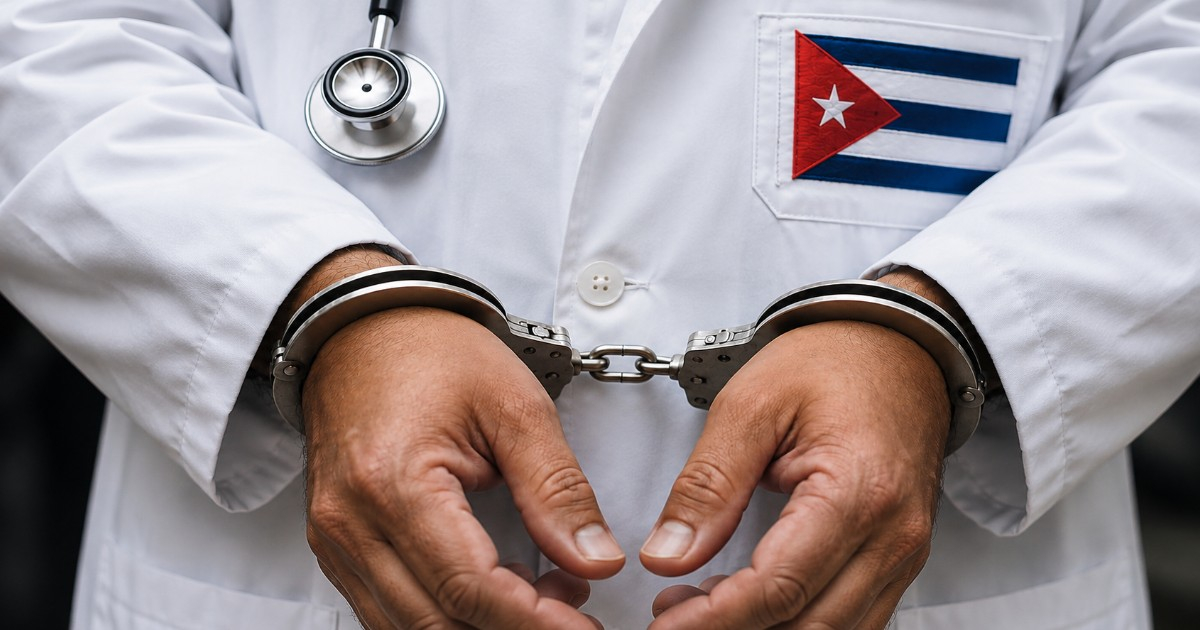
A new report on the Cuban medical brigades documents testimonies, contracts, regulations, and economic data that, according to its authors, reveal patterns of forced labor, surveillance, movement restrictions, wage retention, threats, and punishments against professionals sent abroad.
Prisoners Defenders and Consorcio Justicia presented this Tuesday Cuban Medical Brigades, a platform that gathers historical and current information about the Cuban missions in 209 countries and territories, allowing users to consult agreements, contracts, payments, regulations, testimonies, and reports of possible violations.
The central conclusion of the organizations is that the legal, economic, and disciplinary mechanisms imposed on professionals create a system of forced labor and a contemporary form of slavery.
To support this, they point to opaque or nonexistent contracts, confiscation of income, surveillance, restrictions on private life, sanctions, and family separation.
The platform contains 209 Country Reports and, as of June 2026, identifies 53 active missions, with an estimated active staff of 25,724 professionals.
It also gathers records of 9,646 people classified as "defectors".
Its authors clarify that the number of active staff comes from adding available national estimates and does not constitute a single official census.
The research is also supported by 1,402 testimonies collected since 2018: 1,185 protected and 217 public, corresponding to experiences in 60 countries.
All the statistical percentages published in the new report were calculated exclusively based on the 1,185 protected testimonies.
Coercion and opaque contracts
Among those 1,185 testimonies, 89.79% stated that they had been forced to participate in the mission or had accepted due to coercive circumstances.
In response to a specific question about voluntariness, 77.72% answered that their participation had not been voluntary.
32.41% reported not having received any contract, and another 36.20% stated that they signed a contract but never received a copy.
Furthermore, 69.62% stated that they were unaware of their final destination or that it changed after their arrival, while 75.36% reported having to attend a political-ideological training course.
Surveillance and control of private life
Vigilance emerges as another central element. 40% reported that their passport was taken or detained upon arriving in the destination country, and 77.64% claimed to have been monitored by Cuban officials or individuals linked to them.
81.18% indicated restrictions on movement within the country, 75.27% stated that they could not spend the night outside the assigned accommodation without permission, and 68.69% reported the existence of a curfew.
85.32% stated that they should attend political meetings.
Surveillance mechanisms among colleagues were also documented. 67.76% reported having been encouraged or instructed to monitor other professionals, 77.97% had to report suspicions that a colleague intended to abandon the mission, and 64.64% stated that they had to participate in acts of repudiation against those who did.
The investigation links these practices to the Resolution 368/2020 from the Ministry of Foreign Trade and Foreign Investment, a disciplinary regulation that requires cooperators to report on their romantic relationships, return to Cuba on the date and by the means specified by the contracting entity, and subjects certain public activities and statements in media or social networks to authorization.
Long hours and reduced salaries
The analyzed testimonies reflect an average of 5.75 working days per week and 9.91 hours per shift. When adding on-call duties and extraordinary services, Prisoners Defenders calculates a total average workload of 71.89 hours per week.
Sixty point eighty-four percent stated that they had been forced to artificially inflate attendance statistics or activity, a practice reported in 42 of the 60 countries represented in the testimonies.
Another 65.32% reported having carried out political agenda tasks among the population of the host country, and 63.97% stated that they had to contribute part of their salary to official Cuban organizations.
The average net income reported by professionals during the missions was $462.29 per month.
The economic analysis of the 1,185 testimonies estimates that, on average, the worker received about 15% of the amount pledged by the host country, while the Cuban state and its intermediaries retained or demanded repayment through other mechanisms of nearly 85%. The authors caution that these percentages vary depending on the country, the contract, and the period.
In Calabria, Italy, for example, the documented salary structure for an agreement in 2022 established €4,700 per month for professionals: €3,500 for the Commercializadora de Servicios Médicos Cubanos and €1,200 paid directly to the worker, equivalent to 74.5% and 25.5%, respectively.
Threats, violence, and harassment
The questions about threats and violence included both experiences directly suffered by the declarants and situations they reported witnessing in other colleagues.
Under that criterion, 75.78% reported threats, 21.86% reported physical violence attributed to officials or perpetrated with their consent, and 43.12% reported sexual harassment.
Abandon the mission and be separated from Cuba
The report dedicates another section to the so-called "Eight-Year Law", although it clarifies that this term does not correspond to the official name of a single regulation.
According to the research, the mechanism combines criminal provisions, immigration restrictions, and administrative practices applied to those who leave a mission or refuse to return.
Article 176 of the Penal Code provides for penalties ranging from three to eight years in prison for certain public officials who abandon a mission or refuse to return, while it outlines sanctions of two to five years for public employees.
The research also indicates that, until the entry into force of the new Migration Law on November 1, 2026, Law 1312 remains in effect.
91.14% of the protected testimonies stated that they had been warned that abandoning the mission would mean they would not be able to return to Cuba for eight years.
49.79% said they could not leave due to fear of reprisals against themselves or their families.
40.51% reported having been or continuing to be forcibly separated from minor children, and 53 individuals stated that they were prevented from entering Cuba to see them.
The United Nations Committee on the Rights of the Child had already expressed concern in 2022 about family separations lasting up to eight years.
From private clinics to conflict zones
The update identifies seven international trends. One of them is the expansion of missions to private clinics and commercial providers, with documented cases in countries such as Mongolia, Liberia, Algeria, and Vietnam, as well as a project announced in Botswana and reports about the use of Cuban personnel in private clinics in Angola.
It also includes cases in Ghana and Mali where the arrival of Cuban professionals coincided with strikes by local doctors, as well as instances of unpaid wages or delays in Lesotho, Algeria, Angola, Ghana, the Republic of Congo, Paraguay, and the Solomon Islands.
The research also documents mandatory political tasks, ideological control, and promotion of government discourse, along with the use of missions to promote services, health tourism, medications, and new businesses.
Wage disparities vary significantly depending on the location. The report notes, among other examples, percentages close to 6% for work in certain cases in Mexico, between 8% and 16% in the Bahamas, and around 10% in Qatar.
Another trend is the exposure of professionals to high-risk contexts, with documentation related to the conflict in Nagorno Karabakh, kidnappings in Haiti, the abduction of two doctors in Kenya and their transfer to Somalia, as well as incidents in Namibia, Mexico, and Saint Vincent and the Grenadines.
A file examined by international organizations
Prisoners Defenders emphasizes that the various international pronouncements do not share the same legal nature and that it would be inaccurate to categorize them all as "judgments" or "condemnations from the United Nations."
The document references communications from the United Nations Special Procedures regarding the conditions of Cuban medical missions, concerns raised by the Committee on the Rights of the Child about family separation, statements from the International Labour Organization, a report from the Inter-American Commission on Human Rights and REDESCA about medical missions, and resolutions from the European Parliament.
The IACHR noted in 2026 that certain situations, assessed individually, could constitute forced labor and, in some cases, trafficking. The organization also documented practices related to contracts, document retention, wages, surveillance, and restrictions on freedom of movement.
The platform lists five resolutions from the European Parliament between 2021 and 2026. Among these, the Eurochamber condemned in 2021 human and labor rights violations against the Cuban healthcare staff sent abroad, while in 2025 it approved an amendment that described the brigades as "modern slavery" and "forced labor".
According to the new report, four out of the five cited resolutions directly or unambiguously condemned labor violations or forced labor in the brigades, while the 2023 resolution included references to trafficking allegations through coercive measures.
The authors assert that each Country Report is prepared by reviewing official Cuban and foreign sources, agreements, budgets, contracts, regulations, documents from international organizations, academic research, and testimonies.
They also claim that they preserve discrepancies between sources instead of choosing a figure when contradictory data exists.
The Cuban government rejects accusations of modern slavery and human trafficking. Miguel Díaz-Canel has denied that exploitation exists and maintains that the professionals participate voluntarily, while the authorities present the missions as a humanitarian program and "the noblest face of the Revolution".
Prisoners Defenders questions that version and argues that the documented economic and disciplinary structure contradicts that interpretation.
Furthermore, both organizations comprising the file demand the elimination of criminal, migratory, labor, and family sanctions related to abandoning a mission, the complete publication of contracts and agreements, ensuring free hiring and direct payment, allowing professionals to retain their passports and return to Cuba without reprisals, as well as creating independent mechanisms for reporting and audits in the receiving countries.
These demands align on several points with the recommendations made by the IACHR regarding voluntariness, direct payment, freedom of movement, and independent oversight.
Cuban medical brigades under growing international pressure
The controversy surrounding the missions has intensified over the past year. In August 2025, Secretary of State Marco Rubio announced visa restrictions against Cuban officials and third-country nationals related to the hiring of healthcare professionals from the island.
Washington then described the program as a scheme of forced labor and warned foreign governments about their involvement.
The pressure continued in February 2026, when the United States intensified its offensive against medical missions as a source of income for the Cuban government.
By that time, the Bahamas had suspended the hiring of Cuban doctors, Guyana had terminated the system, and Guatemala had announced a phased closure of its agreement during 2026.
In April, the Inter-American Commission on Human Rights recommended that American countries withdraw from the Cuban Medical Missions Program.
Your report examined practices related to wage retention and documentation, monitoring, restrictions, and retaliation, and called for ensuring voluntariness, direct payment, freedom of movement, and independent inspection mechanisms.
Havana responded by publicly defending the program.
In May, during the 63rd anniversary of international medical cooperation, the director of the Central Unit of Medical Cooperation, Gretza Sánchez Padrón, described the missions as "the noblest face of the Revolution".
Cuban officials insisted on their solidarity and voluntary nature, and rejected international accusations.
The confrontation escalated again in July. The government of Donald Trump sanctioned the Minister of Public Health, José Ángel Portal Miranda, Gretza Sánchez Padrón, the UCCM, and the Commercializer of Cuban Medical Services.
Washington accused those structures of participating in a program that it considers forced labor and human trafficking.
On that same day, Rubio increased pressure on the Cuban government with sanctions targeting nine entities and two high-ranking officials, which also affected medical missions, structures related to GAESA, and the energy sector.
Few days later, the Cuban doctor Raícesa Mora publicly denounced the operation of the missions and stated that professionals receive only a fraction of what is paid by the receiving countries, are monitored, and may face restrictions on their passports and return to Cuba if they leave the program.
His testimony added to the allegations that are now being systematically documented in the new international file.
Related videos:
Filed under: