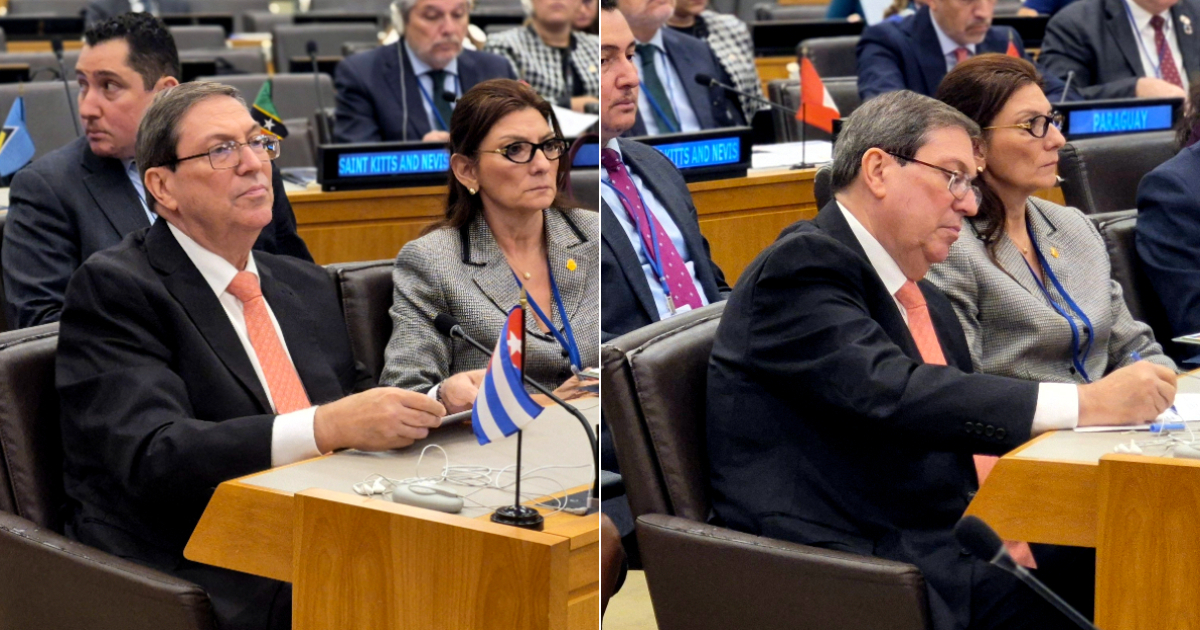
Cuban Foreign Minister Bruno Rodríguez Parrilla appealed to the United Nations on Monday, invoking the 1986 Declaration on the Right to Development to present a well-worn argument that has by now lost all credibility and persuasive power: Cuba's development is hindered by U.S. policies.
In his intervention during the high-level meeting convened by the General Assembly for the 40th anniversary of that Declaration, Rodríguez spoke of an economic order that is «unjust by design», as well as issues of «dependency», «exploitation», sanctions, and the U.S. embargo.
In summary, the head of MINREX presented the Cuban situation essentially as a result of an external blockade and claimed the country's right to self-determination. However, the issue with that narrative arises when reading the entire document that the chancellor himself chose as a reference.
Because the principles of the Declaration do not only point towards Washington or the international economic order. When applied to the Cuban reality, they also directly address the State that Rodríguez Parrilla represents.
The text establishes duties within each country, places the individual at the center of the development process, and explicitly links that development to the full spectrum of human rights. And therein lies a contradiction that is difficult for the Cuban regime to evade.
Rights cannot be selected à la carte
The article 6 of the Declaration states that «all human rights and fundamental freedoms are indivisible and interdependent» and demands equal attention for civil, political, economic, social, and cultural rights.
The same article argues that states must remove the obstacles to development arising from the violation of both civil and political rights as well as economic, social, and cultural rights.
Precision is particularly relevant in the Cuban case.
For decades, the official discourse has showcased its questionable results in education and health as proof of political legitimacy and in response to accusations of a lack of pluralism, restrictions on freedom of expression, persecution of dissent, and the imprisonment of opposition members.
The declaration invoked by Rodríguez precisely prevents establishing that hierarchy.
Literacy does not replace freedom of expression. A medical consultation does not substitute the right to associate. Access to education does not offset the lack of political competition. According to the principle enshrined in the document, social rights do not negate civil and political rights, nor can these be sacrificed in the name of the former.
It is not a contemporary reinterpretation of the text: it was written in 1986.
The part of the Declaration that Bruno omitted
Rodríguez Parrilla focused his remarks on international responsibilities. This dimension exists and it would be impossible to ignore it.
The Declaration calls for cooperation among States and includes the elimination of international obstacles to development. Therefore, discussing the economic effects of U.S. sanctions on Cuba is in line with the document.
What a complete reading does not allow is to stop there.
Article 8 requires States to adopt "at the national level" the necessary measures to make the right to development effective. It calls for equal opportunities to access basic resources, education, health, food, housing, and employment; a fair distribution of income; appropriate economic and social reforms; and popular participation in all areas.
The UN itself, while presenting the commemoration of the 40th anniversary, reminded us that the Declaration requires that people can participate fully and freely in fundamental decisions and calls for equal opportunities and an equitable distribution of economic resources.
Applied to Cuba, the issue is no longer solely about what responsibility Washington has, but also requires examining what responsibility lies with the Cuban state for the political and economic conditions created within the country.
Participate in development without being able to take part in politics?
The contradiction takes on a concrete dimension when comparing that principle of participation with the political reality of Cuba.
Human Rights Watch documented in its World Report 2026 that the regime continued to suppress dissent and public criticism, kept hundreds of critics and protesters imprisoned, and restricted freedom of expression. The organization also highlights the state control over the media and the restrictions on access to external information.
In July 2026, Human Rights Watch estimated, based on data from independent organizations, that around 800 political prisoners remained incarcerated in Cuba, nearly half of whom were linked to the protests of July 2021. According to the organization Prisoners Defenders, that month the Cuban regime had 1,327 political prisoners, the highest number ever documented.
Amnesty International also condemned this year the use of the penal system to punish dissenting expression, calling for the release of artists Maykel Castillo and Luis Manuel Otero Alcántara.
The contrast is evident: the right to development described by the Declaration is not simply about the State providing certain benefits. It recognizes individuals as active subjects of the process.
A crisis that cannot be explained solely from Washington
The Cuban economy raises another issue that was not addressed in the chancellor's speech: the outcome of the economic policies implemented within the country.
CEPAL forecasts a new contraction for Cuba in 2026 and identifies the country, along with Haiti, as one of the factors that significantly reduce the average growth of Central America.
The electrical crisis has reached extraordinary dimensions. Only on July 30, the deficit caused a maximum impact of 2,222 MW, while the available generation was just 1,000 MW against a projected demand of 3,250 MW.
At the same time, one of the major and controversial investment bets by the authorities for years — tourism — is experiencing a historic collapse. Cuba ended 2025 with a hotel occupancy rate of 18.9%, according to figures from the National Office of Statistics and Information, and received only 1.81 million international visitors.
In the first quarter of 2026, occupancy fell even further, down to 12.9%, leaving an economic landscape marked by the loss of 300,000 jobs, nearly 5.1% of the country's active population.
These results raise questions about the productive model, state planning, investment policies, and resource allocation, including the huge investments made over the years in tourism infrastructure while essential sectors deteriorated.
Acknowledging the impact of U.S. sanctions does not absolve internal responsibilities. Additionally, the very comprehensive concept of development invoked by Rodríguez Parrilla requires an examination of these issues.
The awkward case of medical missions
Even one of the traditional pillars of the Cuban discourse on its social achievements—medical service exports—poses challenges when viewed from the perspective of the individual as the subject of development.
In April, the Inter-American Commission on Human Rights published a report based, among other sources, on testimonies from professionals and documented serious restrictions faced by workers sent abroad, including the retention of documents and salaries, coercion, and conditions that the agency linked to indicators of forced labor.
The Cuban regime rejects these accusations and presents the brigades as an expression of international solidarity.
But the controversy raises a question directly related to the document cited at the United Nations: if the individual is the central subject of development, their rights cannot be automatically subordinated to the economic or political interests of the State that manages the outcome of their labor.
A Declaration from 1986 for a world that no longer exists
There is also a historical paradox in the election of Rodríguez Parrilla.
The Declaration was approved on December 4, 1986, by 146 votes in favor, one against—United States—and eight abstentions. It is not an international treaty with conventional obligations equivalent to those of a ratified pact, but rather a declaration adopted through a resolution of the General Assembly. The legal documentation of the United Nations describes it as an instrument of a programmatic nature that, despite this, has exerted considerable influence on the evolution of the concept of the right to development.
The international context in which he was born was radically different.
In 1986, the Soviet Union existed, the Berlin Wall stood tall, the Cold War shaped international relations, and Cuba was economically and politically integrated into the socialist bloc, from which it received extraordinarily favorable commercial conditions and support.
Forty years later, the Soviet Union disappeared, the European socialist bloc ceased to exist, and Russia and China operate with profoundly different economic systems than the centrally planned economies of that time.
The president of the General Assembly himself acknowledged during the commemoration that "the world has changed profoundly since 1986," although he defended the relevance of the commitment to the right to development.
Therefore, the issue is not that Rodríguez Parrilla cites a document from four decades ago. Many of its principles on dignity, participation, equality, and human rights remain fully relevant.
The paradox is another: that the Cuban regime will turn in 2026 to the logic and political language of that era to explain its difficulties primarily through external factors, after forty years of global transformations and its own economic decisions.
A Statement that demands looking inward as well
Bruno Rodríguez Parrilla used the Right to Development to criticize the United States. The 1986 Declaration provides him with some argumentative foundation for his outdated rhetoric to challenge sanctions, economic inequalities, and international obstacles.
But it also establishes something that their intervention overlooked: states have responsibilities within their borders, and development demands indivisible rights, participation, equal opportunities, and an equitable distribution of its benefits.
That is the point at which the Declaration ceases to be comfortable for Havana.
Because if Cuba wants to invoke the right to development to explain its crisis, the document itself necessitates a broader examination: not only towards the policies of Washington but also towards economic decisions, investment priorities, resource distribution, restrictions on freedoms, and the exclusion of citizens from plural and effective political participation.
Forty years after 1986, that may be the most uncomfortable part of the Declaration for the Cuban government: it does not allow for demanding accountability from the world without also examining its own.
Related videos:
Filed under: