
Related videos:
Havana sought to resume diplomatic initiatives this Wednesday with an extensive press conference led by Foreign Minister Bruno Rodríguez Parrilla, focused on denouncing the United States' strategy to influence the vote on the upcoming resolution regarding the embargo in the UN General Assembly.
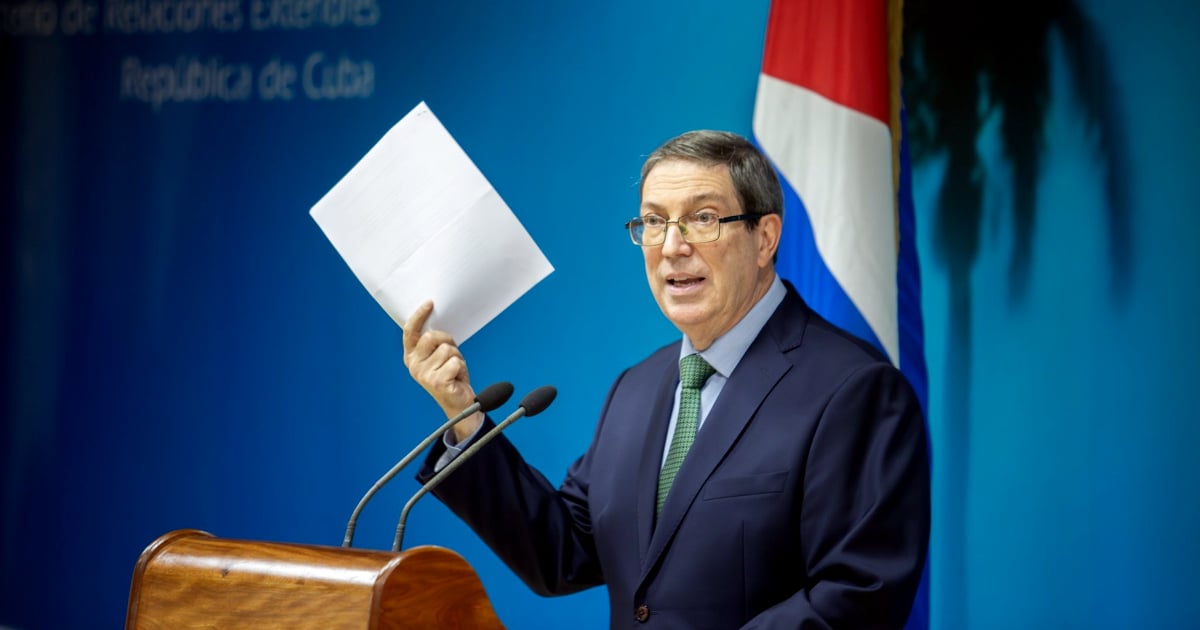
Visibly nervous, the Cuban regime's chancellor called an extraordinary press conference for international media to spend nearly an hour denying U.S. accusations of Russia recruiting Cuban mercenaries and to denounce what he termed a "campaign of blackmail and misinformation."
The chancellor accused Washington of exerting “brutal pressure” on governments in Latin America and Europe to change their traditional stance of support for Cuba.
According to Rodríguez Parrilla, the State Department is allegedly distributing “threatening letters” to foreign ministries, urging them to vote against Havana in the session on October 29, which will again debate the resolution titled “Need to end the economic, commercial, and financial blockade imposed by the United States of America against Cuba.”
"It is a mendacious, defamatory, and disrespectful campaign against the sovereignty of the UN member states," the minister stated, displaying supposed U.S. diplomatic documents. "The United States is trying to intimidate its allies with threats of sanctions if they do not change their vote."
A repeated defense without answers
Rodríguez Parrilla's speech, filled with ideological references and accusations against Washington, nevertheless avoided addressing the issues that have most tarnished the international image of the regime: the participation of thousands of Cubans in the war in Ukraine on behalf of the Kremlin.
Denouncing the arguments of the United States as false, the head of the Foreign Ministry (MINREX) extended discredit and defamation towards international media outlets such as BBC, CNN, Deutsche Welle, Radio France, Reuters, Forbes, The Wall Street Journal, and others, which, along with Ukrainian sources and the ‘I Want to Live’ project of that country's counterintelligence, have published testimonies and evidence documenting the systematic recruitment of Cuban citizens by the Russian army.
Although the chancellor labeled the reported figures as a "lie"—estimating that between 5,000 and 20,000 Cubans are enrolled in Russian forces—the evidence gathered over the past two years contradicts that denial.
Ukrainian intelligence (HUR), along with organizations such as Prisoners Defenders and independent media outlets like this one, have identified air routes from Varadero and Cayo Coco to Ryazan, contracts signed with the Russian Ministry of Defense, and dozens of testimonies from recruits and their families.
For its part, the 2025 Trafficking in Persons Report (TIP) from the U.S. State Department officially included the Cuban case as "a form of state-sponsored trafficking," noting that the regime facilitated the departure of young people with false promises of work and expedited passport and visa processes for military purposes.
For Washington, it is no longer about isolated criminal networks, but about direct government complicity.
A vote under new international pressure
Unlike in previous years, when voting at the United Nations was a routine procedure with predictable outcomes, 2025 presents an unprecedented atmosphere.
The administration of Donald Trump, reinstated in the White House, has toughened its policy towards the Cuban regime and activated a diplomatic strategy to break the nearly unanimous consensus that supported the resolution against the embargo for three decades.
The internal cable from the State Department, leaked by Reuters, instructed U.S. embassies to “persuade allied governments and international partners to vote against or abstain,” arguing that Cuba is the second country, after North Korea, with the highest number of foreign fighters serving Russia.
The document adds that the Díaz-Canel regime "has not protected its citizens from being used as pawns in the aggression war" and that "its silence amounts to complicity."
Diplomatic sources in New York confirmed to CiberCuba that Washington has intensified contacts with representatives from Latin America and the European Union, while Kiev is also actively working to include the issue of Cuban mercenaries in discussions on international security.
The timing—between the vote on the embargo and the scandal involving Cuban recruits—has put Havana in the most precarious position of its diplomatic isolation since the 1990s.
An exhausted narrative
The Cuban regime continues to blame the embargo for all the island's economic woes, repeatedly stating the figure—difficult to verify—of "over 170 billion dollars in losses" accumulated since 1960.
However, studies from institutions such as the Brookings Institution and Columbia University agree that these figures lack technical support and omit a critical fact: the United States remains one of the main suppliers of food and medical products to Cuba.
According to data from the Department of Agriculture (USDA), in 2024 Cuba imported 370 million dollars in food and medicine from the United States, including frozen chicken, wheat, corn, and pharmaceutical supplements.
Moreover, Cuban state and private companies have acquired agricultural machinery, refrigerators, and U.S. industrial parts through authorized intermediaries, demonstrating that there is no "total blockade," but rather a system of financial and trade sanctions that primarily affect the businesses of the regime's elite, sheltered under the umbrella of GAESA, with clear humanitarian exceptions.
The contradiction between discourse and economic practice is becoming increasingly evident. While Rodríguez Parrilla denounces a “genocidal siege,” dozens of Cuban Mipymes continue to import containers of American, European, and Latin American products, which are then resold in the domestic market at prices that triple their purchase value.
Cuba fears losing its political shield
The chancellor's nervousness not only reflects the weight of the accusations against the mercenaries but also the real fear in Havana of losing its traditional support in the UN.
Since 1992, the resolution against the embargo has been approved almost unanimously—187 votes in favor in 2024—with the United States and Israel as the only nations opposing it. However, this time, the combination of factors—the war in Ukraine, human trafficking allegations, Washington's diplomatic campaign—could fracture that majority and leave the regime more isolated than ever.
This landscape is accompanied by an increasingly adverse regional context for the authoritarian axis formed by Cuba, Venezuela, and Nicaragua. Since returning to power, the Trump administration has reactivated a hemisphere-wide containment policy based on the old doctrine of spheres of influence, aimed at curbing the expansion of allies of Russia, China, and Iran in Latin America.
In recent weeks, the U.S. Southern Command has intensified its presence in the Caribbean, conducting joint naval maneuvers alongside the Dominican Republic, Barbados, and other regional partners, which Washington describes as a fight against drug trafficking and the capture of the Venezuelan state by the Cartel of the Suns. However, in Havana and Caracas, this is seen as an unequivocal warning message.
Parallelly, the regime of Nicolás Maduro faces increasing diplomatic pressure, renewed financial sanctions, and political isolation that threaten to undermine Cuba's energy support, which relies on Venezuelan oil. Nicaragua, for its part, is under international scrutiny for its internal repression and its ties with Moscow and Tehran.
In this new geopolitical landscape, the island is no longer just a bilateral issue between Cuba and the United States; it has become a strategic link in a global confrontation for influence in the Western Hemisphere, where Washington aims to restore its supremacy and weaken the regimes allied with extra-hemispheric powers.
According to Rodríguez Parrilla, "this anxiety reflects that the United States government understands that the blockade causes its isolation and discredit." But for many analysts, the anxiety is not in Washington, but in Havana. The difference is that this time the regime does not control the narrative.
The image of Cuba as a “victim” loses strength in light of the data, reports, and testimonies that depict it as a complicit actor in Russian expansionism and a state that exploits its own citizens in medical, military, or labor missions.
The chancellor promised that "the truth will prevail over pressure and slander," but the reality is that the regime arrives at this vote weakened, with its economy in collapse, its diplomacy under suspicion, and its historical narrative in crisis.
If there is one thing that the Castro regime fears more than sanctions, it is the silence of its former allies when the time comes to vote. A change in the pattern of these votes at the UN would be a torpedo to the buoyancy of a dictatorship that, failing in all its economic, political, and social aspects, fears losing one of the few assets it has left on the world stage: the symbolic power of a small communist island, “revolutionary” and fiercely “sovereign,” standing up against the most powerful capitalist "empire" in history.
Filed under: