
Related videos:
The government of President Donald Trump urged its international allies to reject the annual United Nations resolution calling for an end to the embargo against Cuba, arguing that the regime in Havana actively supports the Russian invasion of Ukraine with thousands of Cuban mercenaries integrated into the Moscow army, according to an internal State Department cable revealed by Reuters.
The document, unclassified and dated October 2, was sent to dozens of U.S. diplomatic missions with the instruction to persuade sympathetic governments and international allies to vote against or abstain from the resolution that, since 1992, calls on Washington to lift the trade embargo imposed on Cuba following the so-called "revolution" of the dictator Fidel Castro.
After North Korea, Cuba is the largest contributor of foreign troops to the Russian aggression, with an estimated 1,000 to 5,000 Cubans fighting in Ukraine,” the text noted, as cited by Reuters.
The diplomatic cable stated that the Cuban government "has not succeeded in protecting its citizens from being used as pawns in the war between Russia and Ukraine," and accused Miguel Díaz-Canel of aligning himself with the Kremlin politically, militarily, and in terms of propaganda.
The leak coincided with new reports on the Ukrainian project "I Want to Live," which document the involvement of thousands of Cubans on the eastern front and denounce the passivity of the Havana regime regarding the mass recruitment of its citizens by Moscow.
Diplomatic pressure and political message
According to the Reuters report, the Trump administration seeks to undermine the traditional overwhelming majority that annually supports the resolution presented by Cuba at the General Assembly.
In 2024, 187 countries voted in favor, with only the United States and Israel against, while Moldova abstained.
This year, Washington aims to narrow that margin and expose what it considers the "hypocrisy" of the Cuban regime, which portrays itself as a victim of sanctions while —according to the White House— actively collaborating with the military machinery of Vladimir Putin.
"The Trump Administration will not remain on the sidelines nor support an illegitimate regime that undermines our national security interests in our region," said a spokesperson for the State Department in comments sent via email to Reuters.
The cable urged U.S. diplomats to disseminate details about the recruitment of Cubans for the Russian army, as well as the connections between Havana and Moscow in defense, intelligence, and air transport.
Among the talking points are also accusations of corruption, human rights violations, and misappropriation of resources by the Cuban regime.
Cuba, from "neutral" to accomplice
The report from Reuters confirmed what various sources have been indicating for months: that Washington believes it has evidence of Cuban citizens' involvement in the war in Ukraine, and that Havana has allowed—or even facilitated—their recruitment.
In recent weeks, Ukrainian officials warned the U.S. Congress about the increasing scale of that network, which would include recruitment centers in Ryazan, Belarus, and Cuba itself, with the involvement of Russian and Cuban intermediaries.
The 'I Want to Live' project has published lists with over a thousand names, while Ukrainian military intelligence estimates the total at around 25,000 Cubans recruited since 2023.
"La Habana cannot claim ignorance. In a country where no one travels without state control, silence is complicity," said a European diplomatic source consulted by Forbes recently.
Reaction of the Cuban regime
So far, Cuba's Permanent Mission to the UN has not responded to the accusations.
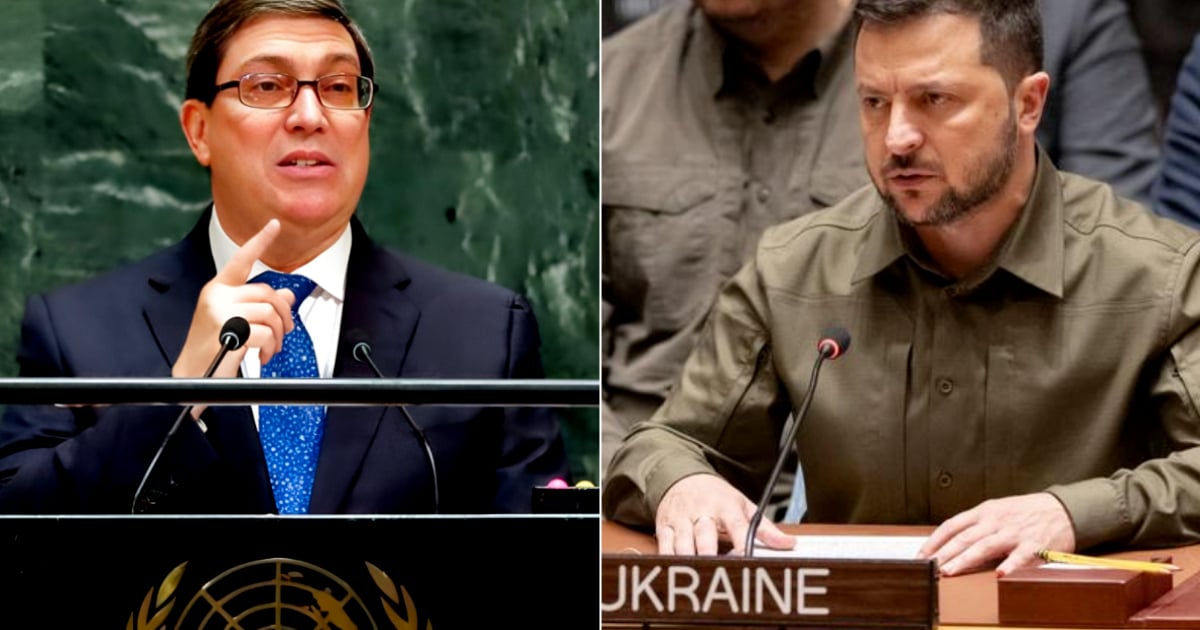
On September 27, the chancellor Bruno Rodríguez Parrilla denounced before the General Assembly what he called the "genocidal blockade" by the United States and accused Washington of using the issue of drug trafficking as a "ridiculous pretext" to maintain its aggression against Cuba and Venezuela.
However, the cable from the State Department asserts that the Cuban resolution “incorrectly blames” the United States for the economic crisis on the island, which is attributed —according to the text— to “the corruption and incompetence of the regime itself.”
Washington intensifies its accusation: From illegal recruitment to state-sponsored human trafficking
The hardening of the U.S. discourse is not limited to the diplomatic realm. In its most recent Trafficking in Persons Report (TIP 2025), the State Department went further by officially classifying the recruitment of Cubans for the war in Russia in Ukraine as a form of state-sponsored trafficking.
The document, published in late September, stated that the Cuban regime actively facilitated the departure of its citizens for military exploitation, expediting the issuance of passports, omitting exit stamps, and allowing thousands of young people to travel with "tourist" visas to Russia and Belarus, where they were hired by the Russian military.
According to the report, between June 2023 and February 2024, more than 1,000 Cubans signed contracts with the Russian Armed Forces, many under false promises of work or residency, and others lured by salaries of up to 2,000 dollars a month, an unattainable figure in the Cuban economy.
The State Department stated that, similar to international medical missions, this military recruitment system is part of a state network of control and exploitation, in which the Cuban state "uses coercion mechanisms, document retention, and deceit" to achieve political and economic benefits.
“The news is clear: what was once referred to as ‘recruitment networks’ is now seen as a state policy. It is no longer about isolated criminal activities, but rather direct governmental complicity,” an expert stated to CiberCuba.
The inclusion of the Cuban case in the TIP 2025 as a state form of human trafficking represents an unprecedented escalation in the accusations against Havana and strengthens the diplomatic arguments that Washington has presented to its allies at the United Nations.
Under this new light, it is no longer sufficient to denounce private recruitment networks: the document demands an investigation into official responsibilities, guarantees of reparation for the victims, and the elimination of migration restrictions that enable this type of exploitation.
As in previous reports, the Cuban regime has labeled the allegations as “political slander”, but this time the evidentiary weight and the legal classification of TIP 2025 weaken its defensive narrative.
What was once viewed as a propaganda maneuver has now turned into a formal accusation of state complicity in human trafficking for military purposes.
While the regime insists on its narrative of being a victim, Washington's message points in another direction: Cuba is no longer a neutral actor, but an operational ally of Russia in its war against Ukraine.
And for the first time in decades, that accusation threatens to break the almost unanimous consensus that Havana maintained at the United Nations.
Filed under: