
Related videos:
The Cuban leader Miguel Díaz-Canel warned this Saturday that private businesses that do not meet their electricity consumption plans could be shut down, even if their owners can pay the bills, amid one of the most severe energy crises in recent years on the island.
“It is necessary to visit the centers of the non-state sector and monitor whether they are adhering to their electricity consumption plan. Waste cannot be tolerated, even if they can afford the electricity. Any location that fails to comply with its plan will be shut down,” the official account of the Presidency of Cuba published on the social media platform X (formerly Twitter), quoting words from the First Secretary of the Communist Party during a meeting on the critical issues of Havana.
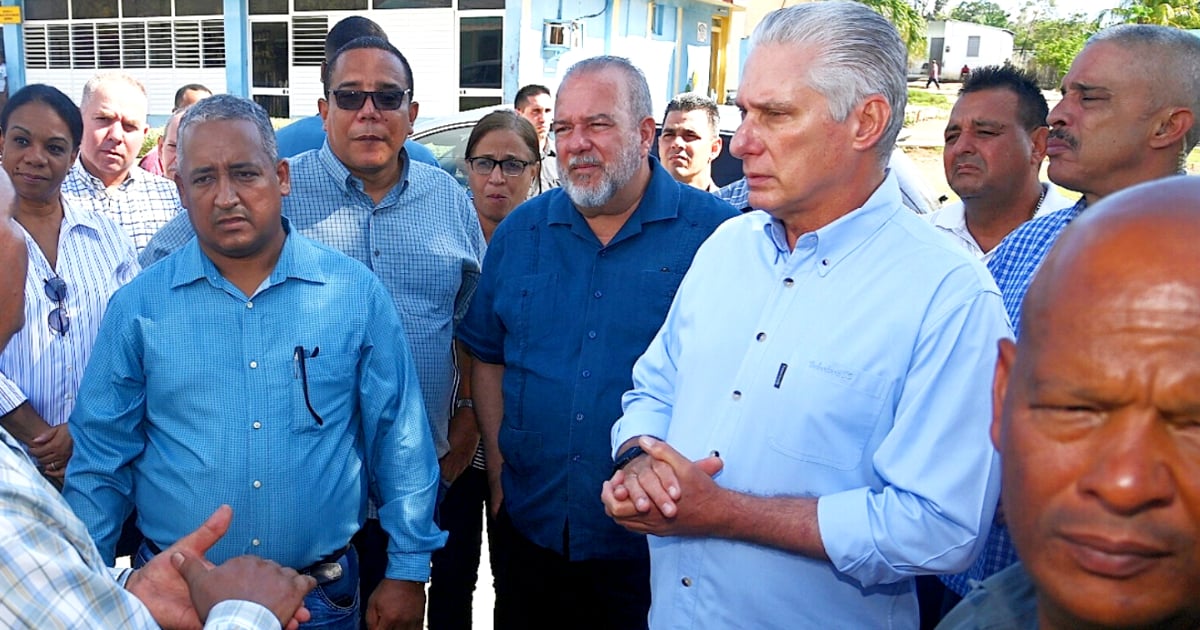
The message was part of a thread in which the Presidency detailed that Díaz-Canel has been leading a "support operation" in the capital since Thursday, focused on garbage collection, water supply, and electrical service, three areas where the government acknowledges an "accumulated deterioration" and a growing "popular discontent," which has led to street protests.
The statements from the ruling party come amid a backdrop of daily blackouts, rising tariffs, fuel shortages, and restrictions imposed on the private sector, which the State itself accuses of “energy wastage” despite many micro, small, and medium enterprises (mipymes) having to operate with generators and fuel purchased in foreign currency.
Official pressure on SMEs
In November 2024, the Cuban government approved Decree 110/2024, which requires micro, small, and medium-sized enterprises (mipymes) and other non-state economic actors to generate, through their own means, at least half of the electricity they consume starting in 2028, in addition to adhering to conservation plans and maintaining air conditioning above 24 degrees.
The penalties for violating these regulations include fines of up to 20,000 pesos and the suspension of electrical service for 72 hours.
The savings measures are compounded by the effects of the blackouts affecting the entire country, which in many cases have led to the loss of goods and food due to a lack of refrigeration.
Merchants and entrepreneurs have reported on social media that prolonged power outages make it impossible to maintain the cold chain or produce consistently, while they must cover the cost of fuel and the maintenance of generator plants.
Despite this, the authorities maintain their message of control and discipline. Díaz-Canel insisted this Friday that inspectors must “visit the centers of the non-state sector” and verify their compliance with the imposed energy plans. “The place that fails to meet its plan will be closed,” the president reiterated.
Rationed electricity, dollarized fuel
Although the government has extended until 2026 the tariff exemption for importing electric generators and solar panels, this measure only partially alleviates the crisis, as the fuel needed to operate the generators is only sold in freely convertible currency (MLC) and with restrictions.
In some areas, gas stations require owners to physically transport their generators to the point of sale in order to refuel, a requirement that further complicates the use of this equipment.
Meanwhile, electric rates increased by 25% in 2024 for consumers who exceed 500 kilowatt-hours per month, while the State continues to charge high prices for energy to a private sector that, however, must endure daily power outages and face confiscations or penalties for "excessive consumption."
The suspicion of power towards private initiative
Although the Cuban regime insists on presenting small and medium-sized enterprises as “a pillar of the economic framework”, its policy towards them continues to be marked by ideological distrust and political control.
Since its legalization in 2021, the private sector has steadily grown, creating jobs, supplying markets, and addressing the shortages of the State, but that same growth has stirred a blend of fear and hostility in the government towards the new economic players.
The contradiction is evident: the State tolerates private activity because it needs it, but at the same time, it monitors, regulates, and punishes it with a zeal that borders on inquisitorial. That is, when it does not directly control it through frontmen serving the ruling elites, that oligarchy of a State captured by its extractive ambition.
Constant inspections, disproportionate fines, arbitrary seizures, and changing requirements regarding pricing, licenses, or energy consumption create a framework that discourages investment and fosters corruption.
In practice, Cuban entrepreneurs live in a state of constant legal insecurity, dependent on permits, controls, and “authorizations” that can be revoked by any official or inspector.
In addition, there is the burden of taxes and bureaucracy: the government blames the micro, small, and medium enterprises for the rising cost of living, accusing them of "hoarding" and "speculation", and thus justifies new controls and sanctions while avoiding acknowledgment of its own role in inflation, scarcity, and the productive deterioration of the country.
The economic paradox: The market progresses despite the state
As Luis Flores, CEO of CiberCuba, recalls in his article “The transition to a market economy in Cuba: inevitable and urgent”, the more than 11,000 small and medium-sized enterprises (mipymes) registered on the island generate over 31% of employment, contribute 23% of tax revenues, and dominate 55% of retail trade.
These data confirm that the real engine of the Cuban economy is no longer the state socialist enterprise, but rather the private initiative, which the regime itself suffocates with obstacles and taxes.
“The socialist company distributes misery, while the micro, small, and medium enterprises generate employment and dynamism,” notes the author, who describes the transition to a market economy as “inevitable and urgent.”
Its argument aligns with the general perception that the centralized planning system not only hinders development but also reproduces the scarcity and inequality it claims to combat.
The analysis also underscores a structural contradiction: the government fears the market not for economic reasons, but for political ones. Allowing the private sector to grow and thrive would imply accepting the existence of an autonomous space—social and financial—that escapes party control.
This is where the rhetoric of "socialist equality" comes into play to justify restrictions, while in practice, inequality is greater than ever: between those who have access to foreign currency and those who rely on a state salary, between those who produce and those who survive with an increasingly empty ration book.
Between suffocation and uncertainty
"Tariffs are rising, they profit from the import of equipment, they demand you save, they ration fuel, they fine you, and they overwhelm you with blackouts... and even so, if you manage to pay the bill, they shut down your business," summarized a user on social media after hearing Díaz-Canel's statements.
The comment reflects the widespread sentiment among Cuban entrepreneurs, who are caught between the fear of sanctions and the impossibility of sustaining their economic activities in an environment where every state decision seems to introduce new obstacles.
While the government insists on controlling electricity consumption in the private sector, the national system continues to experience deficits exceeding 1,800 megawatts, dozens of generating units out of service, and blackouts that can exceed 20 hours daily in several provinces.
In Cuba, even "being able to pay for electricity" does not guarantee being able to turn it on.
And although the transition to a market economy may seem like an ideological heresy to the Communist Party, every business that survives —despite blackouts, taxes, and threats— demonstrates that this transition has already begun, from the bottom up and against the tide.
Filed under: