
Related videos:
New revelations from the Russian outlet Systema, the investigative unit of Radio Free Europe (RFE/RL), have brought to light unprecedented information about the case of Yelena Smírnova, the Russian recruiter accused of defrauding hundreds of Cubans sent to fight in Ukraine.
According to court documents obtained by journalists Yelizaveta Surnacheva and Andrei Soshnikov, Smírnova not only operated a "semiprivate" recruitment network but also maintained connections with Russian military structures and was involved in recruiting more than 3,000 foreigners, including a significant number of Cubans.
The report revealed the existence of a letter dated October 23, 2024, signed by attorney Serguéi Poselyagín, in which the early release of Smírnova is requested and her involvement in the transport of Cubans from Havana to Moscow is detailed.
In the letter addressed to the Commissioner for Human Rights in Russia, the lawyer stated that the woman was covering the travel and accommodation expenses of the recruits, and then recovering the money by withdrawing funds directly from their bank accounts after the military contracts were signed.
That letter was delivered to the media by Ukrainian deputy Marian Zablotskiy, who claimed to have obtained it from unidentified sources. The document, according to the investigation, was considered evidence of the functional relationship between the Kremlin and foreign recruitment networks used to bolster the military offensive in Ukraine.
The Smírnova scheme, based in the Russian city of Ryazan, has been operating since early 2023. It published advertisements in Spanish on social media platforms like Facebook and VK, through groups such as ‘Cubanos en Moscú’, where it offered civilian jobs, income bonuses, and salaries of up to $2,000 a month, along with the promise of Russian citizenship.
The messages were specifically aimed at young Cubans desperate to escape the island's economic crisis.
Once in Russia, the recruits were temporarily housed and forced to sign contracts in Russian that they did not understand. According to the investigation, Smírnova or her associates would take copies of the signers' bank cards and withdraw an initial payment under the pretext of covering transportation costs.
When the Cubans discovered that they would be sent to the front lines, many tried to retract, but they had already lost control of their documents and money.
“When they handed us the uniform and told us to go train, I realized it had nothing to do with construction,” said a recruit to Politico in September 2023. “Once you sign the contract, desertion is tantamount to betrayal,” he added.
In mid-2023, several recruits began to report that Smírnova was stealing their salaries. Two formal complaints were filed in April 2024 and, shortly after, the woman was arrested and charged with fraud. RFE/RL noted that she was released from pretrial detention in 2025, although her current whereabouts are unknown.
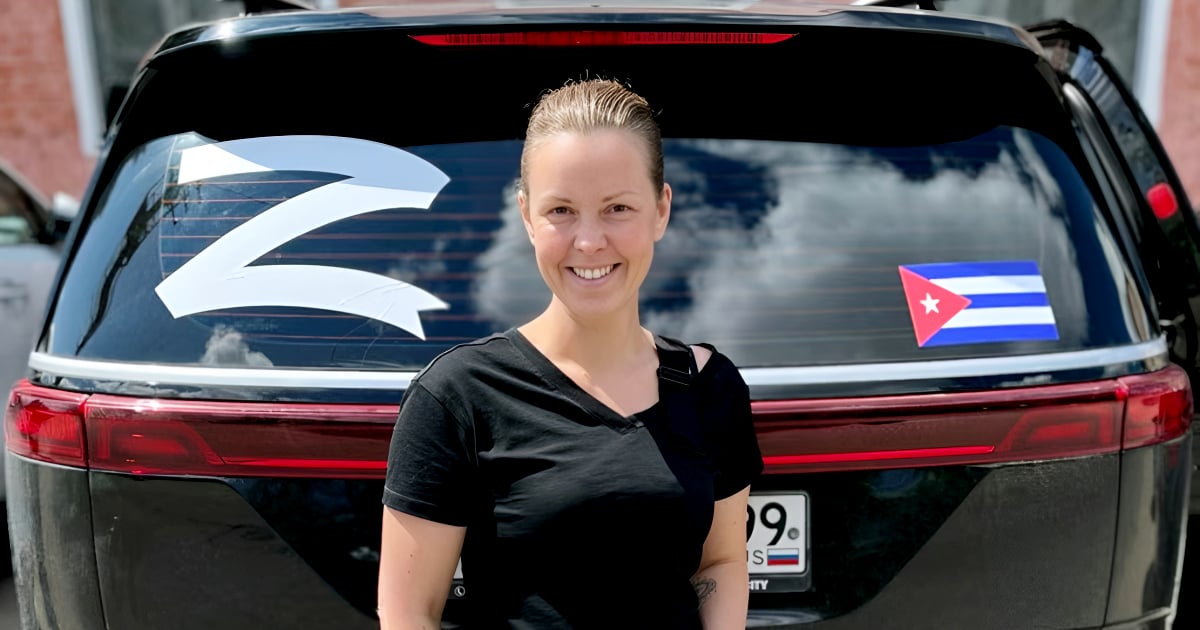
The report also identified Olga Shilyáyeva, a Russian hairdresser married to a military officer, and Dayana Díaz, a Cuban resident in Russia, as collaborators of Smírnova. Both managed contracts and posted job advertisements on social media, where they appeared with Cuban and Russian flags and symbols supporting the invasion.
Sources cited by Systema reported that Shilyáyeva and Smírnova were frequently seen at the recruitment center in Ryazan, processing between 30 and 40 contracts daily, and that in the spring of 2025 both were deployed to the front in Ukraine as part of a unit primarily composed of former prisoners from the Russian army.
Some recruited Cubans believed they would be working in construction, but they were sent directly to combat zones. The same source indicated that most of the scam was coordinated by the Cuban Dayana Díaz, who managed communications with the new recruits from her Telegram account.
The Ukrainian deputy Zablotskiy stated that Smírnova's operations could not have been carried out without the knowledge of the FSB or the GRU, Russia's main intelligence services.
"Tour operators have historically served as a logistical cover for the Russian state. In this case, Smírnova operated with the knowledge of the authorities," Systema reported. Although the outlet did not find direct links to these organizations, it warned that the scale of the recruitment network would have been impossible without state approval.
After the publication of the report, the Cuban Ministry of Foreign Affairs reiterated on October 11 that “Cuba is not part of the armed conflict in Ukraine and does not deploy military personnel there or in any other country,” emphasizing its policy of “zero tolerance towards mercenarism and human trafficking.”
However, new revelations indicate that the network that operated from Ryazan remained active until mid-2025, with the involvement of Cuban nationals and a level of tolerance from the Russian authorities that was hardly unnoticed.
The Smírnova case is no longer just a story of fraud: it is confirmed as a link in Moscow's foreign recruitment system, where the economic needs of Cubans intersect with the Kremlin's propaganda machinery in a war that does not belong to them.
Agreed recruitment: Flights, agreements, and silences from Havana
The Smírnova case cannot be understood in isolation. The evidence gathered in recent months—documents, flights, agreements, and testimonies—indicate that the network for recruiting Cubans for the war in Russia in Ukraine operated within a context of diplomatic and logistical synchronization between Moscow and Havana.
A study published by CiberCuba in May 2025 revealed that every peak in the recruitment of Cuban mercenaries coincided with an increase in flights between both countries and with the signing of bilateral agreements in energy, industry, and especially military matters.
Between June and August 2023, when the influx of Cubans reached record numbers, the leader Miguel Díaz-Canel had visited Moscow and stated that relations with Vladimir Putin were “strategic”.
In those same months, cooperation agreements in defense and logistics were signed, and the Russian Foreign Minister Serguéi Lavrov stated that "military cooperation between Russia and Cuba is successfully developing".
In parallel, the Russian airlines Nordwind and Rossiya increased flights to Varadero and Cayo Coco, tourist destinations that suddenly began to receive more weekly operations without economic or tourism justification.
Aboard, according to investigations by InformNapalm and the Ukrainian project "I Want to Live," there were young Cubans traveling on “tourist” visas, but with military contracts waiting for them in Ryazan and Tula.
The coincidence of routes and dates was not accidental. Everything indicates that the Cuban air and diplomatic infrastructure served as a logistical corridor for the discreet transfer of recruits to Russian bases, with full knowledge of the authorities.
The argument that these trips occurred without state control is implausible in a country where the regime supervises every migratory movement, every passport, and every departure abroad.
However, no Cuban institution —neither the Directorate of Identification, Immigration and Foreigners, nor the Ministry of the Interior (MININT), nor the Foreign Ministry— issued alerts regarding the sudden influx of young people heading to Russia.
The Cuban ambassador in Moscow, Julio Antonio Garmendía Peña, admitted in September 2023 that Havana “had nothing against Cubans who wanted to sign a legal contract with the Russian army,” statements reported by the Russian state agency Sputnik.
Although the Ministry of Foreign Affairs (MINREX) later attempted to soften its words, the damage was already done: for the first time, a representative of the regime publicly acknowledged the acceptance of recruitment.
In the same vein, the portal represorescubanos.com identified Colonel Mónica Milián Gómez, military attaché at the Cuban embassy in Moscow, as a key intermediary in the military cooperation between the two governments.
Ukrainian intelligence sources cited by international media identify her as a direct link between the Russian Ministry of Defense and the Cuban Revolutionary Armed Forces (FAR) in the process of sending fighters.
Meanwhile, the hacking by the group Cyber Resistance into the emails of a Russian official revealed the existence of over a hundred scanned Cuban passports stored in a military base in the Tula region, documents that matched the names of young individuals recruited in Havana and Sancti Spíritus.
These findings reinforce the hypothesis that the recruitment of Cubans was made possible by the leniency —and likely the collaboration— of the Cuban state apparatus, which facilitated the acquisition of passports, air transit, and diplomatic silence.
In a country where an opposition member requires permission even to attend a conference, the idea that hundreds of young people could leave for Russia without the regime noticing is untenable.
Everything points to a carefully calculated inaction, a functional permissiveness towards the interests of the Kremlin and the geopolitical alignment of Havana with Moscow.
The Cuban government may continue to proclaim "neutrality" or "zero tolerance for mercenarism", but the facts reveal an unmistakable pattern: each political rapprochement with Russia coincides with an increase in recruits, every commercial flight conceals a military transfer, and every official silence hides complicity.
In that diplomatic choreography—made up of agreements, flights, and omissions—the human corridor was constructed that took thousands of Cubans from Varadero to the front lines, from misery to the front of a foreign war.
Filed under: