
Related videos:
The Vice Prime Minister and Minister of Foreign Trade and Foreign Investment of Cuba, Óscar Pérez-Oliva Fraga, traveled to Saint Petersburg to participate in the XXIII session of the Cuba-Russia Intergovernmental Commission, scheduled for March 31 and April 1.
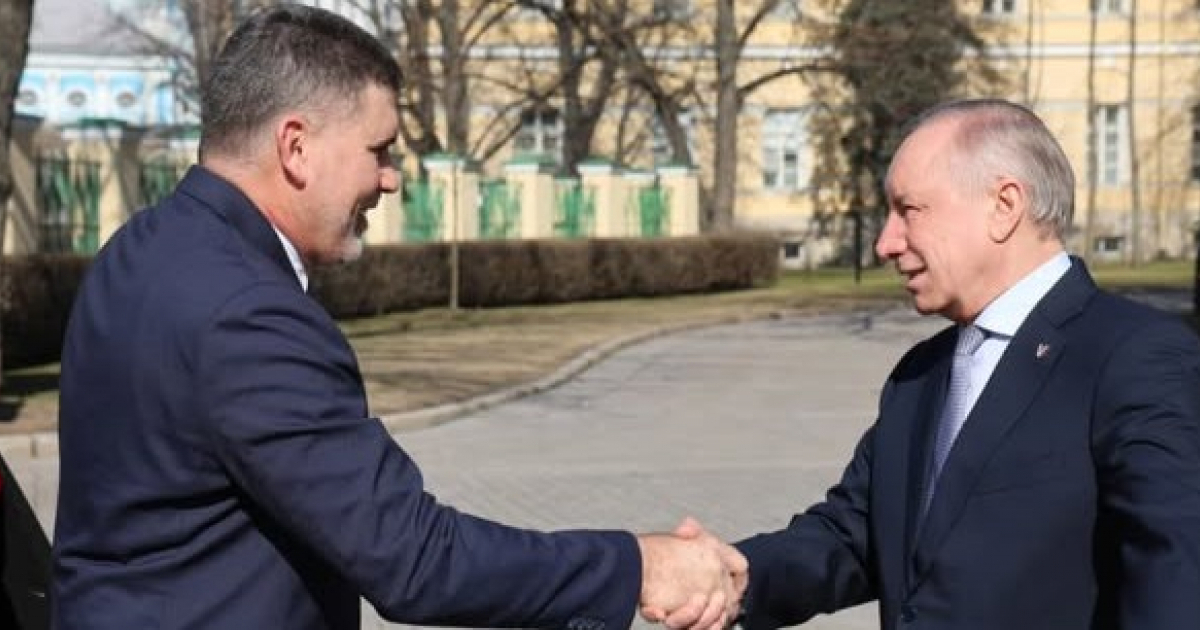
This Monday, the governor of St. Petersburg, Alexander Dmitrievich Beglov, welcomed him at the historic Smolny building, the seat of the city government, in a meeting that the Cuban Foreign Ministry described as marked by the spirit of friendship and cooperation that unites both countries.
According to the report shared on Facebook, Beglov reiterated his solidarity with Cuba and his willingness to strengthen collaboration with the provinces of Santiago de Cuba and Matanzas.
He added that they are working on preparing a significant donation for the public health system of both provinces, which is expected to arrive in Cuba soon, the post adds.
For his part, Pérez-Oliva emphasized the willingness to expand collaboration in the fields of education, culture, and the biopharmaceutical industry, as well as to strengthen commercial and economic ties.
The Cuban leader attended the Euro-Asian Intergovernmental Council held in Shymkent, Kazakhstan, last week, where he reiterated the regime's intention to transform Cuba into a regional productive logistics hub based on the Mariel Special Development Zone.
Speaking before delegations from the five member countries of the Eurasian Economic Union (EAEU) - Russia, Belarus, Kazakhstan, Kyrgyzstan, and Armenia - Pérez-Oliva urged moving from words to action: "It is crucial to enter a new phase of concreteness and implementation of joint projects."
The proposal for the logistical hub is neither new nor has it yielded concrete results. Last year, Díaz-Canel and Marrero Cruz presented it at various economic forums in Minsk, Kyrgyzstan, and Moscow.
The Mariel Special Development Zone, which is controlled by GAESA, has been operating at only 40% of its capacity since its opening in 2013.
Pérez-Oliva's participation in these forums has a political interpretation, as it strengthens his profile as an emerging figure within the dictatorship's leadership.
Nephew-grandson of Fidel and Raúl Castro, he was promoted to deputy prime minister in October 2025 while retaining his position as Minister of Foreign Trade, and his increasing international prominence stands in contrast to Miguel Díaz-Canel's retreat to internal management.
With a less worn profile than other leaders, his increasing international prominence stands in contrast to Miguel Díaz-Canel's retreat to domestic management.
The high power of the regime holds Díaz-Canel and Marrero in Havana, away from international stages and discussing the defense of sovereignty.
As the descendant of the Castros gains visibility and establishes himself as an interlocutor for the regime with international actors, Díaz-Canel is increasingly associated with political fatigue.
Cuba aims to position itself as an economic partner and attract support amid the deep crisis it is facing, marked by pressure from the United States, with which it is holding talks on bilateral matters that could define the country's future.
However, the deputy prime minister had to acknowledge that there is "a difficult situation in the economy, especially regarding the availability of fuels," an admission that reflects the real impact of the oil shortage in the country.
Cuba is experiencing its worst energy crisis in decades: electrical deficits exceeding 2,000 MW, blackouts of up to 30 hours a day, and a cumulative GDP contraction of 23% since 2019, with a projected decline of 7.2% just for this year.
On that same Monday, the Russian tanker Anatoli Kolodkin, carrying 100,000 tons of crude oil – approximately 730,000 barrels – arrived in Cuban waters en route to the port of Matanzas, for the first significant shipment in nearly three months.
Trump authorized its entry on Sunday as a humanitarian measure, provided that Cuba supplied fuel to the U.S. embassy in Havana. "They have to survive!"
Filed under: