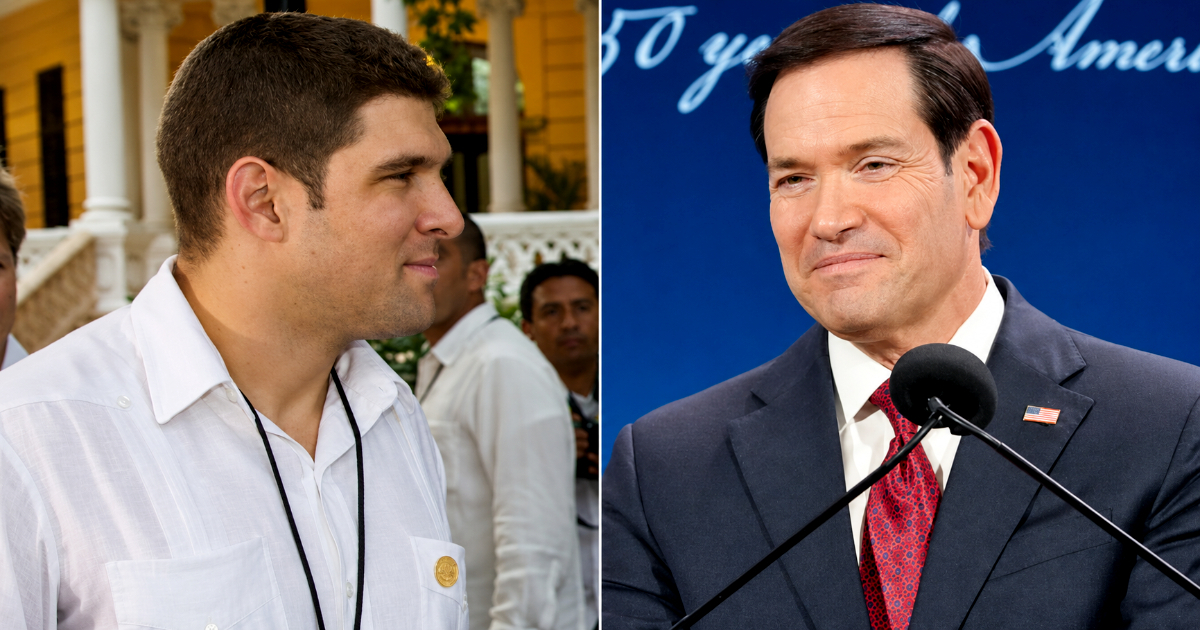
Why would the administration of Donald Trump have chosen Raúl Guillermo Rodríguez Castro, alias «El Cangrejo», as the interlocutor in negotiations with Havana, instead of reaching out to Miguel Díaz-Canel or the authorities of the Ministry of Foreign Affairs?
The former Cuban ambassador Carlos Alzugaray shared his perspective in an interview with El País, published this Friday, where he also discussed the uncertainties surrounding the political rise of Raúl Castro's grandson and the tensions his positioning may be generating within the regime.
According to the retired diplomat, Marco Rubio may have adjusted his strategy towards Cuba after realizing that the events in Venezuela had not led to the collapse of the Cuban regime. Washington would then have chosen to explore a negotiated solution, seeking a dialogue partner within the Castro family.
Rubio comes with his Miami mindset. In Miami, Cuba is not a country; it's the Castro's estate. So, one must negotiate with a Castro., asserted Alzugaray.
His explanation, conceived as a critique of the Secretary of State, raises an uncomfortable question for Havana: to what extent do formally established authorities have the ability to negotiate and make decisions without the consent of Raúl Castro and his family circle?
According to Alzugaray, Washington's options were limited. Fidel had died, Raúl was retired, and his son Alejandro Castro Espín, who participated in the negotiations with the Obama administration, was "out of the game."
«So it seems they have hooked Raulito, and he is willing», he explained.
The offer from Washington and the companions of the Crab
The former ambassador assured that the U.S. proposal included the departure of the Castro family to Moscow with their money and the resignation of Díaz-Canel.
Alzugaray did not provide documentary evidence of that offer, but introduced another element that was until now little known: the possible involvement of a brother of the late General Luis Alberto Rodríguez López-Calleja in the meetings.
All of this has been unclear. For me, it is not clear whether Raulito attended those meetings alone. I was told in recent days that he was not, that he was with a brother of his father.
Raúl Guillermo himself had stated in an interview with in July his willingness to negotiate with representatives from the United States, despite claiming he had never considered a career in politics.
Alzugaray's version leaves unclear who authorized the negotiations, what mandate Raul Castro's grandson had, and to whom he was accountable for any commitments made.
A interlocutor whose power depends on his grandfather
The former diplomat believes that El Cangrejo's positioning is related to the death of his father, López-Calleja, in July 2022, and to the need to preserve the political influence of the Castro family.
However, it raises doubts about whether the grandson has his own authority within the military and party structures.
He is known as a playboy, and that is not well regarded in Cuba. I don't know if the generals agree. If Raúl dies tomorrow, what support does he have?
Alzugaray acknowledges that promoting the grandson over leaders with institutional responsibilities may create discomfort among the regime's high officials.
“Now, out of the blue, you take your grandson and put him above the generals and Díaz-Canel, whom you promoted. Do you think the high-ranking officials of MINREX find this amusing? They can't find it amusing,” he stated.
Here appears one of the main contradictions in his account. While attributing Rubio's decision to negotiate with a Castro to the "Miami mentality," he acknowledges that it would be Raúl himself who is placing his grandson above the official representatives of the Cuban state, effectively acting as if Cuba were "the estate" of this family.
The choice of the American interlocutor would, therefore, reflect an informal distribution of power that the regime itself would have helped to establish.
The tensions that no one dares to question
Alzugaray warns that the lack of institutional authority of Raúl Guillermo could lead to a power vacuum. He even suggests the possibility that an official might refuse to follow his instructions due to the absence of support from his hierarchical superior.
«Perhaps no one dares, but that is building up tensions», he acknowledged.
The observation is particularly significant: the problem would not only be the lack of legal authority of Raúl Castro's grandson, but also the difficulty faced by Cuban officials in enforcing those same rules against a family member.
The former ambassador also acknowledges that Díaz-Canel's political wear is transferring to Raúl Castro and that within the circles of power there are those who question the general's decision to choose him as successor.
In those circumstances, El Cangrejo's ability to act as a interlocutor for Washington does not necessarily equate to the capacity to guarantee an agreement or to impose it on the rest of the Cuban leadership.
That is one of the questions left open by the interview: how much power Raúl Guillermo really has and how much of it is borrowed from his grandfather.
Related videos:
Filed under: