
Related videos:
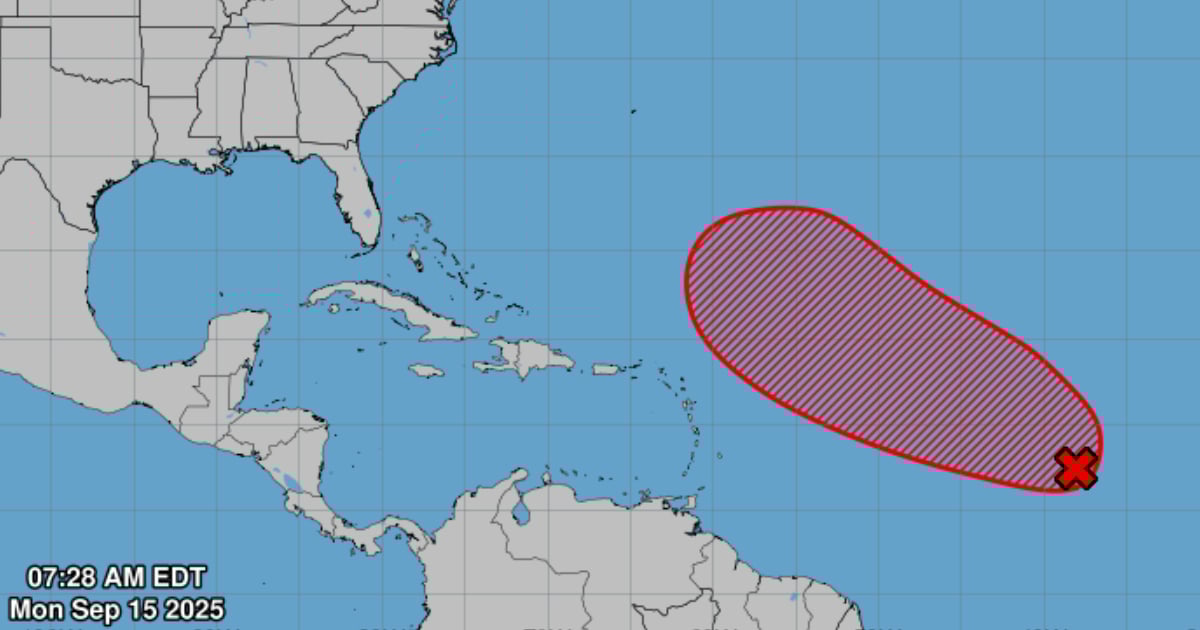
The National Hurricane Center (NHC) of the United States, based in Miami, reported this Monday that the tropical wave located in the central Atlantic no longer poses a threat to Cuba or the immediate Caribbean region.
According to the latest report, the system is moving northwest at a speed of between 16 and 24 kilometers per hour, with a 40% chance of formation in 48 hours and an 80% chance in the next seven days.
The agency explained that the wave could encounter more favorable conditions for its development and could become a depression in the coming days, as it is expected to increase its organization and cyclonic potential.
A change in trajectory that benefits Cuba
The situation represents a significant change compared to Sunday, when models showed the disturbance slightly further south and with a 10% lower chance of strengthening.
The shift to the north significantly decreases the likelihood of impact on Cuba and even rules out effects for Florida, which initially appeared in some scenarios as a potential risk area.
Context of the hurricane season
The Cuban meteorologist Raydel Ruisánchez urged the public to remain alert, as the relative calm of September is unusual during the hurricane season.
"To date, we have only recorded six tropical storms and one hurricane. If the pattern continues towards the historical average, up to eight additional systems could form in October and November, which are critical months for the western Caribbean and the Gulf of Mexico. In Cuba, October is the month with the highest incidence," the specialist recalled.
The current Atlantic hurricane season, which runs from June 1 to November 30, has shown less activity than anticipated, although experts warn that the peak has not yet occurred.
Previous waves that dissipated
Recent weeks have seen monitoring of the Atlantic characterized by systems that appeared to have great potential but ultimately weakened.
Just a few days ago, another tropical wave reached nearly 90% chance of formation and was heading directly toward the Caribbean. However, it weakened before consolidating, highlighting the complexity of forecasts during this time of year.
More recently, another disturbance heading towards the Lesser Antilles raised preventive alerts, although it also dissipated as it moved westward.
A calm that should not be mistaken for safety
Although the current wave does not pose a danger to Cuba, meteorologists insist that the population should remain attentive to official reports.
September and October are historically active months, and experience shows that even after long periods of calm, cyclones with significant impact can develop in the region.
Frequently Asked Questions about the tropical wave in the Atlantic and its impact on Cuba
Does the current tropical wave pose a danger to Cuba?
No, the current tropical wave does not pose a danger to Cuba. According to the National Hurricane Center, the system's path has shifted northward, significantly reducing the likelihood of impact on Cuba and Florida.
What are the chances of the wave turning into a tropical depression?
The wave has a 40% chance of becoming a tropical depression in the next 48 hours and an 80% chance in the next seven days. Although dry air is currently limiting its immediate development, the forecast suggests that conditions will become more favorable for its evolution.
Why are September and October critical months in the hurricane season for Cuba?
September and October are critical months due to the increase in cyclonic activity in the western Caribbean and the Gulf of Mexico. Historically, these months have recorded a high number of cyclones that have impacted Cuba, making it essential to stay informed and prepared.
What measures should be taken in light of the relative calm during the current hurricane season?
The population is advised to stay alert to official reports and not let their guard down. Although the activity has been lower than expected, experience shows that cyclones can develop rapidly even after periods of calm.
Filed under: