
Related videos:
The transportation service in Matanzas barely survives, as only 63 out of 129 buses are operational, which is equivalent to 48.8% of the available vehicle fleet.
At the same time, there is a lack of urban routes, and fuel is barely sufficient to meet essential needs, while the private sector imposes high and unregulated fares, as highlighted in a report by the official newspaper Girón.
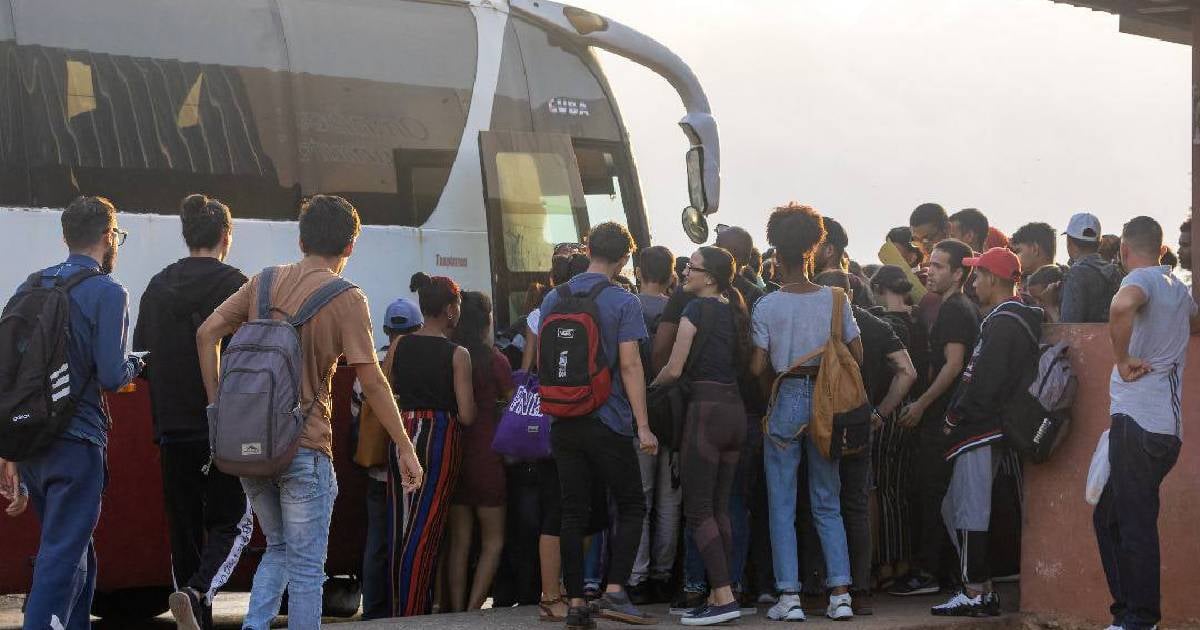
The bus terminal in Matanzas reflects the crisis: passengers standing anxiously, worried about money, time, and the condition of the vehicles.
Many resign themselves to long waits or uncomfortable journeys, while commenting that current transportation is a luxury, comparable only to the scarcity of the Special Period.
According to the media outlet, the city of Matanzas only has nine urban service routes in operation, which most of the time must meet needs related to Health or Education.
Likewise, school transportation programs and family basket initiatives account for a significant portion of the 32% of available fuel.
Roberto Bernal Villena, provincial director of Transportation, acknowledges that prioritizing all sectors is impossible due to resource limitations.
An exception is the case of tourism workers, whose transport service remains a priority for the national economy, said Edonni López Estévez, director of the UEB Transmetro in Cárdenas.
López detailed that the sector receives a protected fuel allocation of about 8,000 liters per day for transportation between Matanzas and Cárdenas and 6,500 liters solely for Cárdenas.
Despite this exception, the director emphasized that the company has 143 active buses out of 233, only 61.4%, "a reduction that is not to be underestimated," he said.
Private transport emerges as an alternative, although with fares up to five times higher than those set by the Administration Councils.
For example, traveling from Colón to Matanzas can cost 1,000 pesos, while university students from Cárdenas, without a scholarship, have to pay up to 600 pesos to commute to and from the provincial capital, something that is unsustainable for thousands of families, the outlet acknowledged.
Many drivers turn to the black market to acquire fuel. A liter of gasoline can cost between 500 and 800 pesos, or they must pay in dollars, to which the costs of vehicle maintenance, employee salaries, and other expenses must be added, further increasing the cost of travel.
The supervision of these units is inadequate, and the population is facing high prices without effective digital mechanisms for payment.
To alleviate the situation, the province has turned to electric and combustion tricycles, as well as "solidarity transport" regulations requiring state vehicles to pick up passengers to their full capacity.
Between May 22 and September 30, these measures have benefited over one million people, although 34 drivers were penalized for non-compliance, according to the source.
Authorities emphasize the need for empathy and cooperation from both drivers and the public.
Recently, it was announced that “soon” five buses powered by biomethane will begin to circulate in the municipality of Martí, as part of a project aimed at “committing to energy sovereignty” and a “carbon-neutral” transportation model.
In the province of Sancti Spíritus, new electric microbuses have been incorporated into passenger service and there are plans to complete a fleet of 40 vehicles, a figure that proves inadequate in light of the transportation crisis in the province and the country.
The public transportation in Santiago de Cuba is in a state of collapse, with routes halted and a shortage of parts, fuel, and vehicles. Makeshift solutions, such as "solidarity transport" or the use of rented vehicles like ambulances and hearses, barely alleviate the crisis.
It is about a strategy already being implemented in the neighboring province of Guantánamo by taxi drivers, some of whom are self-employed under a contract arrangement. The initiative promoted by the Cubataxi Company in that area aims to ease passenger transportation, especially in high-demand zones, by offering free rides during the early hours of the day.
At the beginning of June, after touring the eastern region, the Minister of Transport, Eduardo Rodríguez Dávila, published a report stating that only 126 out of 196 routes are operational (64.3%), many with reduced frequencies due to a lack of fuel, lubricants, and the deplorable condition of the roads.
Frequently Asked Questions about Public Transportation in Matanzas and Cuba
What is the current situation of public transportation in Matanzas?
Public transportation in Matanzas is operating at less than half of its capacity, with only 63 out of 129 buses active, representing 48.8% of the available fleet. Urban routes are limited, and fuel is insufficient, with priority given to sectors such as Health and Education.
Why is private transportation an expensive option in Matanzas?
Private transportation in Matanzas is expensive due to fares that can be up to five times higher than regulated rates, with prices such as 1,000 pesos for a round trip to Colón. The high cost is attributed to the price of fuel on the black market and vehicle maintenance expenses.
What measures are being implemented in Matanzas to improve transportation?
To improve transportation in Matanzas, electric and combustion tricycles have been introduced, and "solidarity transport" rules have been implemented, requiring state vehicles to pick up passengers. Furthermore, the incorporation of buses powered by biomethane is anticipated as part of a sustainable project.
How does the transportation crisis in Matanzas affect the various sectors of the population?
The transportation crisis in Matanzas affects students, workers, and the general population, who face long waits and uncomfortable journeys. Sectors such as Tourism receive priority in fuel supply, while others must deal with shortages and the high cost of private transportation.
Filed under: