
Related videos:
On October 19, 1960, during the Cold War, the United States government imposed a nearly total trade embargo against Cuba, after the victorious "revolution" of Fidel Castro nationalized U.S. refineries and companies on the island without compensation.
That act marked the beginning of one of the longest sanctions policies in modern history, lasting over six decades and undergoing multiple phases of escalation.
Initially, Washington had imposed a ban on the sale of arms in 1958, during the government of Fulgencio Batista, but after the victory of the so-called "revolution" in January 1959 and Castro's rapid alignment with the Soviet Union, tensions escalated.
The October 1960 embargo restricted the export of all U.S. goods to Cuba, except for food and medicine. Later, on February 7, 1962, President John F. Kennedy expanded the measure to include practically all exports, institutionalizing a system of sanctions that continues to this day.
Over the years, various legislations —such as the Helms-Burton Act (1996), the Cuban Democracy Act (1992), and the Trading with the Enemy Act (1917)— have reinforced this legal framework, justifying the policy as a means of applying pressure on the Cuban government to move towards democratization and respect for human rights.
In parallel, the UN General Assembly has annually approved since 1992 non-binding resolutions calling for the lifting of the embargo, with the United States and Israel as the only countries that consistently vote against.
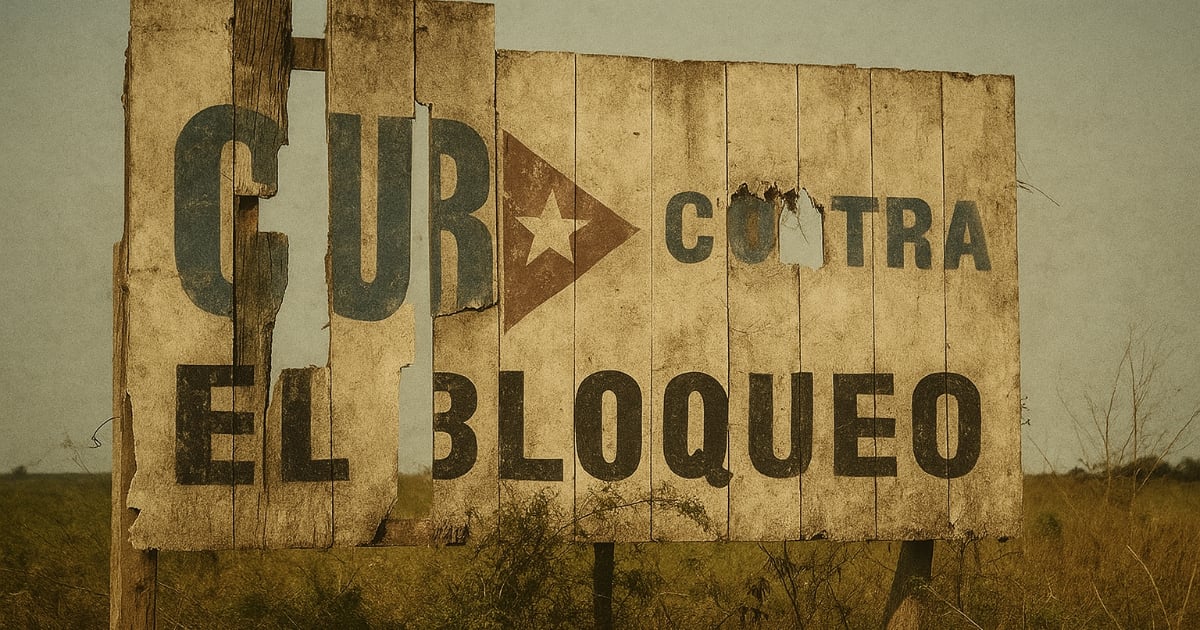
However, beyond the diplomatic debate, the undeniable truth is that the embargo—which the Cuban regime refers to as a "blockade"—has been turned by the state's propaganda machine into a recurring excuse to justify its economic failures and divert responsibility for the internal disaster.
In strictly economic terms, there is no "blockade." Cuba can trade freely with any country in the world, and it does so. The United States, paradoxically, ranks among the top food exporters to the island, particularly frozen chicken, grains, and soy. The embargo does not prevent these transactions; it merely requires that purchases be paid for upfront and without credit, something that the regime itself acknowledges when it's advantageous to them.
The narrative of the “blockade” has been an effective tool of political and emotional manipulation within the island, instilled over generations to keep the myth of the external enemy alive.
But the reality is that the problems Cuba faces today—shortages, blackouts, inflation, corruption, and massive exodus—are not a result of the embargo, but rather of a centralized, unproductive socialist model controlled by a military elite led by Raúl Castro and administered by his political puppet, Miguel Díaz-Canel.
The contrast between the official discourse and the facts is becoming increasingly evident. Since the establishment of private Mipymes in 2021, the country has experienced a sustained increase in the importation of electric motorcycles, cars, appliances, and various goods, many coming from the United States, Panama, or Europe.
These imports are paid for in cash and without the constraints of the "blockade," demonstrating that when there is money and willingness, it is possible to trade with the world.
Later, those same goods are resold within Cuba at prices that double or triple their original cost, in a distorted internal market with no real regulation, where the only beneficiaries are those who have access to the dollar or MLC, currencies that are off-limits for the majority of Cuban workers.
Meanwhile, the regime continues to use the narrative of the "criminal blockade" as a smokescreen to conceal the internal blockade it imposes on its citizens: the lack of economic freedom, political censorship, the persecution of opponents, and the absolute control of resources by the military conglomerate GAESA, which owns a significant portion of the national economy.
The U.S. embargo can be criticized for its ineffectiveness—since it has not succeeded in democratizing Cuba or toppling the communist regime—yet its existence does not justify the social and economic disaster that the island endures.
As various analysts have pointed out, including the academic William M. LeoGrande, this is the “oldest and most extensive sanctions regime in the world,” although it “has never been effective in subduing the revolutionary power.”
Sixty-five years after its establishment, the embargo remains a historical symbol of the Cold War, but it is also a mirror reflecting the stubbornness of two governments: that of Washington, in its pressure strategy aimed at provoking a just regime change and a necessary transition to democracy, and that of Havana, in its effort to use it as a perpetual excuse for immobility and to perpetuate the elites of the dictatorship in power.
The true blockade faced by Cubans is not in U.S. laws, but in the system that keeps them trapped in state control and planned misery.
The U.S. seeks to isolate Cuba at the UN and expose its complicity with Russia
Just a few days before the annual vote at the United Nations on the resolution calling for an end to the U.S. embargo against Cuba, Washington has decided to change its diplomatic strategy.
For the first time in decades, the government of Donald Trump is attempting to break the international consensus that has traditionally supported Havana, appealing to a new argument: the role of the Cuban regime as Russia's operational ally in the war in Ukraine.
A cable from the State Department, dated October 2 and revealed by Reuters, instructed U.S. embassies to persuade allied governments to vote against or abstain on the resolution that annually condemns the embargo.
The document asserts that Cuba has ceased to be a victim of U.S. isolation and has become “one of the main foreign contributors to Russian aggression”, with between 1,000 and 5,000 Cubans fighting in Ukraine under Moscow's command.
The shift aims to undermine the regime's propaganda narrative, which for over six decades has used the "blockade" as an excuse for its economic failures. For the Trump administration, the real issue is not the embargo, but Cuba's political and military alignment with the Kremlin, as well as its involvement in human rights violations, corruption, and human trafficking.
The 2025 Trafficking in Persons Report (TIP) from the State Department reinforced this position by classifying the recruitment of Cubans by Russia as a form of state-sponsored trafficking.
According to the report, the Cuban regime actively facilitated the departure of thousands of young people through "tourism" visas and the omission of immigration controls, in a scheme similar to that of medical missions.
The accusation marks a qualitative leap: no longer is there talk of isolated criminal networks, but rather of direct government complicity in the military exploitation of its citizens.
Washington's aim is to undermine the overwhelming majority that supports Cuba each year—187 votes in 2024—and to expose the hypocrisy of the regime, which presents itself as a victim while supporting a war invader.
Although the final outcome remains uncertain, for the first time in more than three decades, the United States may reduce the diplomatic support that Havana receives at the UN. If it succeeds in getting several countries to abstain or change their vote, Cuba will face a significant loss of international legitimacy and a symbolic blow to its historical narrative of resistance.
Filed under: