
Related videos:
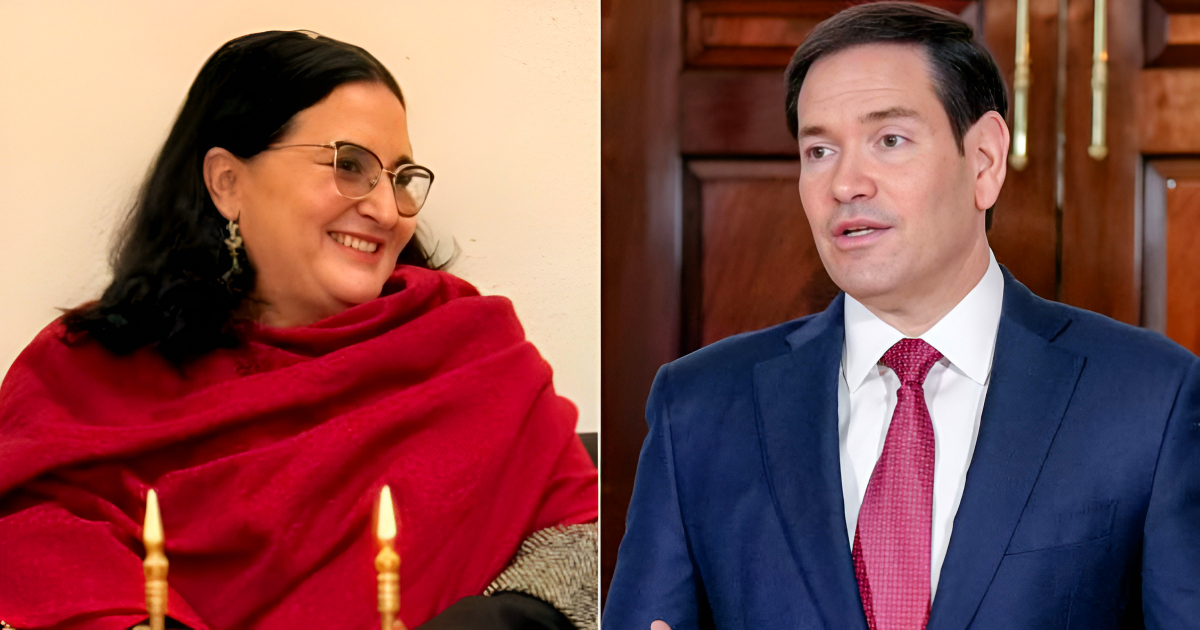
The official from the Cuban Ministry of Foreign Affairs (MINREX), Johana Tablada de la Torre, stirred controversy on social media again by posting an extensive message in which she directly blamed U.S. Secretary of State Marco Rubio for "forcing hundreds of thousands of Cubans to emigrate" with his policies.
The text, shared on her Facebook account, accused Washington of “torturing the Cuban population for purposes of interference, destabilization, looting, regime change, and domination.”
According to Tablada de la Torre, the Cuban-American leading the State Department is the "one responsible for the harshest and inhumane measures against Cuba" and his measures have caused suffering to Cubans "whom Rubio himself forced to emigrate from Cuba".
Beyond the heated tone of the message, the post by the second ambassador in Mexico once again brought the Cuban regime face to face with its most glaring contradiction: that of blaming the United States both for hindering legal migration and for provoking mass emigration.
For years, MINREX itself has accused Washington of "failing to comply with migration agreements," particularly the commitment to grant 20,000 annual visas to Cuban citizens, as established in the bilateral accords of 1994-1995.
The minister Bruno Rodríguez Parrilla and other officials from the ministry have reiterated that the closure of the consulate in Havana and the relocation of procedures to third countries —such as Guyana— hinder regular emigration.
However, in his most recent remarks, Tablada de la Torre asserted exactly the opposite: that Rubio and the Trump administration "forced citizens to emigrate from Cuba" through sanctions and pressures. In other words, emigration was induced, not halted.
That same logic was exposed when the diplomat herself, in an interview granted to Russia Today in 2023, made a statement that now resonates with bitter irony: “The 200,000 that the United States thought would leave to topple the government... emigrated.”
The statement, rather than being a slip, was an involuntary admission of how the regime views emigration: not as a tragedy, but as a triumph. In its narrative, those who protested on July 11, 2021 (11J) were not frustrated citizens disillusioned with the failure of the system, but neutralized enemies who abandoned the battlefield.
The phrase starkly reveals the true political management that the regime applies to the Cuban exodus: to relieve social pressure, empty the streets, and turn the diaspora into a source of foreign currency under the guise of resistance.
The problem is that both arguments cannot coexist without nullifying each other. Either the United States blocks the legal exit of Cubans, or it pushes them out of the country with its coercive policies. Deciding which of the two versions the regime supports depends, as is often the case, on the current propaganda context.
Historically, this strategy is not new. From Camarioca in 1965 to Mariel in 1980 and the balseros in 1994, the Cuban government has used emigration as a pressure relief valve and a tool for political leverage.
When internal unrest threatens to spill over, it opens the floodgates; when it needs an argument before the international community, it accuses the United States of "encouraging irregular migration."
Washington, for its part, has repeatedly warned about this tactic. Officials from the Department of State and the Department of Homeland Security have described the use of migration as a form of "hybrid coercion," designed to destabilize the region and exert pressure on negotiations.
The clearest precedent was the agreements of 1994, which were created specifically to prevent Havana from repeating the demographic blackmail of Mariel.
Tablada de la Torre's speech fits perfectly into this logic: external victimhood and internal denial. It attributes the exodus to "imperial cruelty," while omitting the fact that Cubans flee due to domestic issues: unchecked inflation, blackouts, political repression, and a complete lack of freedoms.
The people do not emigrate because of the tariffs on oil, but because the country has become unlivable and no longer buys into the regime's arguments about the "blockade," which are typical of half a century of crude Castroite propaganda.
It is also symptomatic that the diplomat speaks of “millions of Cubans” who emigrate as victims of external aggression, when those same millions are the direct result of the regime's policies of immobility and censorship. And to invoke the suffering of Cuban families while their government relies on the remittances of those emigrants to survive.
In his post, Tablada de la Torre promised that Cuba "will resist and will overcome." However, far from a gesture of dignity, his words revealed the desperation of a regime that can no longer sustain its narrative.
By blaming Rubio for migration, the official ultimately confirmed what she tried to deny: that the massive exodus is the inevitable consequence of the failure of the Cuban model, not of external sanctions.
Filed under: